
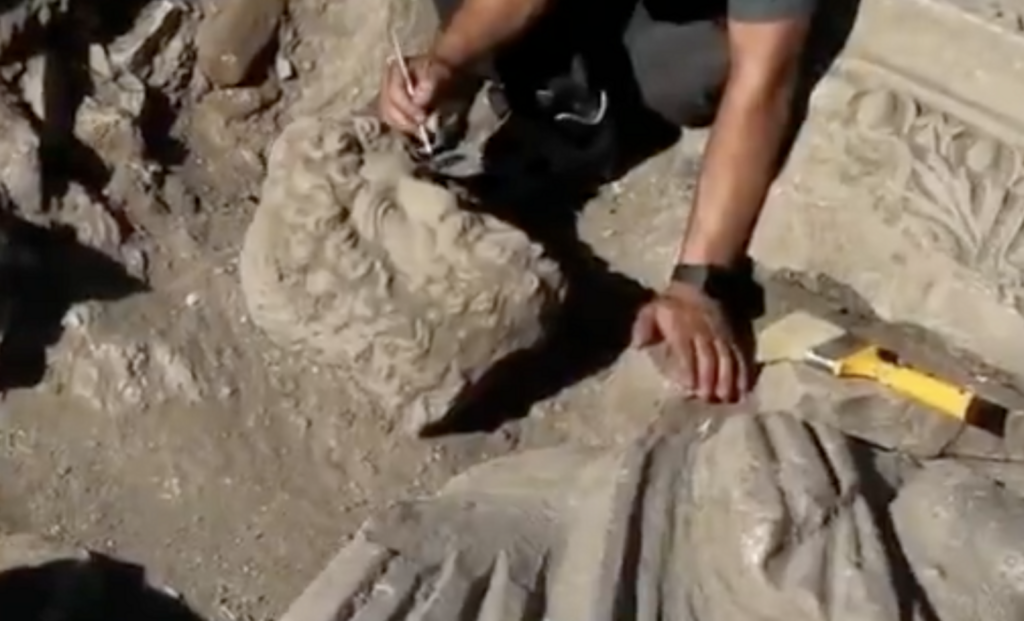
Beneath the rubble of a long-collapsed gateway in southern Türkiye, archaeologists have brought back into the light a face that Roman-era Aspendos once looked to for hope: Asklepios, the god of medicine, carved in marble and standing taller than most people who walk past him today.
The discovery was announced by Türkiye’s Minister of Culture and Tourism, Mehmet Nuri Ersoy, who shared the news on his social media account rather than waiting for a formal press conference: a sign of just how eager the Ministry was to share the find. Ersoy described it, in his own words, as a nearly 1,800-year-old symbol of healing finally seeing daylight again in Aspendos.
A God and His Son, Buried in the Ruins of a Gate
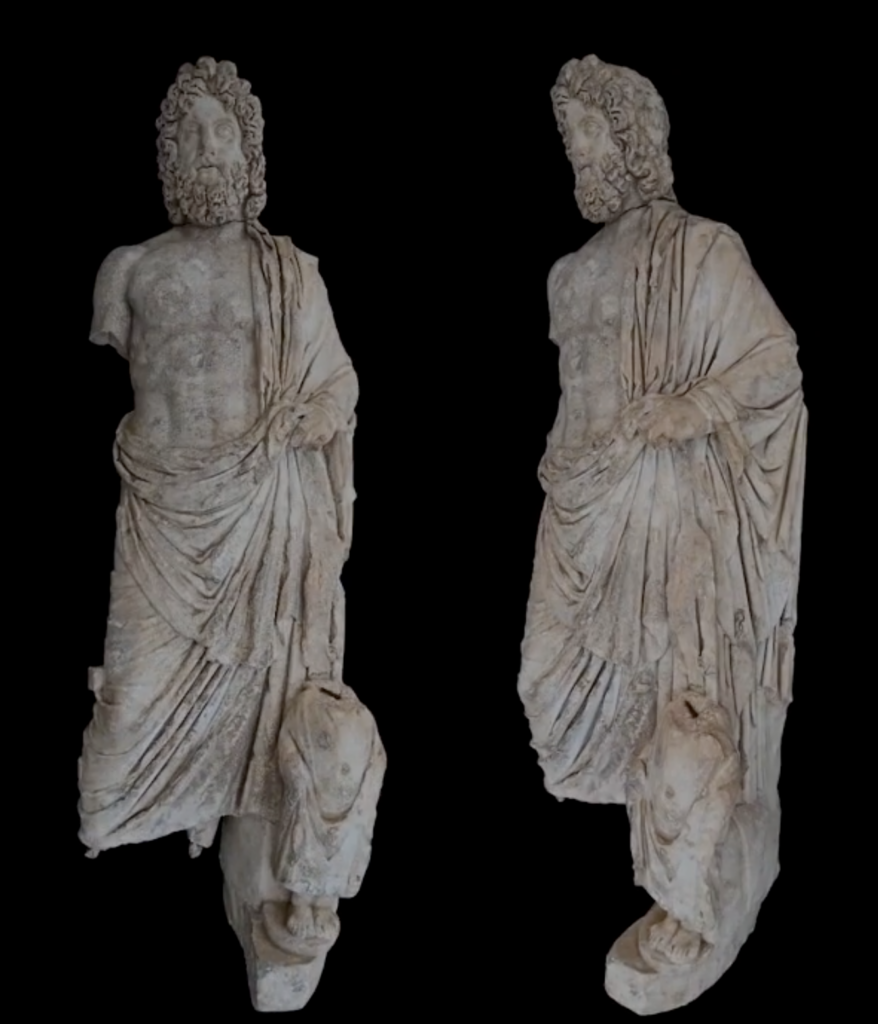
The statue itself is not a small find. Standing roughly 2.20 meters tall — taller than most doorframes — the marble group depicts Asklepios alongside a smaller figure at his feet: his son and constant companion, Telesphoros. It was unearthed among the collapsed remains of the northern wing of the Monumental Gate, right where Aspendos’s East Plaza opens onto Theatre Street, one of the busiest and most visible corners of the ancient city.
That location matters. This wasn’t a hidden shrine tucked away for private worship — it was public space, somewhere ordinary people would have walked past on their way to the theatre or the agora. Finding a statue of the god of healing here suggests health and medicine weren’t just private concerns in Roman Aspendos; they were something the whole city took pride in and put on display.
The excavation is part of Türkiye’s “Heritage for the Future” project, a nationwide effort to fund and coordinate archaeological work at historic sites, and the piece has been dated to the final quarter of the 2nd century AD — the same general era that produced Aspendos’s famous theatre.
What the Statue Actually Shows
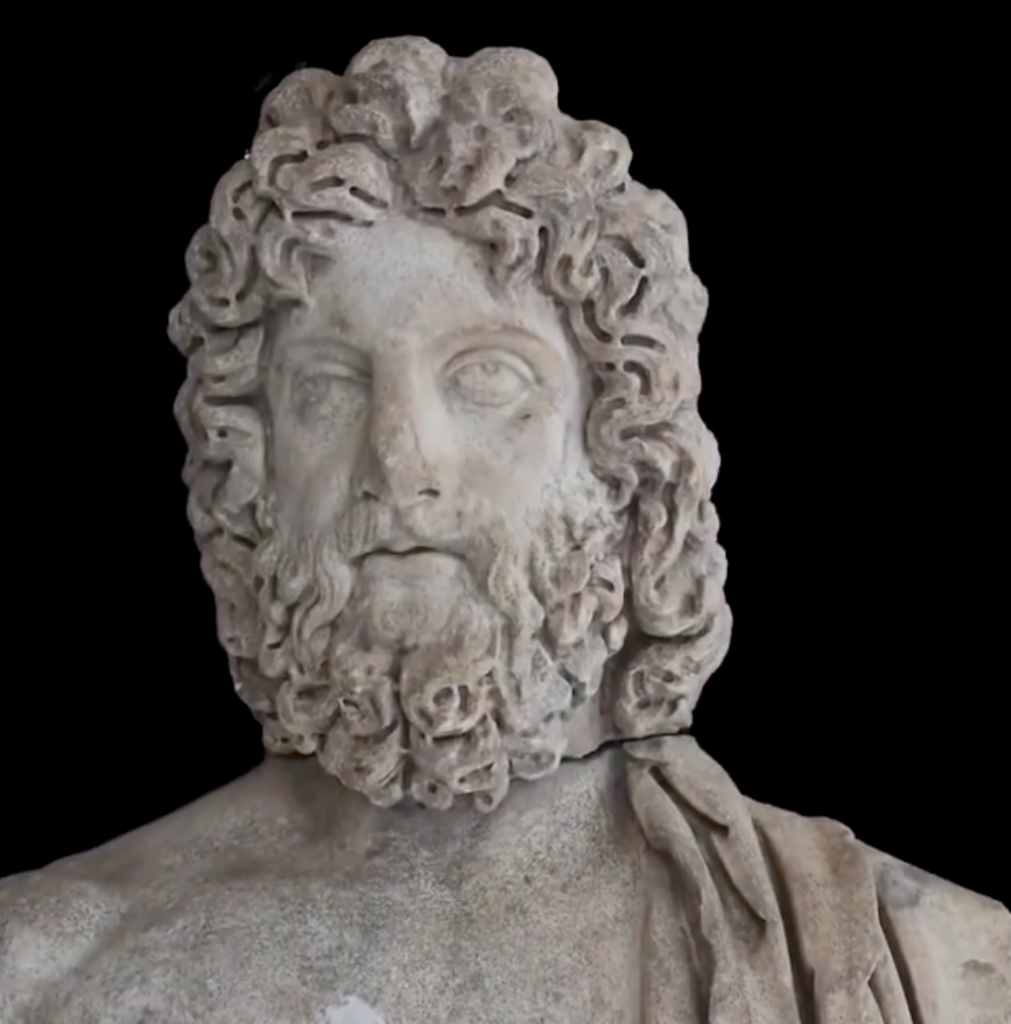
Picture Asklepios the way sculptors of his time imagined him: standing straight on, a mature man with a full head of hair and a carefully worked beard, his weight settled onto his left leg while his right leg bends gently and steps forward. His upper body is left mostly bare, but a cloak — a himation — is draped over his left shoulder and falls in deep, deliberate folds around his waist and legs. According to the Ministry, it’s exactly this kind of detail — the stance, the drapery, the treatment of the face and hair — that marks the piece as a genuine product of Roman-era sculptural workshops rather than a later imitation.
At his feet stands Telesphoros, and here the sculptor took a completely different approach. Instead of an idealized adult body, Telesphoros appears as a small, child-like figure wrapped from head to toe in a long, hooded garment that hides almost every anatomical detail and gives him an almost column-like silhouette. It’s a deliberate visual contrast, and it wasn’t arbitrary: in the ancient imagination, Asklepios represented medicine itself — diagnosis, treatment, the ongoing fight against illness — while Telesphoros stood for what came after: recovery, convalescence, the slow return to health. Put the two side by side, and you get a complete visual story of what it meant to get sick and get better in the Roman world.
What Makes This Find So Rare
It’s easy to read a headline like this and move on, but archaeologists will likely be talking about this find for years, for a few reasons.
For one, direct physical evidence of the Asklepios cult specifically in Aspendos has been thin on the ground until now. Worship of Asklepios was common across the Greek and Roman world — the great healing sanctuaries at Epidaurus and Pergamon are the most famous examples — but tying that broader tradition concretely to Aspendos itself has, until this find, relied more on inference than on hard evidence. Now there’s a statue to point to.
The location adds another layer. Because the piece turned up near a monumental civic gate rather than inside a secluded temple, it suggests healing imagery wasn’t confined to quiet, sacred spaces — it was part of how the city presented itself publicly, alongside its theatre, its agora, and its other grand architecture.
There’s also something valuable in the fact that both figures survived together, and largely intact. Asklepios and Telesphoros are often found separately, damaged, or missing entirely from the archaeological record, which forces scholars to reconstruct the pairing from fragments and written sources. Having both figures in one largely complete group gives researchers something rarer: a chance to study the full symbolic arc of ancient healing beliefs exactly as an ancient audience would have seen it.
And because the statue’s dating lines up closely with the theatre’s own construction under Marcus Aurelius, it hints that this piece may belong to the same wave of ambitious public building that reshaped Aspendos in the late 2nd century AD — a period when the city was clearly investing heavily in its own image.
It’s also worth noting how this story spread. Nearly every Turkish outlet that covered the find — from major national papers to regional sites — sourced their reporting from the same place: the Ministry of Culture and Tourism’s official statement and Ersoy’s own social media post. The core facts (the statue’s height, its age, where exactly it was found, and its dating) were repeated consistently across coverage, but none of the reporting reviewed included independent commentary from outside archaeologists. That’s fairly typical for a fresh announcement like this one — the more detailed academic analysis, if it comes, will likely follow in scholarly publications down the line rather than in same-day news coverage.
The City Behind the Statue
To understand why this find is such a big deal, it helps to know a bit about Aspendos itself. Located in the Serik district of Antalya, on Turkey’s Mediterranean coast, Aspendos has been inhabited since the 5th century BC, when it grew into an important Pamphylian port and trading hub — known in antiquity for exporting salt, wine, olive oil, grain, and horses so prized that they were sought after across the Near East.
Most visitors today know Aspendos for one thing above all: its Roman theatre, widely considered the best-preserved Roman theatre anywhere in the Mediterranean world, famous for acoustics so good that a whisper on stage can reportedly still be heard from the back row. It was built between roughly AD 161 and 180, under Emperor Marcus Aurelius, by the architect Zenon, son of a local man named Theodorus — and it’s still in use today, hosting the International Aspendos Opera and Ballet Festival every year since 1994.
The theatre isn’t the only thing left standing. The site also holds a monumental aqueduct system, a city gate, a nymphaeum, an agora, a basilica, a council house, a stadium, baths, and a gymnasium, most of it dating to the 2nd and 3rd centuries AD. Since 2015, “The Ancient City of Aspendos, its Theatre and Aqueducts” has sat on UNESCO’s World Heritage Tentative List, and excavation work has continued steadily since 2014 under Prof. Dr. Veli Köse of Hacettepe University’s Department of Archaeology, building on a surface survey that began back in 2008. Even Mustafa Kemal Atatürk, founder of the Turkish Republic, visited the theatre in March 1930 and personally ordered its restoration — a sign of how long Aspendos has held a place in Turkey’s national imagination.
It’s against that backdrop — a city that has always been defined by its grand public architecture — that this new statue makes so much sense. Aspendos didn’t just build a theatre people would remember for centuries. It also, it turns out, made sure its god of healing had a prominent place to stand.
Türkiye’s Minister of Culture and Tourism, Mehmet Nuri Ersoy, via X
