
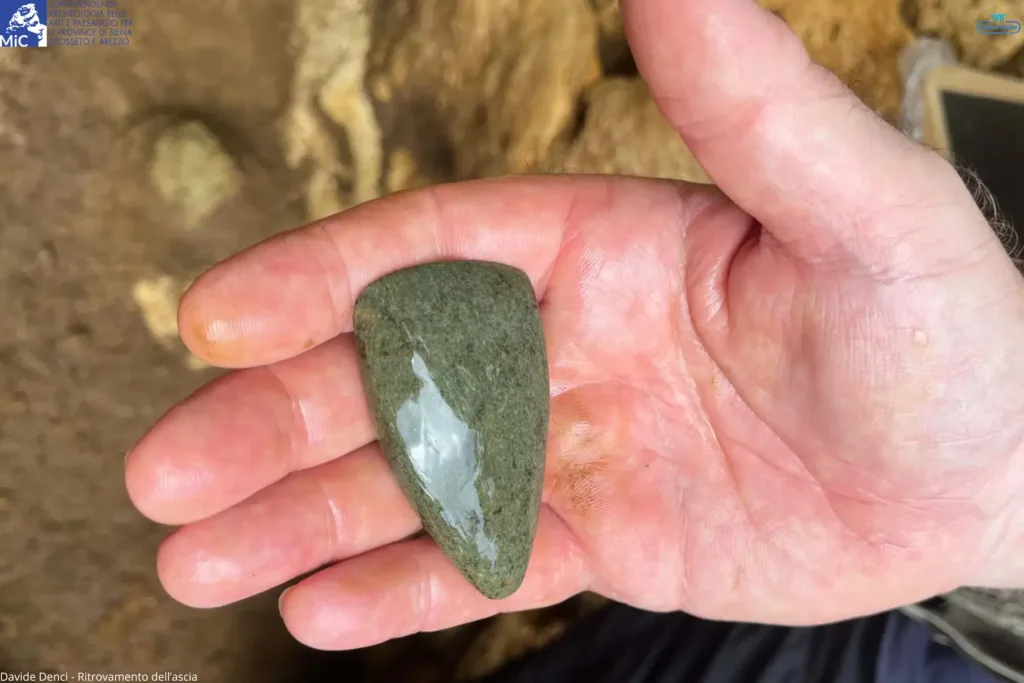
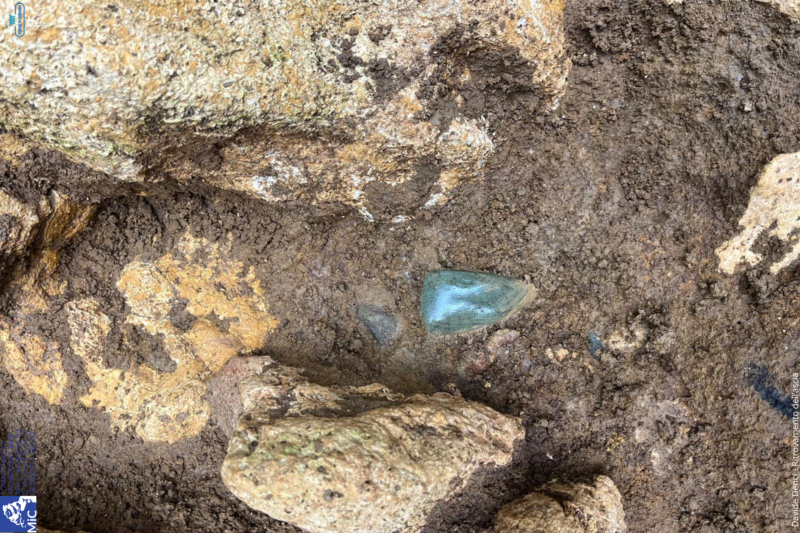
In a hot spring visited by humans approximately 6,500 years ago in the Tuscany region of Italy, a green stone axe has been discovered. The object features a sharp edge that remains intact and shows no signs of use.
Archaeologists believe that this meticulously polished object, which likely originated from the Western Alps, was used for ceremonial purposes rather than daily tasks. The discovery of the axe in a cave where hot water surfaced thousands of years ago raises new questions about the significance Neolithic communities attributed to these natural resources.
The find occurred during the third excavation season at the Terme di Sorano archaeological site in the province of Grosseto, Italy. The research, led by archaeologist Stefano Giuntoli, focuses on understanding how prehistoric humans utilized hot springs and whether these sites held an importance beyond the scope of daily life.
The Green Stone Axe: From the Western Alps to Tuscany
Despite its small size, the newly discovered axe possesses remarkable characteristics. The stone is skillfully shaped, polished, and sharpened, with its edge remaining preserved to this day. Researchers found no traces of wear or use on its surface.
Pasquino Pallecchi, working at the diagnostic laboratory of the Florence Institute for the Protection of Archaeology, Fine Arts, and Landscape, examined the material of the axe using optical and scanning electron microscopes. The analyses revealed that the object is made of eclogite, a hard and dense metamorphic rock.
The geological origin of the eclogite makes the discovery even more intriguing. Researchers believe the stone most likely came from the Western Alps. Neolithic communities obtained such raw materials from high mountainous regions, riverbeds, and glacial deposits.
According to excavation director Giuntoli, eclogite and jadeite were among the primary raw materials for Neolithic stone axes, which remained in circulation across Europe for approximately three thousand years. While some of these objects were used for daily chores, others gained importance as precious items symbolizing social status, power, or religious meaning.
The fact that the Sorano axe was never used strongly supports the latter possibility. Furthermore, researchers note that high-quality green stone axes of this kind are quite rare in Tuscany.
Why Was an Unused Axe Left in a Hot Spring?
In Neolithic Europe, polished stone axes were not used solely for cutting trees or woodworking. Archaeologists have found similar examples in the graves of high-status individuals and in areas associated with rituals. Water-related sites, such as springs, waterfalls, and marshes, are among the primary locations where these objects were deposited.
Therefore, the discovery at Sorano may carry a different meaning than that of an ordinary stone tool. The axe was found within a natural formation where hot water once surfaced. When its unused condition, precious material, and location are evaluated together, it seems likely that the object was left as a conscious ritual offering.
While comparative examples of the sanctity of water sources in Neolithic societies provide important clues, further archaeological evidence is needed to explain the exact function of the Sorano find.
Rock-Cut Steps and a 6,500-Year-Old Stone Structure
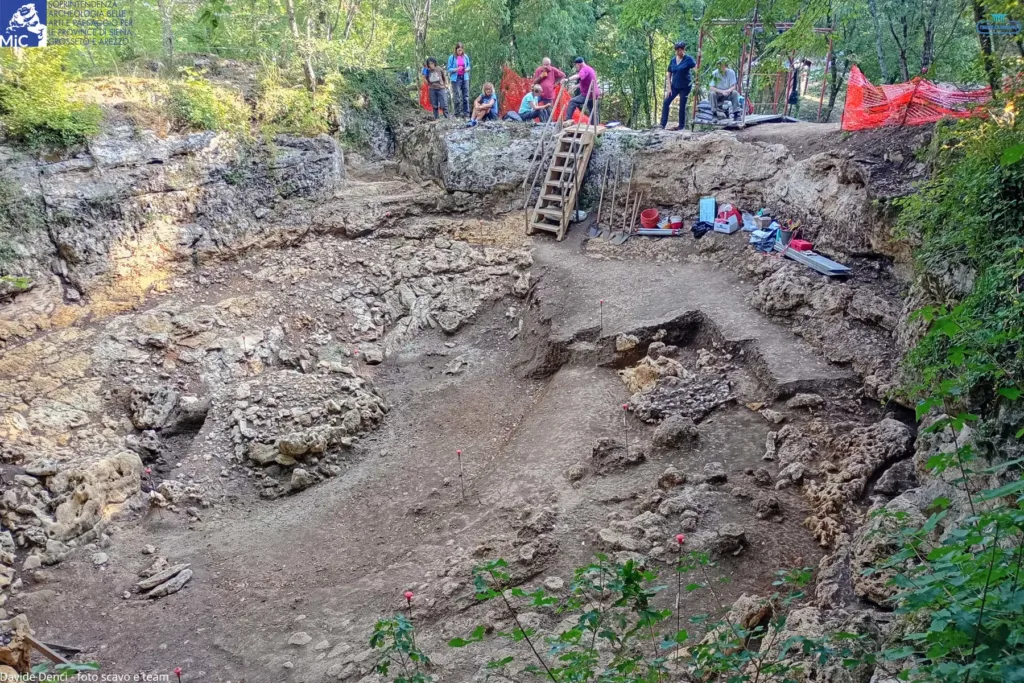
The cave where the axe was found is located within a large travertine formation covering an area of approximately 320 square meters. Today, this site is situated directly above the historic thermal pool known as Bagno dei Frati, which has been in use since the Middle Ages.
During the first excavation season, which began in July 2024, researchers identified three steps carved directly into the rock at the cave’s entrance. Deeper inside, they encountered an elliptical stone structure measuring approximately 2.60 x 2.20 meters, constructed from travertine and tuff blocks.
According to a statement released by the Italian Ministry of Culture in January 2026, radiocarbon analysis of charcoal fragments in direct contact with the stone structure yielded dates between 4495–4335 BCE. Researchers also identified an ancient thermal water level that had not been previously documented at this location.
These results indicate that humans interacted with the Sorano hot spring during the Neolithic Age. The research team suggests that the water may have been used for health or ceremonial purposes, although the exact nature of these activities remains unclear.
The discovery of the new axe reinforces the assessments of activities that may have taken place at this site thousands of years ago. In particular, the presence of a precious object transported from a great distance highlights the significance of the spring for the communities living in the surrounding area.
Traces of Life in the Cave
Archaeologists are investigating other materials associated with Neolithic activities in the cave beyond the axe. Ceramic fragments, flint and jasper processing residues, and animal bones bear witness to the activities that took place around the hot spring.
However, the number of ceramics and stone artifacts found so far in the 320-square-meter cave is relatively low. This suggests that the cave may not have been a permanent settlement, but rather a site visited for specific purposes. Researchers are considering the possibility that the actual settlement where people lived was located in the nearby vicinity.
Among the ceramics are vessel fragments made of coarse and partially refined paste, some of which feature embossed decorations. Most of the stone finds consist of flint and jasper processing waste. Researchers also identified traces on some stone surfaces associated with sudden temperature changes.
Animal bones examined by Chiara A. Corbino from the University of Basilicata open another line of inquiry. Cattle are particularly prominent among the remains, though pig and sheep bones are also present. Remains of wild animals, such as deer, roe deer, and foxes, are fewer in number.
While it is noteworthy that some of the cattle died at a young age, this alone does not prove the practice of sacrifice. Further research is required to determine whether the bones are related to food preparation, daily activities, or rituals.
The Relationship Between Neolithic Communities and Hot Springs
The excavations at Terme di Sorano are conducted with the permission of the Italian Ministry of Culture and funded by the Antiche Terme Acqua di Sorano company. Stefano Giuntoli’s team is collaborating with the conservation institutes responsible for Siena, Grosseto, and Arezzo, while researchers from the University of Florence are contributing to the three-dimensional documentation of the site.
A significant portion of the cave has yet to be examined. Future studies on new stone structures, ceramics, and animal remains may help determine how frequently humans visited this spring and what activities they performed there.
