
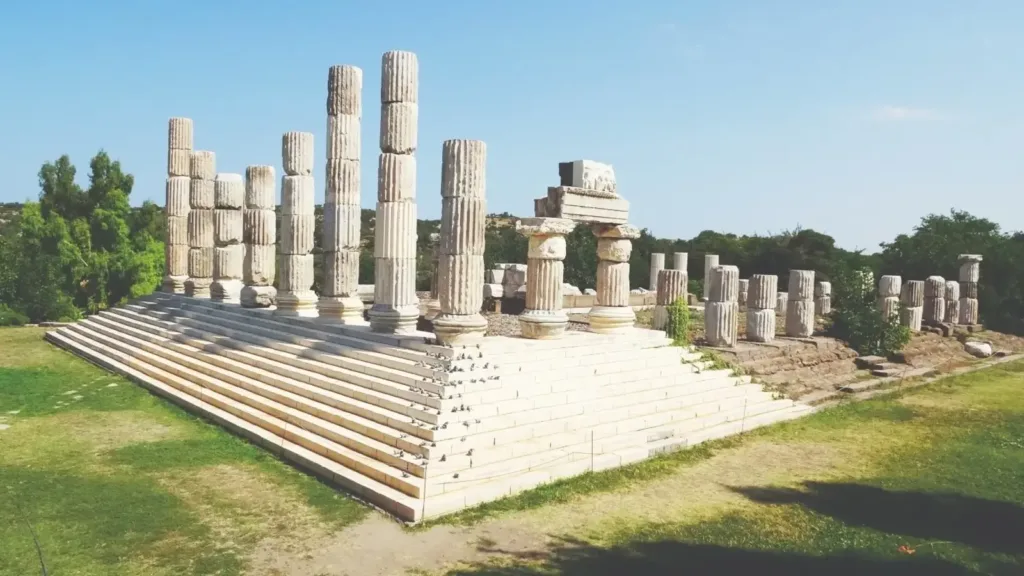
Archaeologists digging at the ancient Sanctuary of Apollon Smintheus, tucked into the northwestern Turkish province of Çanakkale’s Ayvacık district, have unearthed a stone mortar dated to roughly 1,500 years ago alongside a set of storage jars believed to be around 1,300 years old. Together, the finds are opening a rare window onto the everyday lives of the early Christian farmers and craftspeople who moved into the sanctuary after its days as a pagan shrine had ended.
A Sanctuary With Deep Roman and Pagan Roots
Long before Christianity took hold in the region, the site in Gülpınar village was revered as sacred ground dedicated to Apollo Smintheus — a name that translates to “Apollo the Lord of Mice,” a curious epithet tied to ancient local legend and cult worship.
The sanctuary has drawn sustained scholarly attention since 1980, when systematic excavation and restoration efforts first began there, gradually revealing layer upon layer of the site’s long and shifting history.
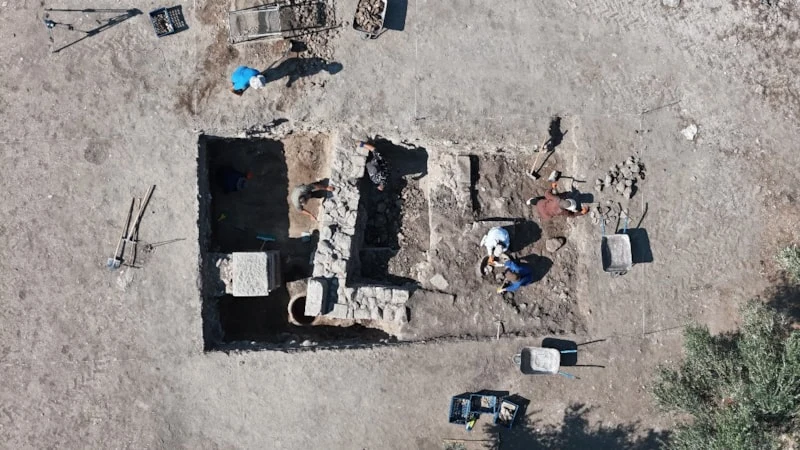
This year’s excavation season, now underway for roughly two weeks under the direction of Professor Davut Kaplan of Samsun Ondokuz Mayıs University’s Department of Archaeology, has focused on the sanctuary’s western section, in what researchers call the “Western Bath.
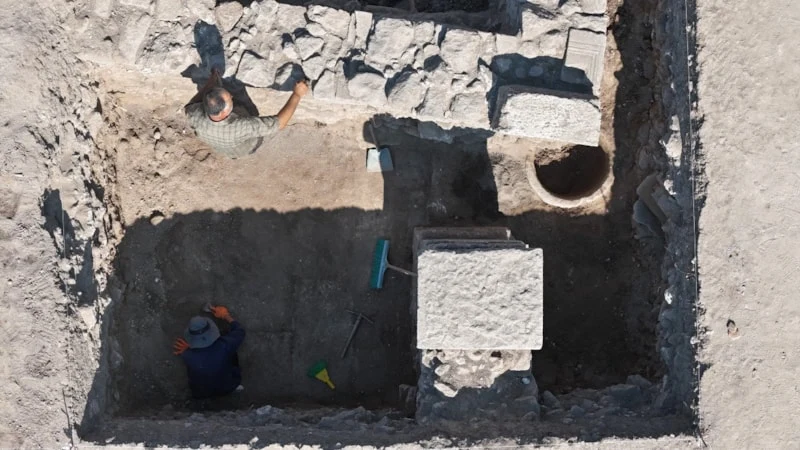
Digging into the third bath structure of the complex, the team has now identified traces from two distinct phases of Christian occupation, layered directly atop the remains of a Roman-era bathing complex.
Roman Engineering Still Impresses, Nearly 1,700 Years Later
Beneath the Christian-era remains, excavators found a caldarium — the hot room of a classic Roman bathhouse- dated to close to 1,700 years old, complete with its original heating infrastructure still intact enough to study.
Alongside it, the team uncovered a hypocaust system, the ingenious Roman method of channeling hot air beneath raised floors to heat interior spaces from below. It’s a striking reminder that the underfloor heating prized in modern luxury homes today has a design lineage stretching back nearly two millennia to Roman bath engineers.
From Bathhouse to Farming Community
According to Professor Kaplan, the real story emerging from this season’s dig is one of transformation. Once pagan worship was outlawed, the sanctuary’s Roman-era architecture and building materials didn’t disappear — they were repurposed. A new Late Antique settlement grew up directly on top of the old sacred and bathing complex, built by Christian residents who reused what earlier generations had constructed.
The team has now distinguished two separate Christian occupation layers sitting above the Roman bath floor. The earlier of the two, dated to around 1,400 to 1,500 years ago, sat directly on the bath’s original floor level and belonged to a farming community, the very people who left behind the newly discovered mortar, along with other tools connected to food preparation, storage, and daily agricultural life.
A fill layer separates this earlier settlement from a later Christian occupation above it, though evidence from that more recent phase is harder to read, having been disturbed over centuries of subsequent farming activity in the area.
That later phase is where the storage jars, known as pithoi, come in. Dated to roughly 1,200 to 1,300 years old, the large vessels are now being carefully cleaned by the excavation team and are expected to shed further light on how the community stored food and managed resources in its final stretch of occupation.
A Community Shaped by Hardship and Faith
Professor Kaplan notes that life for these Christian settlers was far from stable. The region experienced periodic invasions and stretches of economic hardship, and historical evidence points to a broader weakening of Christian presence in the area during the eighth and ninth centuries. A later wave of resettlement did follow, but because so little physical evidence survives from that final phase, researchers are still working to piece together exactly what that community’s daily life looked like.
One of the more telling shifts the excavation has revealed concerns the bath complex itself. Under Roman rule, the baths were a central, heavily used feature of communal life. Christian residents, by contrast, didn’t share the same cultural attachment to communal bathing, and the practice appears to have faded from daily habit.
Over time, the bath structures lost their original purpose altogether, giving way to a settlement built around agriculture and animal husbandry instead.
What This Means for Anatolian Archaeology
Every excavation season at Apollon Smintheus adds another piece to a much larger puzzle: how communities across Anatolia adapted, rebuilt, and reinvented sacred and civic spaces as the Roman world gave way to the Christian era.
The newly uncovered mortar, storage jars, and bath remains don’t just document a single site’s history — they offer a tangible, close-up look at how ordinary people navigated one of the most significant religious and cultural transitions in the ancient Mediterranean world.
