
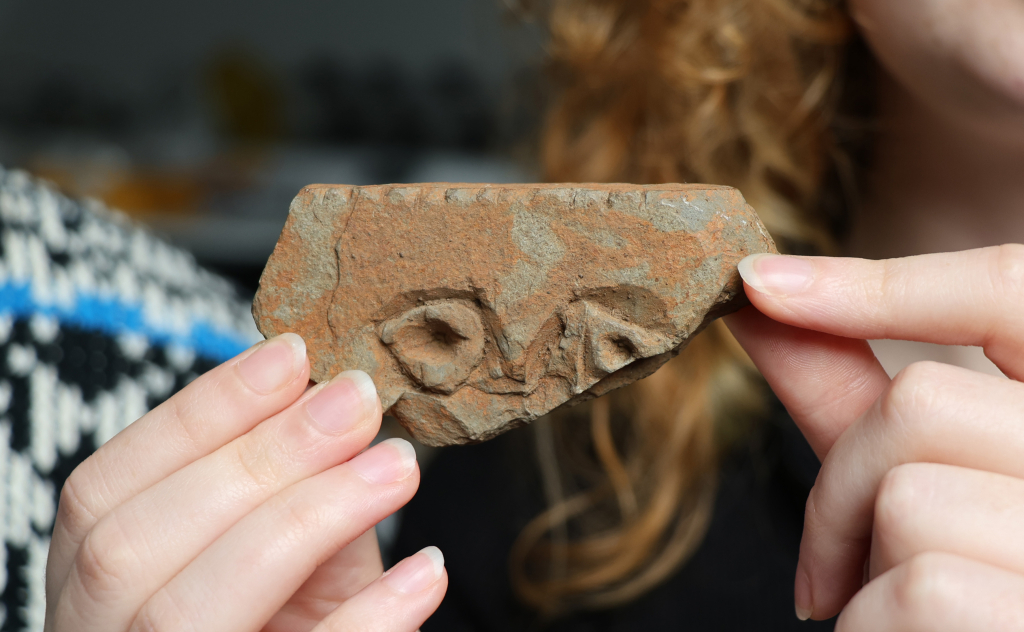
A remarkable discovery at a hillfort in Fife has brought archaeologists face-to-face with Scotland’s enigmatic Pictish past. A carved stone, believed to depict a human face dating back nearly 1,500 years, was uncovered by University of Aberdeen archaeology student Jodie Allan while volunteering on a summer excavation.
The rare find has been hailed as a significant addition to the growing body of evidence that East Lomond was once a thriving settlement of the Picts, a confederation of tribes who dominated much of northern and eastern Scotland during the late Iron Age and early medieval periods.
Student Stumbles Upon Extraordinary Discovery
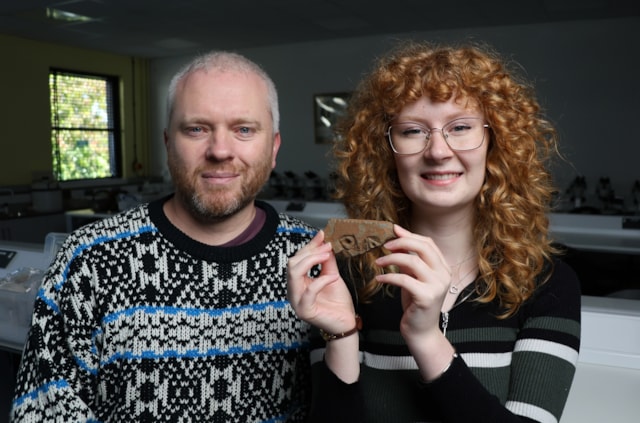
Allan, a third-year archaeology student, was taking part in a dig at East Lomond hillfort, organized by Professor Gordon Noble of the University of Aberdeen and Joe Fitzpatrick of the Falkland Stewardship Trust. While sieving soil from an early medieval building, she noticed a small object measuring about 10–12 cm.
“At first, I thought it was just a piece of slag,” Allan explained. “But the unusual coppery-green color caught my attention. When I showed it to Professor Noble, his reaction immediately told me it was something special. Looking closely, you can see two eyes, a nose, and even what seems like a hairline.”
The moment marked a career-defining experience for the young archaeologist, who had joined the excavation to gain hands-on fieldwork experience.
An Important Site in the Pictish World
Excavations at East Lomond have been underway for several years, with researchers and community volunteers uncovering layers of evidence pointing to a wealthy, well-connected settlement. The hillfort lies on what is believed to have been the southernmost frontier of the Pictish kingdom, strategically overlooking Fife and the Forth valley.
Finds from the site have included Roman imports such as Oxfordshire Ware pottery and E-ware from northern France, items typically associated with elite households. These discoveries suggest that the Picts of East Lomond had far-reaching trade links and were part of a broader cultural exchange network in the post-Roman world.
Joe Fitzpatrick of the Falkland Stewardship Trust emphasized the richness of the site:
“There is an incredible depth of archaeology here, with hearths built upon hearths and buildings replacing earlier structures. The sheer number of complete objects we are finding is unusual for the Pictish period and points to a community of wealth and influence.”
A Rare Glimpse of Pictish Identity
Professor Noble described the carved stone as “an incredibly rare schematic representation of a human face,” noting that depictions of people are almost unheard of in early medieval Scotland.
“This carving has two eyes, a nose, and what appears to be a hairline at the top,” Noble said. “It resembles some of the human figures seen in early medieval manuscripts. If confirmed, it could even represent a rudimentary portrait of a local inhabitant of East Lomond during the fifth to seventh centuries.”
The discovery challenges long-held perceptions of the Picts, often portrayed in popular culture as mysterious “painted warriors” shrouded in obscurity. Instead, the stone face hints at a society that engaged in personal representation and identity through art and craftsmanship.
“The face suggests that Pictish people here were producing simpler, more expedient carvings,” Noble added, “possibly made for family or community members, in contrast to the monumental symbol stones erected for public display.”
What Comes Next?
Archaeologists will now conduct radiocarbon dating of the building layers associated with the carved stone to narrow down its age. They will also compare the artifact with other artistic parallels from across early medieval Europe to better understand its cultural context.
In addition to the carved stone, the 2025 dig season uncovered a complete iron mattock head and fragments of weaponry, further supporting the interpretation of East Lomond as a settlement of high status and strategic importance.
From Excavation to Screen
The story of East Lomond and its Pictish inhabitants is also reaching a global audience. The discovery is featured in Enemies of Rome: In Search of the Picts, a new documentary on History Hit, the streaming platform founded by historian Dan Snow. It will also appear in an upcoming episode of the BBC2 series Digging for Britain.
History Hit presenter Tristan Hughes reflected on the importance of the find:
“For more than a millennium, the Picts have remained an enigma. Discoveries like this show us they were far more complex than the old stereotypes of blue-painted barbarians. Sites like East Lomond are rewriting their story before our eyes.”
A Window into Scotland’s Ancient Past
For Allan, the experience of uncovering the stone face will remain unforgettable:
“To know that I held something that could represent a person who lived here more than a thousand years ago is incredible. It makes the past feel so much closer.”
As analysis continues, the carved stone promises to offer fresh insight into how the Picts saw themselves and expressed identity through art. For archaeologists and historians, it is yet another step toward piecing together the rich and complex tapestry of early Scotland’s history.
Cover Image Credit: The Pictish stone resembling a human face. University of Aberdeen
