
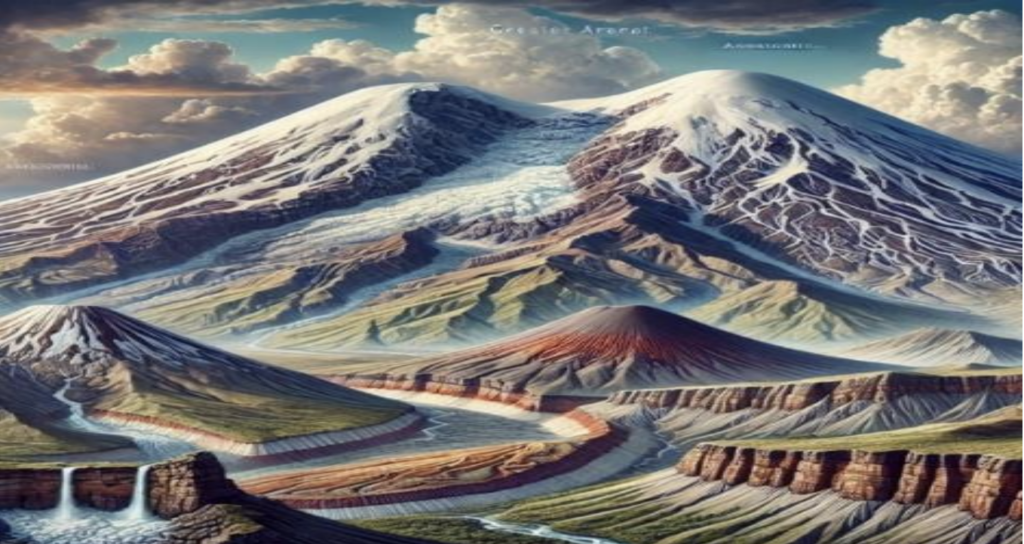
At sunrise, when the first light hits the snow on Mount Ararat, the mountain does something strange: it looks close enough to touch, yet impossibly distant. For centuries, that same paradox has defined the story attached to it. The Ark is near. The Ark is far. The truth is visible. The truth is contested.
A new academic assessment revisits one of humanity’s oldest narratives—not to sensationalize satellite images or revive conspiracy theories—but to examine how a single mountain carries three powerful spiritual interpretations at once. The study places Christian scripture and historical expeditions, Armenian religious identity, and Islamic theology side by side. The result is less about proving where the Ark landed and more about understanding why the question still matters.
In the Christian world, the story begins in the Book of Genesis. After the flood, the Ark comes to rest on the “mountains of Ararat.” That phrase—brief, almost understated—has fueled centuries of belief and exploration. Medieval pilgrims risked their lives climbing icy slopes. Nineteenth-century explorers returned with sketches and stories. Twentieth-century adventurers carried cameras and hope. Each expedition was driven by the same desire: to bridge scripture and stone.
But even without physical proof, the mountain holds theological weight. For Christians, Ararat is not just a location; it is the place where judgment ends and mercy begins. It represents covenant, renewal, and the fragile restart of humanity after catastrophe. Whether interpreted literally or symbolically, the Ark resting on Ararat embodies divine forgiveness after destruction. The snow becomes part of the story. The height becomes part of the hope.
For Armenians, however, the mountain is not merely Biblical—it is personal.
From the capital city of Yerevan, Ararat dominates the horizon. It appears on the national coat of arms. It fills paintings, poetry, and memory. Yet it lies beyond Armenia’s modern borders. This tension—visibility without possession—has turned Ararat into something deeper than a religious landmark. It has become a symbol of continuity.
Within Armenian Christian tradition, the Ark narrative intertwines with national ancestry. Early Armenian historians described their people as descendants of Noah’s lineage. In this telling, the slopes of Ararat are not only where humanity survived, but where civilization resumed. The mountain becomes cradle and compass at once. Even today, many Armenians describe Ararat as the spiritual center of their identity, a silent witness to survival through centuries of upheaval.
Then there is the Islamic perspective, which both parallels and diverges in fascinating ways.
In the Quran, the Prophet Nuh is described as a man of extraordinary patience, preaching for centuries before the flood arrives. The Ark is built. The waters rise. The believers are saved. But the Qur’an does not name Ararat. Instead, it says the Ark came to rest upon “Al-Judi.”
This difference has sparked centuries of scholarly discussion. Some Muslim scholars associate Al-Judi with a mountain in southeastern Türkiye. Others argue the emphasis is not geographical at all. In Islamic theology, the lesson outweighs the location. The story underscores moral accountability, perseverance, and the principle that faith—not lineage—determines salvation. Even Noah’s own son does not survive, a stark reminder that belief is personal, not inherited.
What makes the new study compelling is not that it chooses one interpretation over another. It doesn’t. Instead, it lays them side by side and asks readers to consider how one mountain can carry multiple sacred geographies simultaneously. In Christian thought, it is covenant fulfilled. In Armenian consciousness, it is homeland remembered. In Islamic understanding, it is a stage for moral truth rather than territorial claim.
Meanwhile, science watches quietly.
Geologists describe Mount Ararat as a stratovolcano shaped by lava flows, glacial movement, and tectonic forces. Archaeologists note the absence of verified physical evidence for the Ark. Climatic conditions, avalanches, and centuries of erosion make preservation unlikely. Yet the lack of timber has not weakened the legend. If anything, it has strengthened the symbolism.
Perhaps that is the deeper revelation. The power of Ararat does not rest in wooden beams frozen in ice. It rests in narrative endurance. Across three faith traditions, the flood story speaks of collapse and continuation, punishment and mercy, loss and rebuilding. Every culture facing disaster can recognize itself in that rhythm.
In a region often defined by political tension, Mount Ararat stands as both dividing line and shared inheritance. It is visible from one nation, located in another, referenced in multiple scriptures, and claimed by none in absolute certainty. It belongs, in a sensearched for meaning after devastation.
And that may be why the mountain still matters.
Long after expeditions return empty-handed, long after debates over Al-Judi and Ararat continue, the image endures: a vessel grounded after chaos, humanity stepping onto solid earth again, and a covenant stretching like a rainbow over uncertain skies.
Three faiths. One mountain. A story that refuses to sink.
Efe, A. (2025). An assessment of Mount Ararat’s role in the narrative of Noah’s Ark: historical, religious and political perspectives. Ağrı İbrahim Çeçen Üniversitesi Sosyal Bilimler Enstitüsü Dergisi, 11(2), 261-290. https://doi.org/10.31463/aicusbed.1646109
Cover Image Credit: A digital illustration of Mount Ararat for its geological history with
volcanic formations, glacial features, and its twin peaks. Efe, A. (2025)
