
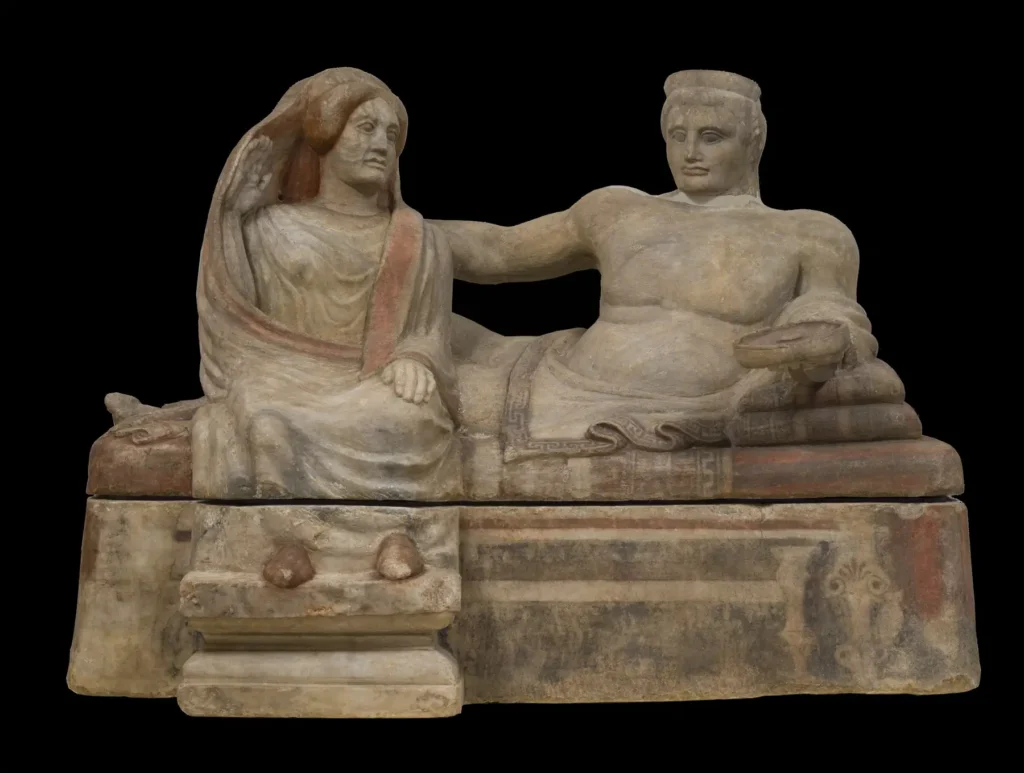
More than half a century after the catastrophic 1966 Arno flood submerged vast sections of Florence, one of the city’s most intimate ancient masterpieces has regained its lost brilliance. The Urna del Bottarone, a 2,400-year-old Etruscan funerary urn preserved at the Museo Archeologico Nazionale di Firenze, has undergone a major scientific restoration that has revealed its original colors—and restored the emotional intensity of the sculpted couple embracing on its lid.
Carved between 425 and 380 BCE from white alabaster streaked with grey veins, the urn is considered an exceptional example of Etruscan funerary art. Its rediscovered polychromy, including traces of Egyptian blue, ochre, and cinnabar, offers rare insight into the vibrant appearance of Etruscan sculpture—long assumed to be monochrome by later viewers.
From Flood Disaster to Conservation Revival
When the Arno River overflowed in November 1966, muddy water rose more than two meters inside the museum, inundating storage rooms, restoration laboratories, archives, and countless artifacts in the Etruscan collections. The Bottarone urn survived—but not without damage.
An initial intervention between 1969 and 1970 focused primarily on removing mud deposits. Structural concerns, particularly in the male figure’s head, were stabilized, yet the surfaces gradually greyed over time. The sculpture’s original chromatic richness remained hidden beneath decades of degradation.
In 2022, a new diagnostic and conservation campaign was launched through bilateral cultural funding between Italy and Switzerland. Advanced imaging technologies—including multispectral analysis—allowed conservators to detect and map pigments invisible to the naked eye. Egyptian blue, one of antiquity’s most prized synthetic pigments, was identified alongside iron-based ochres and vivid cinnabar red.
The results fundamentally change how the urn is perceived: not as a pale relic of antiquity, but as a once-colorful monument designed to communicate emotion, status, and identity.
A Rare Motif in Etruscan Funerary Sculpture
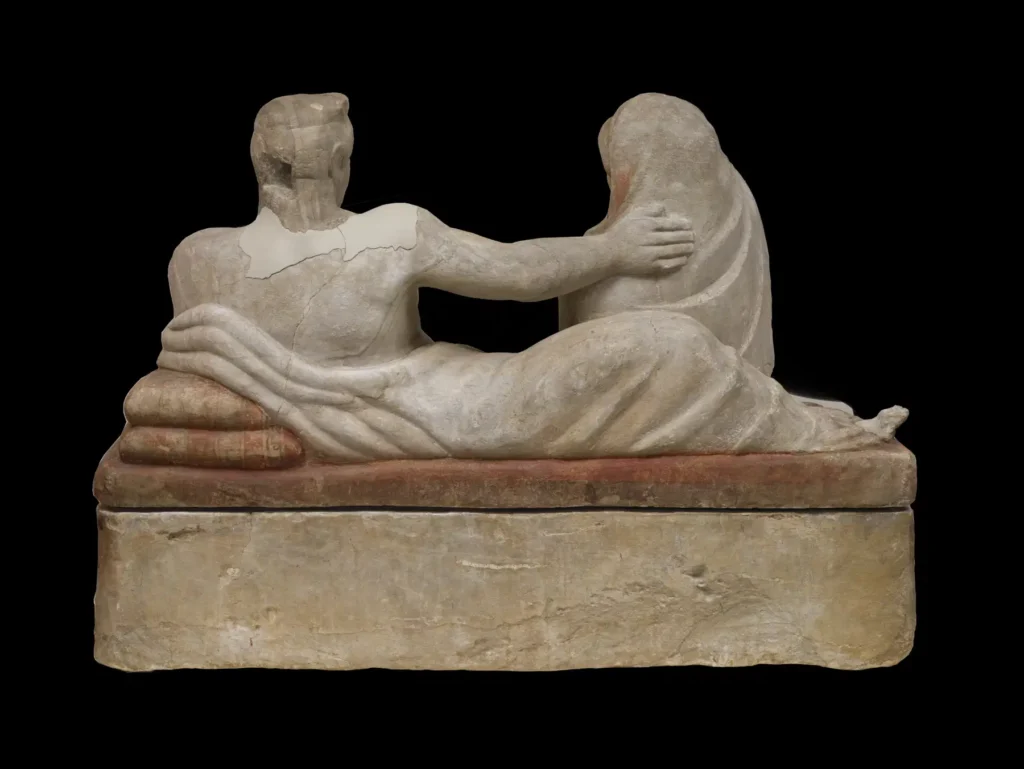
The Bottarone urn was discovered in 1864 near Città della Pieve and later entered the Florentine museum collections in 1887. Its lid depicts a reclining husband and wife in a close embrace—a motif that stands out within the funerary sculpture tradition of Chiusi.
In many Etruscan tomb monuments of the 5th century BCE, the deceased is typically accompanied by a winged female daemon guiding the soul to the afterlife. Here, however, the female figure is clearly the wife, identified by her unveiling gesture. This subtle movement transforms the composition from mythological symbolism into an intimate conjugal scene.
The embrace is not theatrical. It is restrained, dignified, and tender. Such imagery reflects a distinctive aspect of Etruscan society: the comparatively elevated social presence of women. Unlike in contemporary Greek contexts, Etruscan women appeared in banquets, owned property, and were depicted alongside their husbands in public and funerary art.
The Bottarone urn therefore embodies more than personal memory—it expresses a cultural worldview in which marriage, lineage, and shared identity extended into the afterlife.
The Etruscans and the Art of the Afterlife
The Etruscans flourished in central Italy between roughly the 8th and 3rd centuries BCE, before their gradual absorption into the expanding Roman Republic. Known for their urban planning, metallurgy, maritime trade, and complex religious rituals, they developed a highly distinctive visual language in funerary contexts.
Alabaster urns from Chiusi and Volterra often featured reclining figures on lids, referencing the banquet—a powerful metaphor for eternal life. These sculptures were originally brightly painted, their surfaces animated with color to enhance realism and symbolic depth.
Over centuries, pigment loss led to the misconception that classical antiquity favored pure white stone. Modern conservation science continues to overturn this assumption, demonstrating that ancient Mediterranean sculpture was vividly polychrome.
The Bottarone urn now stands among the clearest examples of this rediscovered chromatic heritage.
Exhibition and Cultural Significance
The restored urn was recently presented to the public during the tourismA cultural heritage event in Florence, marking a symbolic moment: from the mud of disaster to renewed visibility. After the exhibition, the sculpture returns to the Etruscan galleries of the Museo Archeologico Nazionale di Firenze.
Museum director Daniele Federico Maras described the restoration as a collaborative achievement that unites conservation science, international cooperation, and cultural memory. The project represents not only technical excellence but also a broader message about resilience: cultural heritage, even when damaged by catastrophe, can be studied, understood, and revived.
Revealing the Lost Polychromy of Etruscan Art
The Bottarone urn is not simply an artifact recovered from flood damage. It is a case study in how modern technology reshapes historical interpretation. By identifying pigments such as Egyptian blue—used across the ancient Mediterranean from Egypt to Rome—researchers deepen our understanding of trade networks, artistic exchange, and symbolic language in the 5th century BCE.
More importantly, the rediscovered colors restore the humanity of the sculpture. The bride and groom are no longer pale silhouettes; they reemerge as vibrant figures, once meant to be seen in full chromatic intensity by mourners standing before the tomb.
In that sense, the restoration bridges three timelines: the Etruscan past, the trauma of 1966 Florence, and the present moment of scientific rediscovery.
What was once submerged in mud has returned—not merely cleaned, but reinterpreted.
The Direzione regionale Musei nazionali della Toscana
Cover Image Credit: The Direzione regionale Musei nazionali della Toscana
