
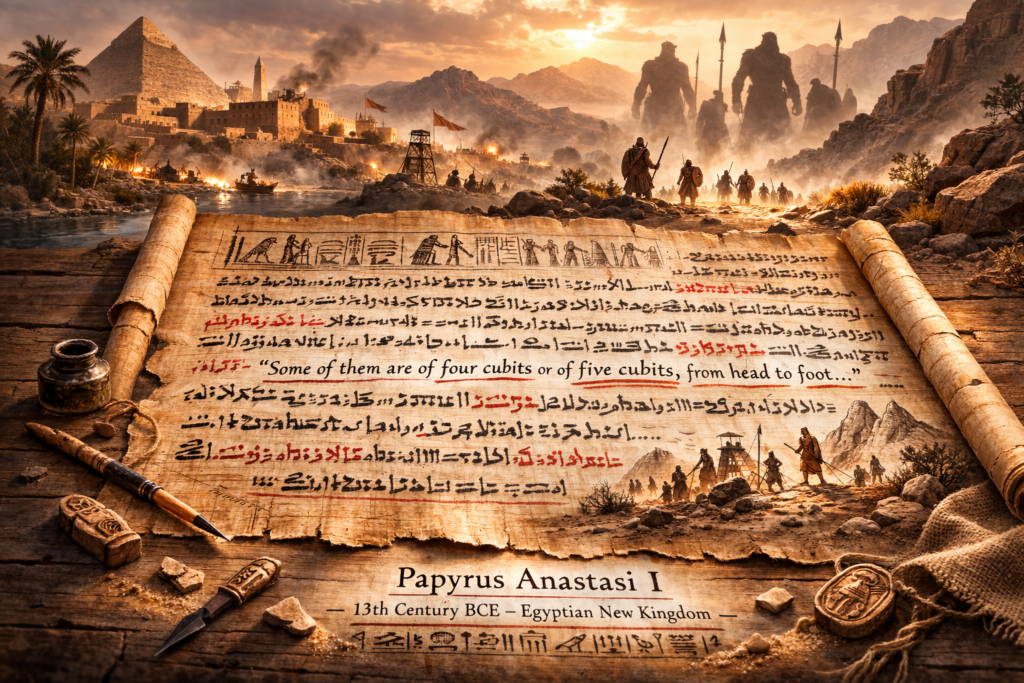
Stories of giants have always stood at the uneasy crossroads of faith, folklore, and archaeology. Now, a 3,300-year-old Egyptian text preserved in the British Museum is once again fueling one of the Bible’s most controversial debates: were the giants of the Old Testament rooted in real historical encounters?
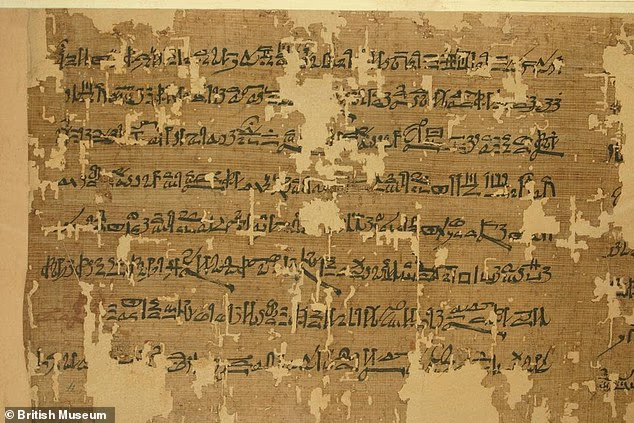
At the center of the discussion is Papyrus Anastasi I, a New Kingdom Egyptian document written as a letter between scribes. Though long known to scholars, the text has recently drawn renewed attention after being highlighted by researchers affiliated with Associates for Biblical Research and reported in mainstream outlets including the Daily Mail. The renewed spotlight has prompted a fresh wave of questions about whether ancient Egyptian records may echo biblical references to towering warriors in Canaan.
An Egyptian “War Correspondent” in Canaan
Papyrus Anastasi I is typically dated to the 13th century BCE. Written in hieratic script, it takes the form of a sharply worded letter from a scribe named Hori to another official, Amenemope. The tone is instructional—and often mocking. Hori criticizes his colleague’s lack of knowledge about geography, logistics, and military realities in the Levant.
Far from being a mythological tale, the document reads like a field manual infused with sarcasm. It references specific routes, cities, supply calculations, and the dangers awaiting Egyptian forces operating in Canaan. For many historians, this makes the papyrus a rare and vivid window into how Egyptian officials conceptualized foreign campaigns.
One passage in particular has drawn extraordinary interest. Hori warns about a narrow mountain pass “infested with Shosu concealed beneath the bushes,” describing some of them as measuring “four cubits or five cubits, from head to foot, fierce of face, their heart is not mild.”
The measurement matters. The royal Egyptian cubit was approximately 20.6 inches (about 52.3 cm). That would place these Shosu individuals somewhere between roughly 6 feet 8 inches and 8 feet 6 inches tall—well above the average height of the Late Bronze Age population.
For advocates of a historical core behind biblical giant traditions, this numerical detail is difficult to ignore.
Echoes of the Anakim and the Nephilim?
The Hebrew Bible refers multiple times to unusually large figures. Genesis 6 speaks of the enigmatic Nephilim, often translated as “giants.” In Numbers 13:33, Israelite scouts describe encountering the “sons of Anak” in Canaan, claiming they felt like “grasshoppers” in comparison. Deuteronomy 3:11 recounts Og, king of Bashan, whose bed is described as nine cubits long.
Researchers associated with Associates for Biblical Research have suggested that Papyrus Anastasi I may represent rare extra-biblical corroboration of such traditions. As reported in the Daily Mail, proponents argue that the reference to Shosu of exceptional stature parallels biblical depictions of the Anakim—figures remembered as imposing and formidable.
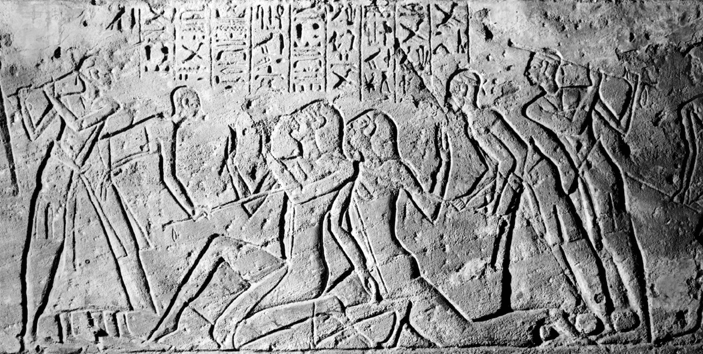
The argument gains further context from other Egyptian sources. So-called Execration Texts—ritual inscriptions from earlier periods—list foreign enemies whose names were inscribed on clay objects and ritually smashed. Some scholars have noted possible linguistic parallels between names in these texts and the biblical Anak. Additionally, reliefs from the reign of Ramesses II depicting conflicts near Kadesh portray captured Shasu figures in ways that some interpret as emphasizing unusual size.
For supporters, these threads form a tapestry: Egyptian military accounts describing tall Levantine warriors, ritual texts naming enemy groups, and biblical narratives recalling fearsome giants in the same geographic sphere.
Satire, Hyperbole, or Historical Memory?
Yet most Egyptologists approach such conclusions with caution.
The British Museum characterizes Papyrus Anastasi I primarily as a didactic composition—a training text designed to test and refine scribal knowledge. Its exaggerated tone suggests satire. Hori’s criticism of Amenemope includes rhetorical flourishes intended to highlight incompetence. In that context, descriptions of towering enemies may function as literary devices rather than anthropometric data.
The late biblical scholar Dr. Michael Heiser argued that even heights approaching seven or eight feet do not imply a separate race of supernatural giants. Modern medical science documents individuals who naturally reach or exceed such stature. Rare? Yes. Impossible? No.
Moreover, no verified skeletal remains, architecture, or material culture clearly indicate the existence of a distinct population of giant humans in the Bronze Age Levant. Archaeology has yet to uncover physical evidence that matches the dramatic scale implied in biblical passages.
Many historians interpret ancient height references as rhetorical amplification. Depicting enemies as unusually large was a powerful literary strategy. It heightened drama, emphasized danger, and magnified the glory of eventual victory.
The Power of Ancient Battlefield Reporting
Whether or not giants once roamed Canaan, Papyrus Anastasi I remains extraordinary for another reason: it may represent one of the earliest examples of battlefield reporting in world history.
Long before modern war correspondents such as Edward R. Murrow broadcast from London during World War II, Egyptian scribes were documenting terrain, threats, and military realities in contested regions. The papyrus demonstrates a concern for logistical precision—rations, routes, defensive positions. Accuracy, after all, was essential to survival.
In that light, the mention of Shosu heights may reflect careful observation—at least from the perspective of an Egyptian scribe. The question is whether those measurements were literal or stylized.
Where History and Belief Intersect
The renewed debate surrounding Papyrus Anastasi I underscores a broader truth: ancient texts are rarely simple. They blend memory, ideology, theology, and lived experience.
For believers, the Egyptian reference to unusually tall Shosu fighters may strengthen the case that biblical giant traditions were grounded in historical encounters with real, physically imposing populations. For skeptics, the passage illustrates how ancient writers employed vivid exaggeration to dramatize hostile terrain and formidable foes.
The evidence, at present, remains textual rather than physical. No archaeological discovery has definitively confirmed a race of biblical giants. Yet neither can the papyrus be dismissed as meaningless coincidence. It shows that Egyptian observers in the Late Bronze Age associated certain Levantine groups with exceptional stature.
Ultimately, Papyrus Anastasi I does not resolve the giant question. Instead, it sharpens it. It reminds us that across the ancient Near East, peoples remembered—and recorded—encounters with enemies described as larger than life.
Whether those descriptions reflect biology, perception, or literary artistry remains a matter of interpretation. But the debate itself reveals something enduring about human storytelling: when communities confront the unknown, they often frame it in terms that stretch the boundaries of ordinary experience.
And three millennia later, we are still trying to decide how literally they meant it.
Cover Image Credit: Stylized composite image inspired by Papyrus Anastasi I, with the original hieratic text in the foreground and a faint background interpretation of towering Shasu warriors. This visual was created using artificial intelligence for illustrative purposes.
