
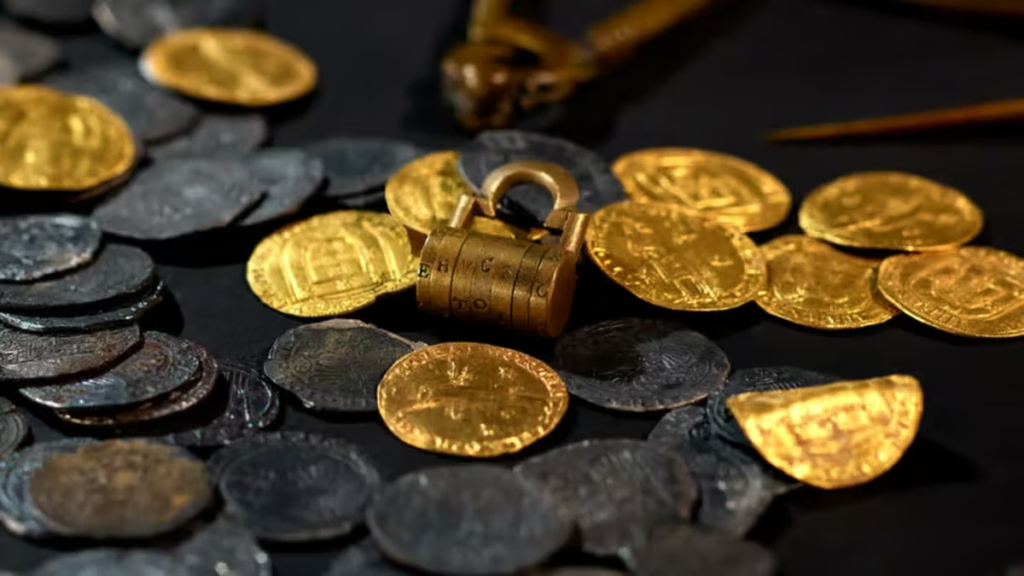
A brass combination lock recovered from a 16th-century shipwreck off the coast of Wales has finally surrendered its secret. After more than 400 years beneath the sand, researchers have discovered the four-letter code that once protected a merchant’s valuables, although what the lock originally secured remains a mystery.
Researchers from Cardiff University and Amgueddfa Cymru – Museum Wales used advanced micro-CT scanning technology to examine the lock’s internal mechanism without damaging the fragile artefact. Their investigation revealed the combination ANCE, bringing an end to a mystery that began with the sinking of the merchant ship Ann Francis in 1583.
A Shipwreck, a Storm and a Lost Fortune
On December 28, 1583, the Ann Francis encountered a violent storm while returning from Spain to England. The vessel drifted off course and wrecked on Margam Beach, near present-day Port Talbot in South Wales.
The ship carried a valuable cargo of gold and silver coins, personal possessions, navigational instruments and other merchandise. Much of this material remained buried beneath the coastal sands for centuries, until storms and changing beach conditions gradually exposed traces of the wreck.
Between 1996 and 2017, metal detectorist Peter Hughes recovered a substantial collection of artefacts from the beach. Among them was a remarkably well-preserved brass lock with four rotating rings, each bearing letters that formed part of an elaborate combination mechanism.
Hughes immediately recognised the quality of its craftsmanship. Remarkably, the lettered rings still moved freely despite spending four centuries in the sand, but the correct sequence remained unknown.
The lock was among hundreds of objects recovered from the wreck. According to Museum Wales, the finds also include approximately 870 gold and silver coins from Spain, Portugal, Germany and the Americas, reflecting the ship’s connections to international trade.
Scientists Look Inside a 400-Year-Old Lock
Rather than forcing the lock open, researchers turned to micro-computed tomography, a technique that uses X-rays to create detailed three-dimensional images of an object’s interior.
Dr David Williams, a research associate at Cardiff University’s School of Engineering, examined the mechanism using equipment normally employed to investigate bones and other biological structures.
“Micro-CT scanning allowed us to look inside the lock without damaging it,” Williams explained.
The resulting images revealed how internal notches corresponded to letters on the rotating rings. By analysing their alignment, Williams identified the combination ANCE, allowing the museum team to open the historic lock successfully.
For Williams, the result marked an unusual application of a familiar scientific technique. He recalled waiting for the museum specialists to test his findings and described the confirmation as an exceptionally satisfying moment.
The discovery also demonstrates how modern imaging techniques can answer archaeological questions that traditional examination cannot resolve without risking damage to valuable objects.
What Did the Lock Protect?
Solving the combination has not answered the more intriguing question: what did its owner consider important enough to lock away?
The artefact was discovered near Spanish silver coins and two coin weights, suggesting that it may once have secured a small chest containing money or other valuables. Researchers have also considered the possibility that the chest held documents or textiles, materials that could have disappeared during the centuries since the wreck.
Alastair Willis, Senior Curator for Numismatics and the Welsh Economy at Amgueddfa Cymru, emphasised the lock’s exceptional condition and its connection to a precisely dated maritime disaster.
The newly discovered code presents another puzzle. As Willis observed, “we are left wondering if the code meant something to its owner.”
The museum’s collection record identifies the object as a type sometimes called a Nuremberg lock. Measuring just 31.8 millimetres in maximum height and weighing 28.5 grams, it belongs to a broader tradition of letter-operated security devices used during the 16th century.
Other surviving examples employed recognisable letter combinations. A comparable lock in the British Museum opens with MARCI, showing that such mechanisms could use sequences resembling names or words. Whether ANCE carried a personal meaning, represented part of a name or simply served as a security code remains uncertain.
A Shipwreck with a Troubled History
The story of the Ann Francis extends beyond its lost cargo. Historical records examined by Museum Wales reveal that its owner, Francis Shaxton, belonged to a merchant family associated with smuggling in Elizabethan England.
Following the disaster, local authorities and landowners disputed ownership of the wreck and its contents. Court records describe accusations of organised looting, while an inventory lists three chests whose locks had already been broken.
These documents provide an important historical setting for the newly deciphered artefact, although researchers cannot establish whether it belonged to any of those particular chests.
The wreck also illustrates the international trading networks of the late 16th century. Its cargo brought together European currencies and silver coins minted in Spanish-controlled territories in the Americas, reflecting the movement of wealth through Atlantic commerce.
Today, the combination lock and other objects recovered from the Ann Francis form part of the collection at the National Waterfront Museum in Swansea. Tides of Treasure is on display at the National Waterfront Museum, Swansea, until September 2027.
