

Pieces of 1,700-year-old Chinese armor have emerged from the ground with something archaeologists would hardly expect from ancient iron: traces of a bright, silvery-white metallic shine.
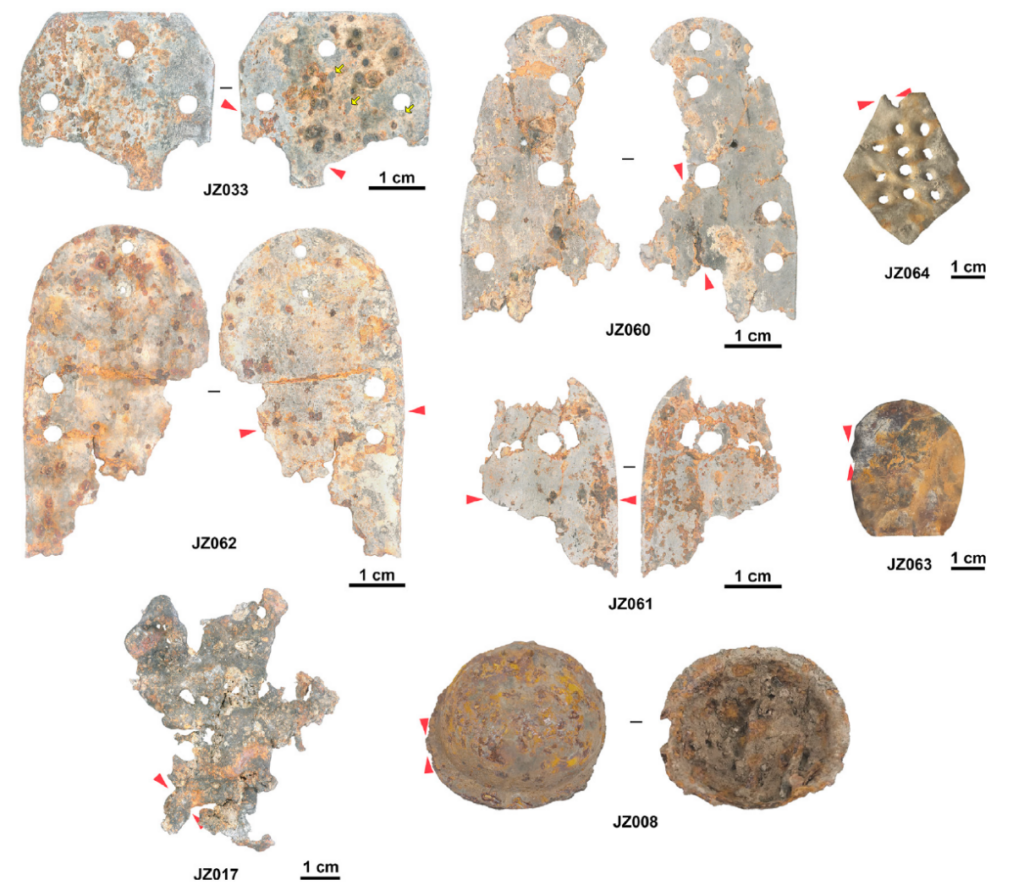
The armor fragments, excavated at the Jizhong site in Shaoxing, Zhejiang Province, date to the Eastern Wu kingdom of China’s Three Kingdoms period, AD 222–280. Laboratory analysis has now revealed why they were preserved so well. Ancient metalworkers coated the finished iron armor with molten tin, creating a protective surface that resisted corrosion while also giving the equipment a striking silver-like appearance.
The discovery provides the earliest known evidence in China for tin-coated iron and, according to the researchers, the earliest currently recognized evidence anywhere for a systematic iron-tinning industry with a reconstructable production sequence.
Armor from an age of competing kingdoms
The armor belonged to one of the most turbulent periods in Chinese history.
After the collapse of the Han dynasty, political power divided among three rival states: Cao Wei in the north, Shu Han in the southwest, and Eastern Wu across much of the lower Yangtze region and southeastern China. Eastern Wu established its independence in AD 222 under Sun Quan, who proclaimed himself emperor in 229. The kingdom survived until its conquest by the Western Jin in 280.
Jizhong lay within this world. Located in the southern part of ancient Shaoxing, the archaeological site formed part of an important urban landscape with a much longer history stretching from the ancient Yue state through the Han and Six Dynasties periods.
Excavations have produced not only tinned armor plates but also unfinished pieces, ironworking debris, tin metal and other remains associated with armor manufacture. This wider context would prove crucial in understanding what craftsmen were doing there.
The secret lies beneath the silver surface
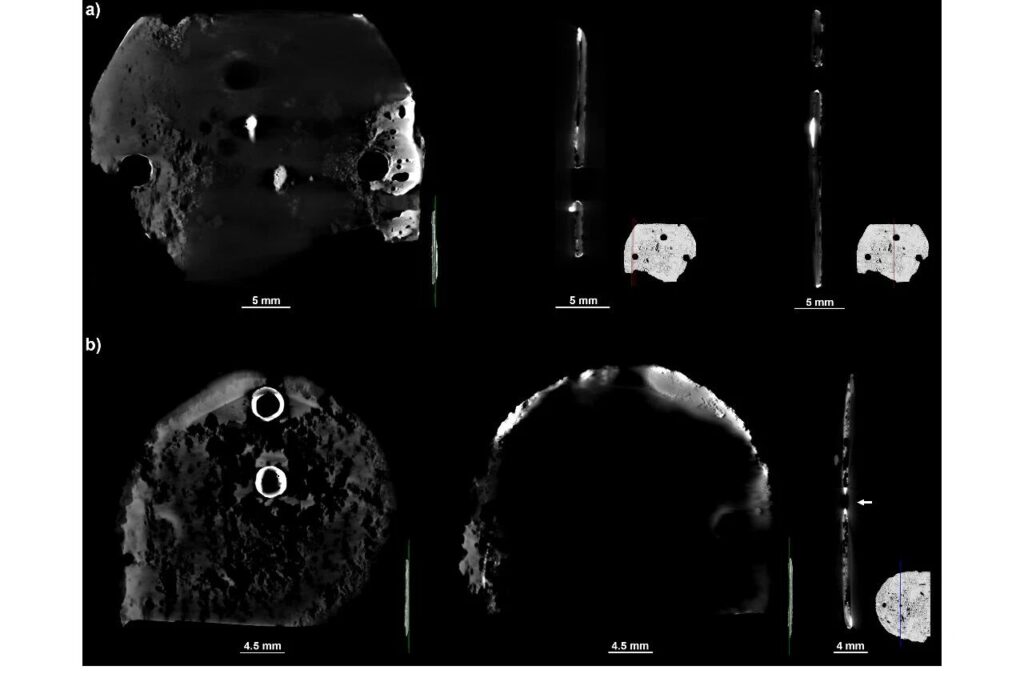
Researchers from the University of Science and Technology Beijing and the Shaoxing Institute of Cultural Relics and Archaeology examined samples using scanning electron microscopy, X-ray diffraction, metallographic microscopy and micro-CT imaging.
They found a high-purity tin layer roughly 110 to 330 micrometers thick covering parts of the iron.
More revealing was a microscopic layer of FeSn₂ formed where the iron met the tin. Researchers also observed places where molten tin had collected around holes and armor edges, sometimes leaving droplet-like flow marks.
Together, those traces point to hot-dip tinning. Craftsmen first completed the iron objects, prepared their surfaces, and then exposed them to molten tin. They were not simply cutting armor plates from metal sheets that had already been coated.
The process created a continuous barrier between the iron and moisture in the surrounding environment. That dramatically reduced corrosion.
Its success can still be seen today. Some of the armor retained a silvery-white metallic luster even after approximately 1,700 years of burial.
There was probably another reason for using tin: appearance. Freshly tinned iron would have looked very different from ordinary dark iron armor. Its reflective silver surface may have given the equipment a more prestigious or visually imposing character. Researchers have even raised the possibility of a connection with the “Mingguang,” or “Bright Light,” armor mentioned in traditions associated with the Three Kingdoms era.
That identification remains speculative, however. The archaeological evidence cannot yet demonstrate that the armor from Jizhong was specifically what historical sources called Mingguang armor.
The idea of tinning iron was older — but Jizhong is different
Jizhong was not the first place in the ancient world where craftsmen discovered that tin could change the surface of another metal.
Tin coatings appeared on Greek and Etruscan bronze objects by around the fifth century BC, where they could provide a silver-like appearance. Archaeological literature also records an iron object from Spain dating to around 450 BC as the earliest known example of tinned iron. Later examples occur across the Roman world and medieval Europe.
Archaeological studies have identified tinning on Roman and Early Medieval metal objects, while medieval craftsmen also used techniques in which molten tin was applied to heated iron or bronze surfaces.
So the Chinese discovery does not show that people at Jizhong invented iron tinning before everyone else. What makes it exceptional is scale and archaeological context.
Earlier evidence for ancient tinned iron is sporadic. At Jizhong, archaeologists have the coated armor itself alongside tin, semi-finished products, and manufacturing remains. Together they allow researchers to reconstruct a deliberate sequence of production rather than identify an isolated coated object.
The study therefore describes Jizhong as the earliest currently recognized evidence for a systematic iron-tinning handicraft industry anywhere in the world.
An older Chinese tradition adapted to iron
The technique may also have had deep local roots. Chinese craftspeople had worked with tin coatings long before the Three Kingdoms period, applying the metal to materials including bronze and pottery. Recent archaeological research has documented several different methods used to create tin-covered surfaces on ancient Chinese vessels.
The Jizhong craftsmen appear to have taken that accumulated knowledge and adapted it to a new problem: protecting iron military equipment.
The location may have helped. Archaeological evidence points to different metallurgical crafts operating within the wider Jizhong complex, including bronze casting and iron production. Such proximity could have allowed skills developed in one workshop tradition to move into another.
What survives is therefore more than a collection of armor fragments. The silver sheen still visible on some pieces records a sophisticated attempt to solve two problems at once: how to keep iron from rusting and how to make armor stand out.
Seventeen centuries later, the solution is still visible on its surface.
University of Science and Technology Beijing (USTB)
Q. Peng, S. Ge, L. Li, Y. Lou, J. Zhang, K. Chen, Iron tinning in 3rd-century China: Evidence from the Jizhong site, Shaoxing, Journal of Cultural Heritage 80 (2026) 219–231. 10.1016/j.culher.2026.05.008
