
Excavation reveals a Byzantine-era artifact with no known parallel anywhere in Christian art history
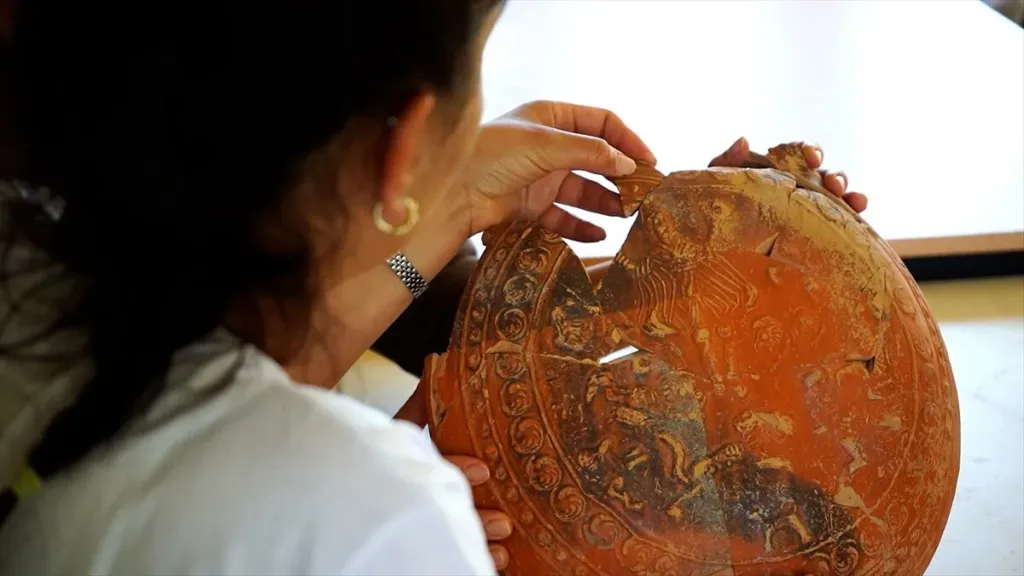
Archaeologists excavating the ancient city of Pisidia Antiokheia, in the Yalvaç district of Isparta, Türkiye, have unearthed an approximately 1,500-year-old liturgical vessel decorated with imagery that, according to the excavation director, has no known parallel in Christian iconography.
Dated to the 6th century AD, the double-handled vessel bears a striking composition drawn from the Book of Daniel: the Prophet Daniel is shown alongside the four beasts and the lion from his visionary dream, all rendered together on a single object: a combination that has never before been documented on any known artifact.
Found in the ruins of a destroyed monastery church
Professor Dr. Mehmet Özhanlı, faculty member at Süleyman Demirel University’s Department of Archaeology and head of the excavation, told Anadolu Agency that the vessel was recovered from a monastery within the ancient city, amid the ruins of a church destroyed during Arab raids in 713 AD.
According to the Book of Daniel in the Old Testament, Daniel was among the Jewish exiles living under Babylonian rule. The biblical account tells of his survival after being cast into a lions’ den and, in a separate vision, describes four beasts rising from the sea.
The imagery on the newly discovered vessel draws on this latter vision, one of the most influential passages associated with Daniel in later Jewish and Christian interpretation.
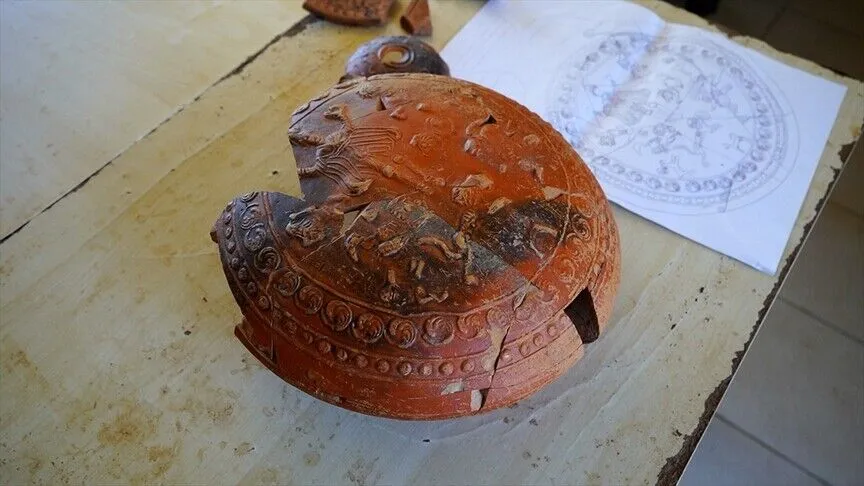
Unique 1500 Year Old Liturgical Vessel Unearthed at Pisidia Antiokheia Heralding the Coming of Christ. Credit: AA
A composition loaded with Christian iconographic meaning
According to Özhanlı, Jewish tradition identifies the four beasts with the Babylonian, Median, Persian, and Hellenistic kingdoms, while Christian interpretation reads the fourth beast in particular as a symbol of the Roman Empire, with the “Son of Man” descending from heaven representing the coming of the Messiah. For this reason, Daniel’s vision has traditionally been interpreted within Christianity as one of the texts foretelling the arrival of Christ.
Özhanlı emphasized that it is precisely this full narrative — depicted in its entirety, with every element present — that makes the vessel so significant for the study of Christian iconography.
What sets the vessel apart, according to Özhanlı, is not any single motif but the completeness of the scene: individual elements of Daniel’s vision — the prophet himself, the lion, the four beasts — appear separately on other Byzantine-era objects, but no known piece brings every figure together within one unified composition.
Liturgical vessels of this kind were typically used in the celebration of the Eucharist or in other rites performed within the church, meaning their imagery was seen and understood by the congregation as part of active worship. A vessel carrying such a doctrinally rich scene — one read in Christian tradition as foretelling the coming of Christ — would have carried real theological weight for the community that used it, making the object far more than a decorative or functional item.
As a liturgical object recovered from a monastery complex, the vessel also provides evidence for how biblical imagery could be incorporated into objects used within an explicitly religious setting.
“No other example is known to date”
The two-handled liturgical vessel carries representations of Daniel and the four beasts on both of its faces, while additional motifs including a lion, a deer and a dog also decorate the object, Özhanlı said.
He described the arrangement as exceptional within the currently known archaeological and art-historical record.
“The vessel was produced in the form of a double-handled liturgical container. No other example is known to date that brings together all the creatures from Daniel’s vision within a single composition rendered in Christian iconography. In this respect, the piece is unique in the world,” Özhanlı told Anadolu Agency.
The assessment currently rests on the comparisons made by the excavation team; a detailed academic publication of the newly discovered vessel has not yet been cited in reports about the find.
Evidence of Antiokheia’s own ceramic production
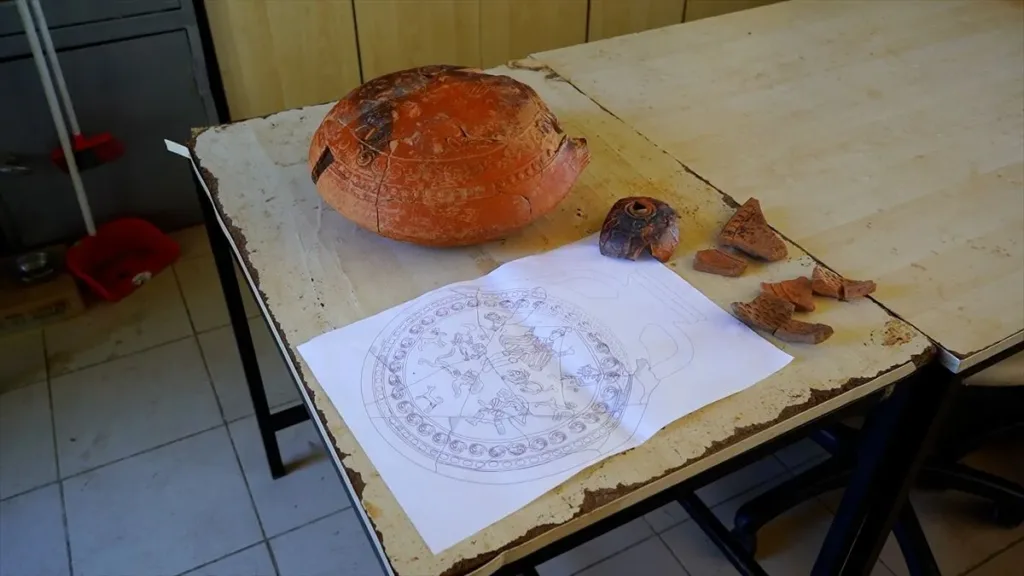
The excavation also yielded numerous ceramic molds, which Özhanlı said point to a developed ceramic production industry within the ancient city.
The excavation team believes the newly discovered liturgical vessel may also have been manufactured locally at Antiokheia.
“These finds document that Antiokheia possessed a ceramic production center advanced enough to meet its own needs,” Özhanlı said.
The broader archaeological project adds important context to the discovery. Excavations at Pisidia Antiokheia have been directed by Özhanlı since 2008, while the site was included in Türkiye’s Ministry of Culture and Tourism’s “Heritage for the Future” project in 2024. According to Süleyman Demirel University, only about 5 percent of the ancient city’s roughly 67-hectare central settlement area has so far been excavated.
That limited excavation footprint suggests that much of Antiokheia’s archaeological record remains unexplored.
A major center of early Christian history
Pisidia Antiokheia occupies an important place in the history of early Christianity. According to the Acts of the Apostles, Paul and Barnabas visited the city during their first missionary journey in the 1st century AD and preached there.
In the centuries that followed, Antiokheia developed into an important Christian center. After the Council of Nicaea in AD 325, the city also became the metropolitan seat of the Pisidia region.
The discovery of the 6th-century vessel therefore adds a new piece of material evidence to a city already closely associated with the development.
AA
