
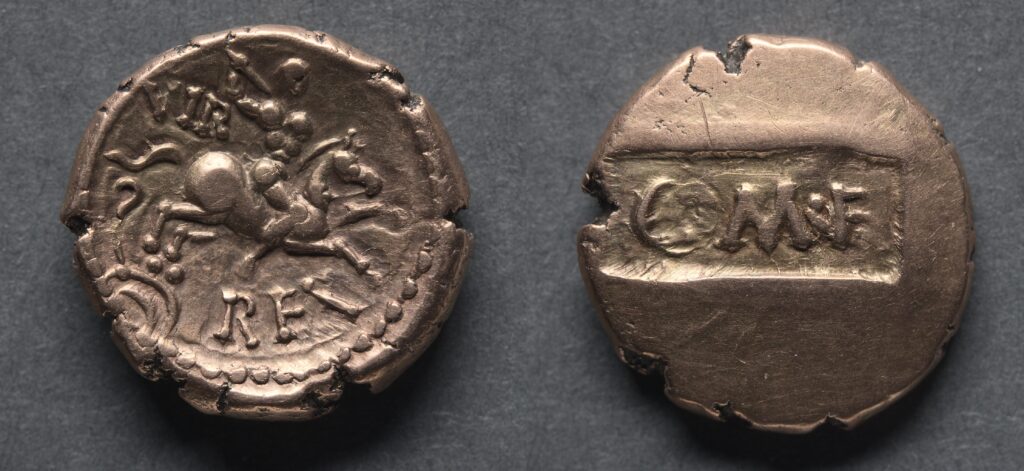
The 2,000-year-old Verica coins from ancient Britain have reopened a debate about a ruler linked to Rome’s invasion in AD 43. Archaeologist Miles Russell suggests that Verica, traditionally identified as a king, may have been a woman. His interpretation draws on the figures depicted on the coins and the meaning of their Latin inscriptions.
Russell, from Bournemouth University, published his assessment in the journal Current Archaeology. The researcher did not discover new coins; instead, he re-examined known archaeological materials to question the traditional narrative regarding a significant figure in British history.
Verica’s Role in the Roman Invasion of Britain
In the first half of the 1st century AD, Verica ruled the Atrebates community in southern Britain. The ruler, who maintained close political ties with Rome, lost power as a result of regional power struggles and, according to traditional historical interpretation, sought help from Emperor Claudius.
The Roman historian Cassius Dio, in his work Roman History, describes an exiled Briton named Bericus who convinced Claudius to send troops to the island. Historians generally accept that Bericus and Verica were the same person. This identification makes Verica one of the key figures in the political background of the Roman invasion in 43 AD.
However, the decision for Rome’s invasion cannot be explained solely by the request of an exiled ruler. The Empire’s expansionist goals and the political conditions within Britain also played a role in the expedition.
Do the Figures on Verica Coins Depict a Female Ruler?
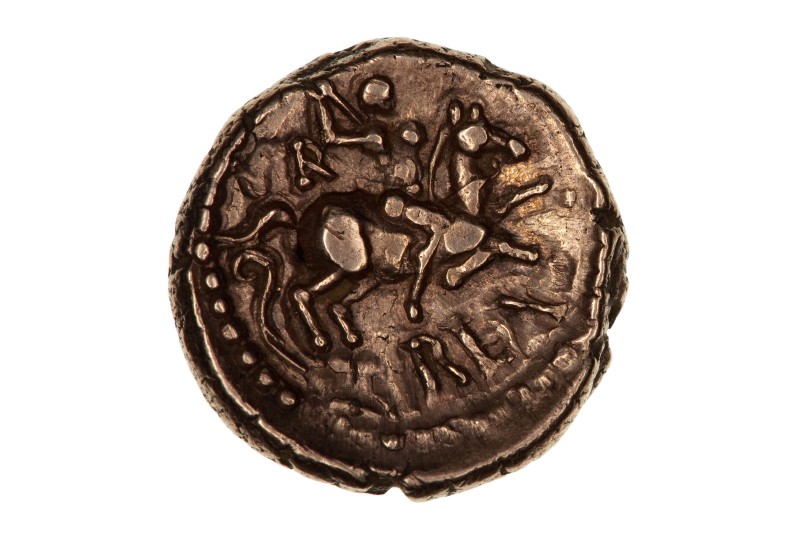
One of the pieces of evidence Russell highlights is the depiction of mounted warriors on coins minted in Verica’s name. The researcher believes that the physical characteristics of some figures could be interpreted as female. In his view, these details provide a justification for re-evaluating the established assumption regarding Verica’s gender.
However, human figures on Iron Age coins were not always portraits of the rulers who minted them. Depictions representing political authority, military power, or mythological characters were also used. Therefore, even if Russell’s interpretation is correct, the presence of a female figure on the coins does not, on its own, prove that Verica was a woman.
The second important piece of evidence in the debate is the Latin inscriptions on the coins.
Researchers have traditionally explained the abbreviation COM F, seen in some examples, as Commios filius, meaning “son of Commios.” Russell argues that the same letters could also mean Commios filia, or “daughter of Commios.” The abbreviation does not definitively reveal the gender distinction between the two words.
The title REX appearing on Verica’s coins is another part of the debate. While the Latin word typically means “king,” Russell suggests it may have been used for female allied rulers as well, calling for a reassessment of the traditional interpretation.
Thus, the debate extends beyond the appearance of the figures on the coins to the language Rome used to define British rulers.
Why Do Experts Object to Russell’s Interpretation?
Russell’s claim has caused disagreement among experts working on ancient coins and Latin inscriptions. Roger Tomlin from Oxford University states that clear comparative evidence is needed to show that the title rex was used for female rulers.
Coin expert Daphne Nash Briggs points out that some of Verica’s coins feature figures that could be interpreted as male. This objection demonstrates how problematic it can be to directly link coin depictions to a ruler’s gender.
The interpretation of ancient written sources also requires equal caution. Cassius Dio was a historian who lived approximately 160 years after the Roman invasion and described Bericus as a man. However, Dio’s text does not directly prove that Bericus was the same person as Verica.
Consequently, the debate rests on both the meaning of archaeological depictions and the reliability of the information provided by ancient historians.
The Position of Women in Iron Age Britain
Russell’s proposal is linked to research on the status of women in pre-Roman British societies. An ancient DNA study published in the journal Nature in 2025 indicated that some Iron Age communities in southern Britain had female-centered kinship and settlement patterns.
Research contributed to by Russell revealed that in certain communities, women remained in the same settlement across generations, while men joined other communities through marriage. However, these findings do not necessarily mean that women held political power, nor do they provide direct evidence regarding Verica’s gender.
The existence of female rulers such as Boudica and Cartimandua in British history is already known. Russell’s new interpretation brings up the possibility that Verica could be among these names.
Ultimately, the 2,000-year-old Verica coins have not changed; what has changed is how researchers interpret their figures and inscriptions. It has not yet been proven that Verica was a woman. However, the debate shows how the re-examination of archaeological evidence can lead us to question our assumptions about the political relationships preceding Rome’s invasion of Britain.
Cassidy, L.M., Russell, M., Smith, M. et al. Continental influx and pervasive matrilocality in Iron Age Britain. Nature 637, 1136–1142 (2025). https://doi.org/10.1038/s41586-024-08409-6
