

Archaeologists at the ancient city of Kibyra in southwestern Türkiye have uncovered the remains of monumental marble statues depicting Roman Emperor Hadrian and his wife, Empress Sabina, revealing what appears to have been an imposing display of the imperial household at one of the city’s main entrances.
Fragments recovered during excavations allowed the team to reconstruct Hadrian’s statue to a height of about 2.14 meters (7 feet). Substantial sections of Sabina’s statue have also come to light, alongside pieces belonging to other large marble figures that once stood above Kibyra’s Monumental City Entrance Gate.
The sculptures date to around AD 130, placing them within Hadrian’s reign from AD 117 to 138. Archaeologists believe the group may have been commissioned in connection with the emperor’s extensive travels through Anatolia, although no evidence has yet shown that Hadrian himself visited Kibyra.
The excavations are led by Burdur Mehmet Akif Ersoy University as part of Türkiye’s Legacy to the Future Project.
A Roman imperial display shattered by an earthquake
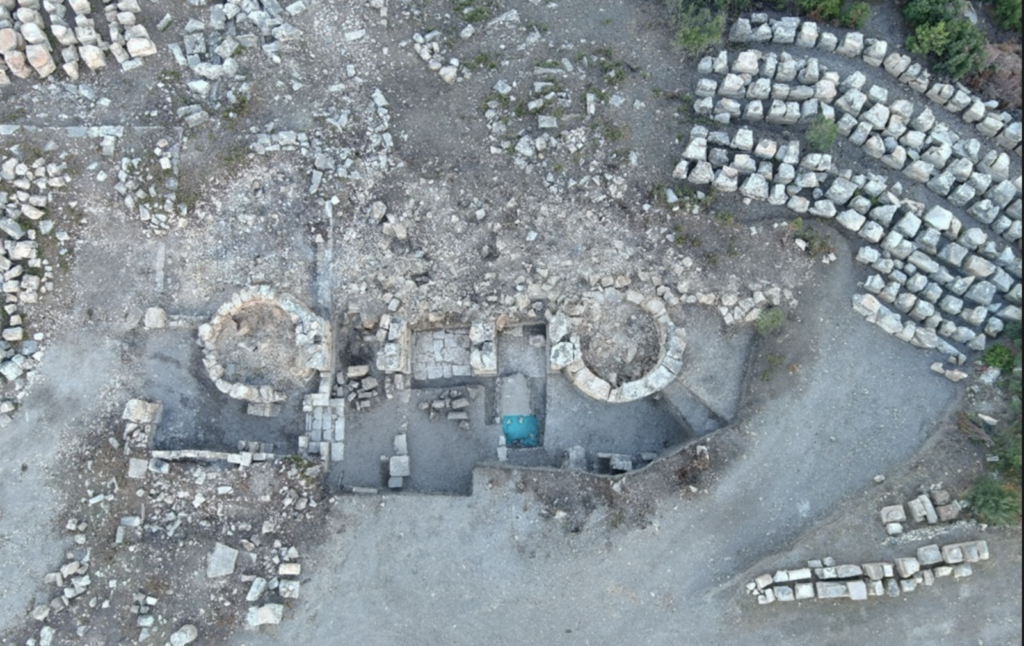
Recent work at Kibyra has focused on the Monumental City Entrance Gate, where the road approaching from the necropolis entered the city.
Excavation director Prof. Dr. Şükrü Özüdoğru said archaeologists identified fragments belonging to four monumental marble statues that are thought to have stood on the upper section of the gateway.
The display probably survived for centuries before disaster struck. The excavation team believes the statues fell from the monument during a major earthquake in AD 417 and shattered on impact.
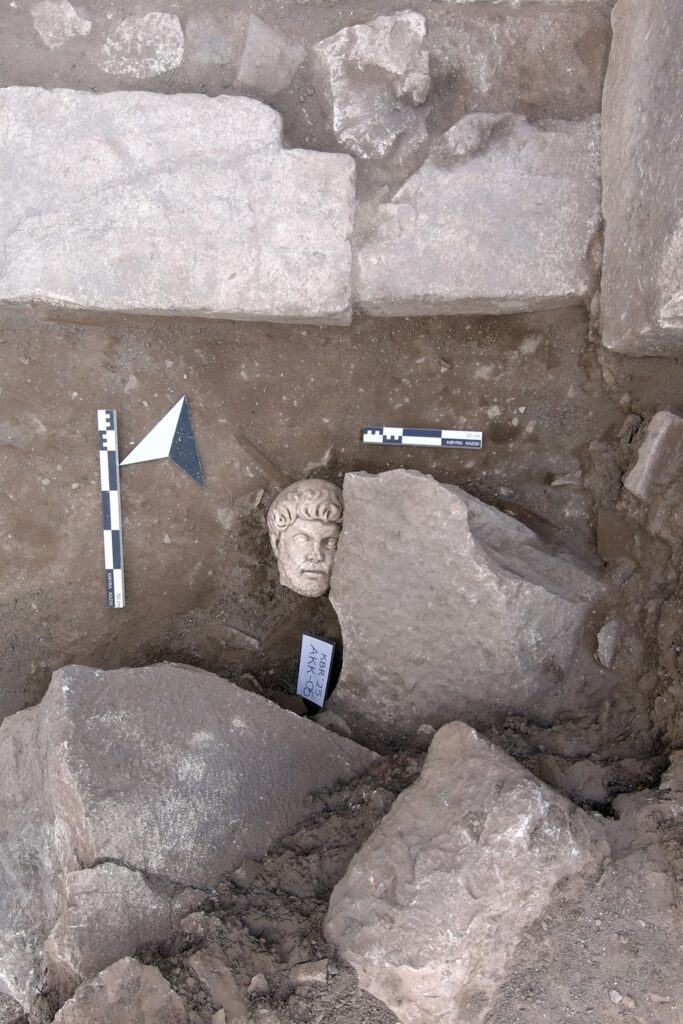
Across successive stages of excavation, archaeologists recovered around 20 sculptural fragments, including arms, legs and feet. A particularly important discovery was a well-preserved portrait head of Hadrian.
Researchers established that the portrait belonged to an armored torso found earlier. After the pieces were matched and conserved, the team reconstructed much of the statue, restoring the emperor to a standing height of approximately 2.14 meters.
The 2026 conservation work was carried out by the excavation restoration team under Prof. Dr. Ünal Demirer of Mehmet Akif Ersoy University.
Rare marble statues of Roman Emperor Hadrian and Empress Sabina have been discovered at ancient Kibyra in Türkiye, including a 2.14-meter imperial figure. Credit: Council of Higher Education (YÖK), Türkiye
Hadrian appears in military dress
The statue portrays Hadrian as a military ruler rather than in civilian or divine form.
Its cuirass carries prominent lion and eagle reliefs, while researchers identified high-quality marble associated with Afyon-Döğer and İscehisar. The portrait itself provided the decisive evidence for identifying the figure as Hadrian, according to Özüdoğru.
The discovery is particularly notable because substantially complete statues of Hadrian are not common in Anatolia.
The emperor left an enormous architectural and political imprint across the Roman world, but surviving imperial portraits often reach archaeologists as isolated heads, torsos or fragments. At Kibyra, enough of the original figure survived to allow the statue’s overall appearance to be recovered.
Sabina makes the discovery more significant
The presence of Empress Sabina adds another dimension to the find.
Vibia Sabina came from the highest levels of Rome’s imperial aristocracy. She was a grand-niece of Emperor Trajan and married Hadrian in AD 100, years before he became emperor. By AD 128 she held the title Augusta, placing her formally at the center of imperial representation. Her portrait also appeared widely on Roman coinage.
At Kibyra, archaeologists have recovered important portions of her marble statue, although it has not yet been reconstructed as completely as Hadrian’s.
Finding representations of the emperor and empress within the same monumental setting is particularly relevant to the date proposed for the sculptures.
Sabina did accompany Hadrian during at least part of his travels through the eastern Roman Empire, and inscriptions show that cities across Asia Minor honored her during his reign. Archaeological and epigraphic evidence records dedications to Sabina, sometimes alongside Hadrian, at places including Patara, Tlos, Rhodiapolis, Hierapolis and other cities in Anatolia.
This wider pattern makes the Kibyra sculptures especially interesting. They may have formed part of a coordinated display celebrating not simply Hadrian as emperor, but the imperial household represented by Hadrian and Sabina together.
It does not, however, prove that the couple visited Kibyra.
Were the statues prepared for an imperial visit?
Özüdoğru dates the sculptures to around AD 130 and suggests that Kibyra may have commissioned them in anticipation of Hadrian’s travels through Anatolia.
Hadrian was unusual among Roman emperors for the extraordinary amount of time he spent travelling through the provinces. Cities along his routes erected statues, inscriptions and monuments to advertise their relationship with the emperor and demonstrate civic loyalty.
A similar practice involving both Hadrian and Sabina is documented elsewhere in Asia Minor. Research published in the Journal of Roman Archaeology, for example, has examined paired or related dedications to the imperial couple and their possible connection with Hadrian’s eastern journeys.
No inscription or other evidence currently confirms that Hadrian entered Kibyra. The statues could instead represent preparations for a possible visit, commemorate his movements through the broader region, or simply express the city’s relationship with imperial power.
Continued excavation may help distinguish between those possibilities.
A prosperous city at the crossroads of Anatolia
The scale of the sculptural display fits Kibyra’s importance during the Roman period.
The city stood near the meeting point of several ancient cultural regions, including Lycia, Caria, Phrygia and Pisidia. Ancient accounts describe its inhabitants as multilingual and particularly skilled in horse breeding, leatherworking and ironworking. Kibyra also headed a regional federation with Boubon, Balboura and Oinoanda before Roman administrative changes reshaped the area.
Its surviving architecture points to a prosperous urban center.
Among Kibyra’s most impressive monuments are its stadium, theater, agora, Roman baths and large odeon. The odeon is especially famous for its Medusa floor, created from precisely cut pieces of colored marble using the opus sectile technique.
The monumental gateway now being excavated formed part of this urban landscape. Round towers stood on either side of the entrance, while three arched passages controlled movement from the necropolis road into the city.
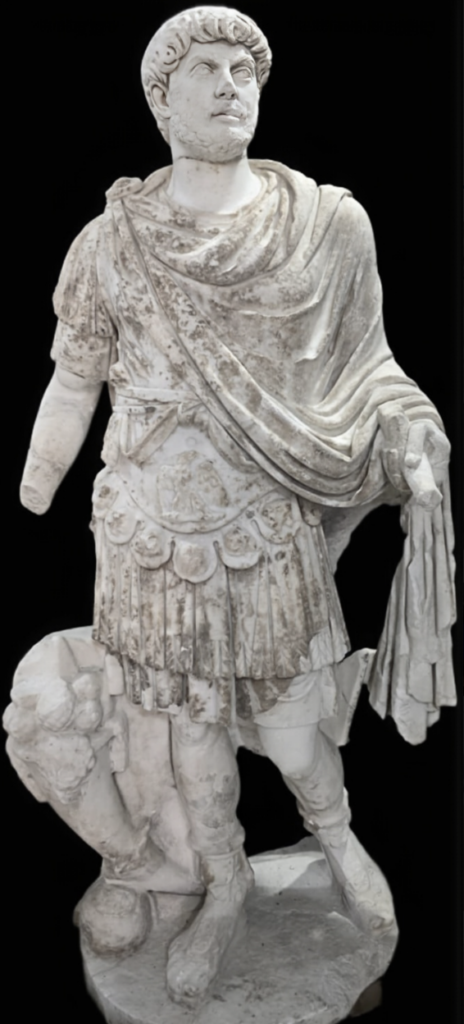
The sculptures date to around AD 130, placing them within Hadrian’s reign from AD 117 to 138. Credit: Council of Higher Education (YÖK), Türkiye
Archaeologists moved 2,500 blocks from the collapsed gateway
Excavations at the entrance began in 2025, when archaeologists encountered much of the structure as a massive concentration of collapsed stone.
The team has since moved, documented, and classified approximately 2,500 architectural blocks. Excavation of the entire monument remains incomplete, and another season of fieldwork is expected before a full restoration project can begin.
The same area may also hold missing pieces of the imperial statues.
Along with Hadrian and Sabina, archaeologists have recovered remains connected with another armored imperial figure, a female statue, and a male portrait head. Further excavation could establish how these sculptures originally related to one another and how the complete group was arranged above the gateway.
Once conservation and reconstruction are finished, the statues are expected to enter the Burdur Museum collection for public display.
For Kibyra, the discovery does more than restore the image of a Roman emperor. The surviving figures of Hadrian and Sabina offer a rare opportunity to reconstruct how an Anatolian city presented the imperial household in one of its most visible public spaces nearly 1,900 years ago.
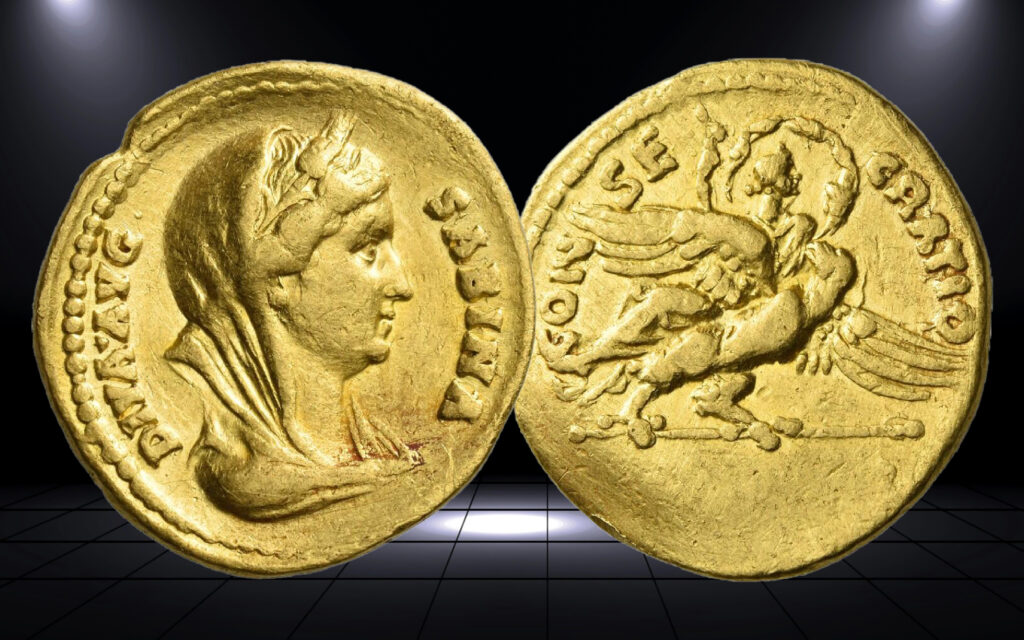
Gold aureus of Empress Sabina. The obverse bears her portrait and the legend “DIVA AVG SABINA,” while the reverse shows the deified empress ascending to the heavens on Jupiter’s eagle, with the legend “CONSECRATIO.” Credit: Public Domain
