
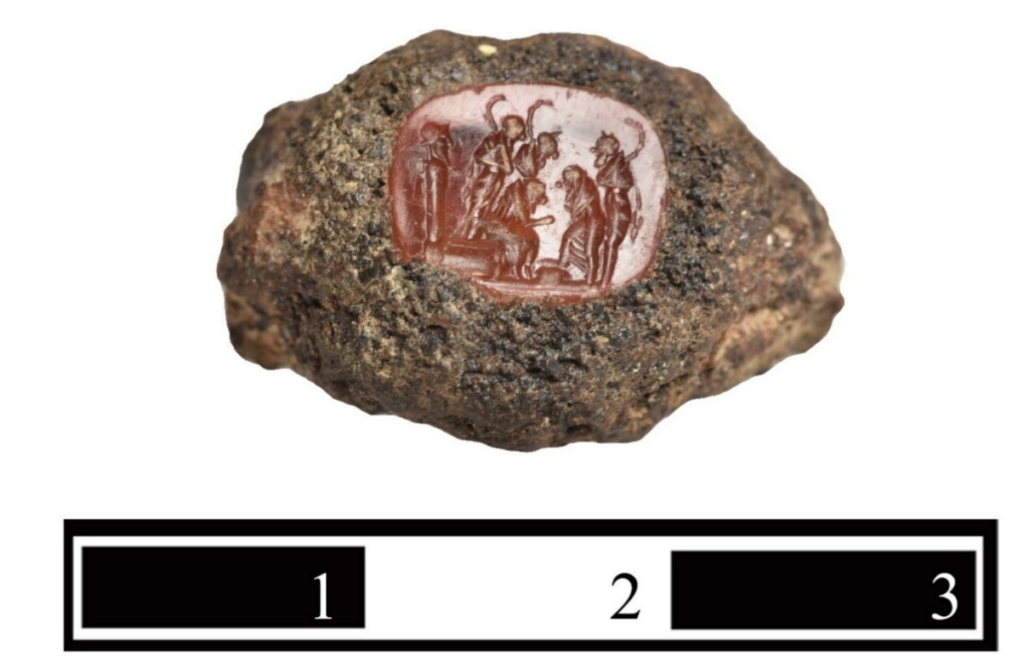
A single red gemstone measuring only 13 × 11 mm contains an astonishingly detailed theatrical scene from antiquity. About 2,100 years ago, a stone master managed to fit satyrs, a poet, and a statue representing Dionysus onto this tiny surface. Researchers have now identified a small female figure in the background that could represent Thalia, the Muse of comedy. The most striking feature of the piece is that, unlike comparable examples, the actors are shown not with theatrical masks but as direct mythological characters.
In a study published in Cedrus on 29 October 2026, Melih Arslan and Ahmet Emirhan Bulut examined the carnelian stone set in an iron ring from the Gaye Çarmıklı Collection of the Ankara Ethnography Museum. The authors dated the object to the first half of the 1st century BC and concluded that it depicts a scene from a satyr play of ancient Greek theatre.
Five Figures on a One‑Centimetre Stone
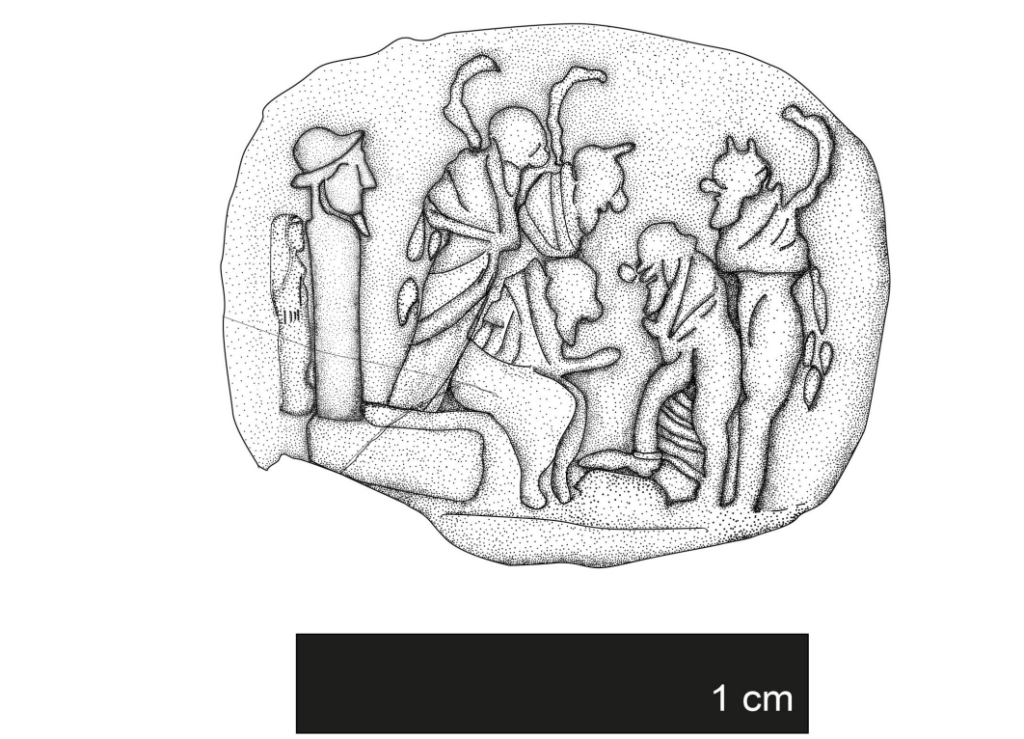
The reddish‑caramel carnelian measures 13 mm in length and only 11 mm in width. The master placed five main characters, a herm representing Dionysus, and a small female figure in the background within this narrow area. The different postures, garments, and objects they hold increase the composition’s complexity.
The artisan used the intaglio technique, carving the figures directly into the stone surface. The researchers identified traces of round‑tipped drills in the body outlines and varying thicknesses of rotary abrasives in the clothing folds. Small perforations were used to form the noses, offering another technical detail on how such fine work was achieved at this scale.
At the centre of the scene sits a long‑garmented, seated male figure. Because he looks at a two‑leaf tablet, he may represent a poet or playwright. Opposite him stands a figure with one foot placed on the stone, possibly the leader of the satyr chorus.
The remaining figures are distinguished by horns, tails, and curved staffs on their shoulders. These attributes link them to the half‑human, half‑animal satyrs that surrounded the god of wine and theatre, Dionysus, in Greek mythology.
The Small Female Figure Behind Dionysus
On the left side of the composition there is a bearded herm associated with Dionysus. In antiquity, herms were statues that typically combined a human head or bust with a square pillar. Given the close relationship between the Dionysian cult and theatre, such a figure makes sense in the scene.
Arslan and Bulut point to another detail: the master added a small female figure behind the herm, with hair flowing down her back and arms extended to the sides. The researchers suggest this figure could be Thalia, the Muse of comedy in Greek mythology.
Thalia was one of the nine Muses, who were regarded in antiquity as sources of inspiration for poetry, music, history, and various arts. She was especially associated with comedy and light‑hearted poetry, making her presence in a theatrical scene an appropriate iconographic choice.
The identity of the woman, however, is not yet definitive. Scholars evaluate this possibility by examining the composition’s theatrical theme and comparing it with similar examples.
A Rehearsal or the Play Itself?
Satyr plays combined tragic subjects with humorous elements in ancient Greek theatre. Typically featuring a chorus of satyrs, they were an important part of the Athenian festival programmes from the 5th century BC onward and later survived as independent performances. The only complete work that reaches us today is Euripides’ Kyklops.
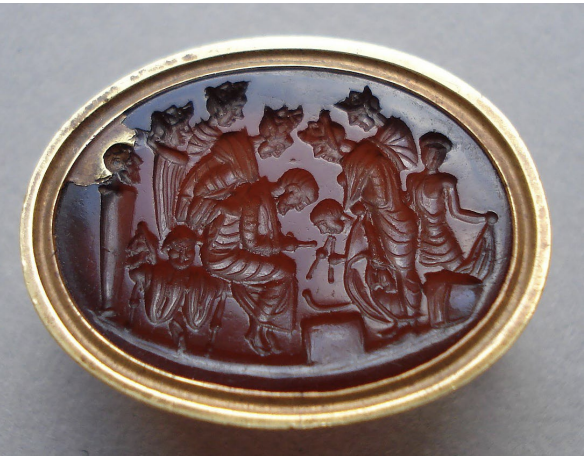
The researchers compared the Çarmıklı ring stone with similar pieces in the British Museum and the Rijksmuseum van Oudheden in the Netherlands. Those objects usually depict a rehearsal: actors lift their masks onto their heads rather than wearing them, and the central poet examines the text he holds.
The Çarmıklı example diverges from this tradition. The master rendered the characters as satyrs directly, without the usual masks. Arslan and Bulut argue that this detail may indicate the scene represents the play itself—or its narrative—rather than a rehearsal.
The scarcity of comparable works makes this difference especially significant. According to the researchers, the direct depiction of satyrs on the Çarmıklı stone offers a previously undocumented iconographic approach among known theatrical reliefs.
Did the Ring Belong to a Theatre Artist?
It is unknown who owned the ring. Most of the iron shank has been lost, leaving only a heavily corroded fragment. Although the carnelian stone shows two fine cracks and some wear, all figures remain legible.
Because the piece did not arise from a controlled archaeological excavation, its provenance is difficult to trace. Museum records suggest the ring may have originated near Sardis, but the find‑spot and archaeological context are unknown, preventing confirmation.
Arslan and Bulut consider that the ring could have belonged to a theatre professional or someone with a strong interest in the performing arts. Such jewelry might reflect the owner’s artistic inclinations or occupational identity, though the carvings do not allow a definitive identification.
The researchers dated the object through its form, technical attributes, and comparison with similar artefacts. Small drill marks, the treatment of clothing folds, and the material of the stone all support a dating to the early half of the 1st century BC.
The Çarmıklı ring stone is a rare example of how ancient theatrical visual culture could be expressed on personal adornments.
Arslan, M., & Bulut, A. E. (2026). A Rare Ring Stone Depicting a Satyr Play. Cedrus, 14, 391-404. https://doi.org/10.5281/zenodo.22642626
