
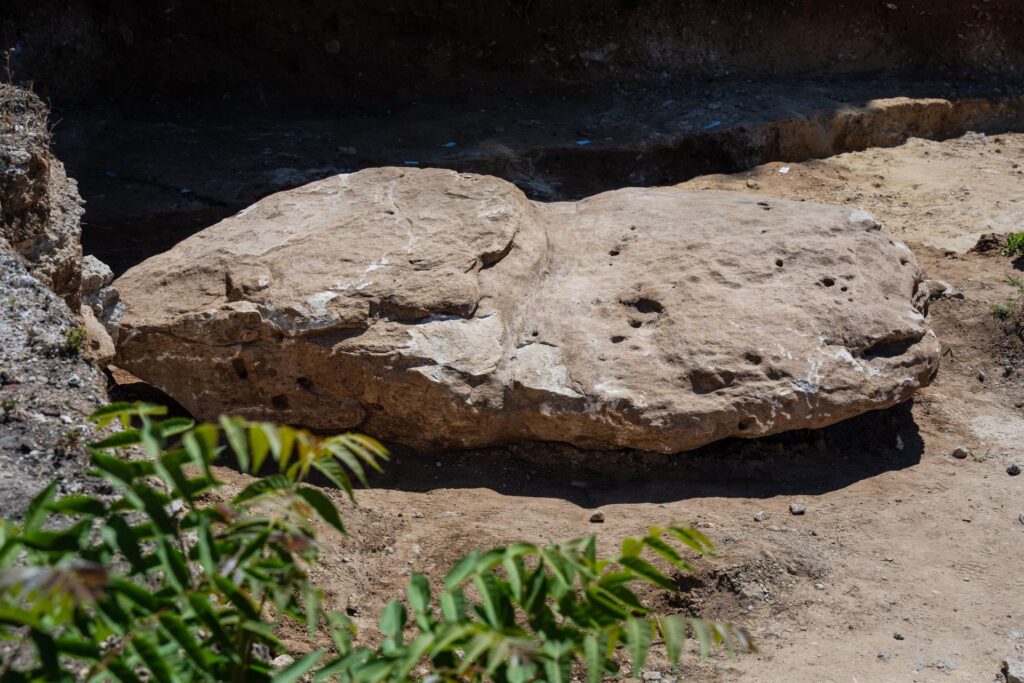
A nearly 10-ton stone carved with human features, a skeleton buried in a seated position, and a mysterious monument containing no grave are among the discoveries at a 6,500-year-old Neolithic cemetery near Paris. Archaeologists also found evidence that its builders used a primitive form of cement, revealing an unexpected level of complexity in the construction of this prehistoric burial ground.
The discoveries come from Champigny-sur-Marne, where archaeologists from France’s National Institute for Preventive Archaeological Research (Inrap) investigated a site threatened by planned property development. Dating to between 4750 and 4300 BCE, the cemetery contains 11 graves and 30 megalithic stone blocks. Such an extensive funerary complex is unusual in the Île-de-France region, where burials from this period are more commonly found in isolation.
A Nearly 10-Ton Stone with Human Features
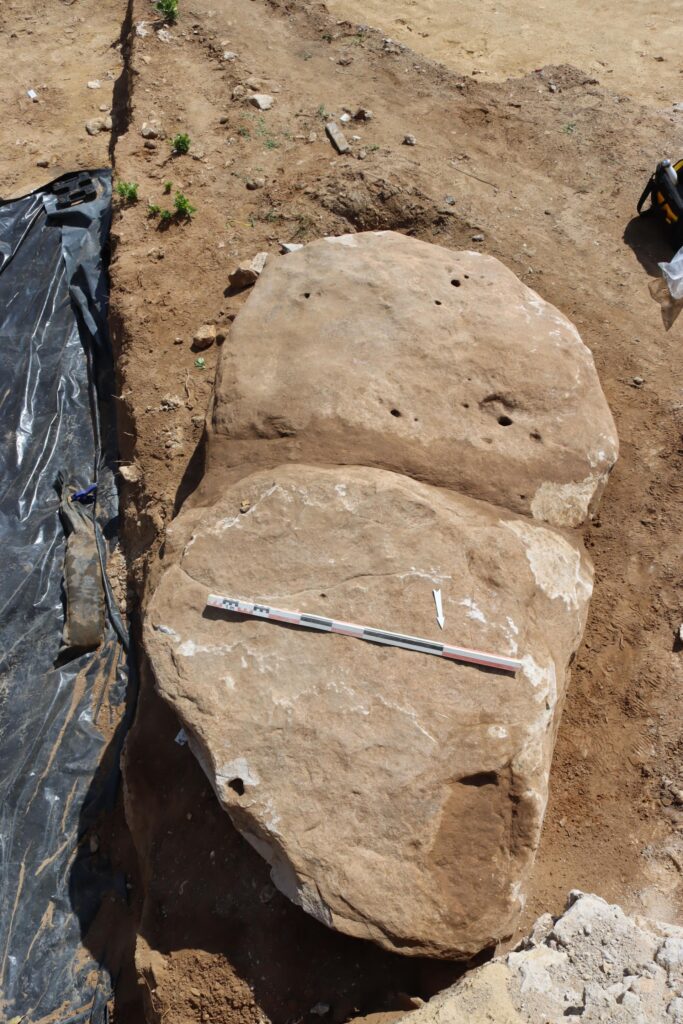
The most striking monument is a massive statue-menhir, an anthropomorphic standing stone measuring 3.04 metres long, 1.68 metres wide, and 0.74 metres thick. Its estimated weight is 9.7 tonnes. The stone bears an engraved belt and a series of cupules, small circular depressions deliberately cut into its surface. Archaeologists also identified possible traces of black and white pigments, suggesting that the monument may once have displayed painted details.
Researchers discovered the statue-menhir lying flat inside a clearly identifiable setting pit. Inrap interprets its position as a snapshot of abandonment following the monument’s collapse, although what caused it to fall remains unknown. Two smaller sandstone blocks were also found nearby: one resembles a small stele, while the other may have served as a marker for the burial area.
Eleven Graves, Including a Seated Skeleton
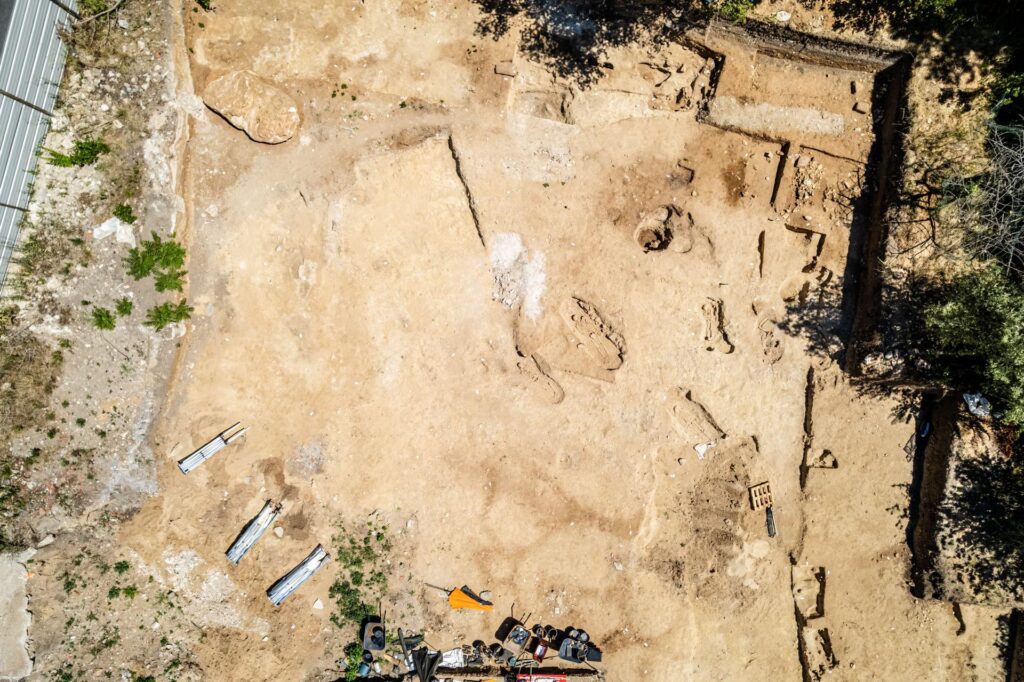
The cemetery occupies the top of a terrace formed by sediments deposited by the Marne River. Eight graves were grouped within approximately 60 square metres south of a mound-like structure, while three others lay farther north, around the statue-menhir and two additional megalithic blocks. Modern construction had disturbed parts of the northern area, complicating the interpretation of the original arrangement.
During the preliminary investigation, archaeologists discovered two eroded graves containing women buried on their backs and aligned east to west. Excavation subsequently revealed nine more burials, seven of which were extended burials. Most individuals occupied large pits, and postholes near their skulls suggest that wooden markers may once have identified the graves.
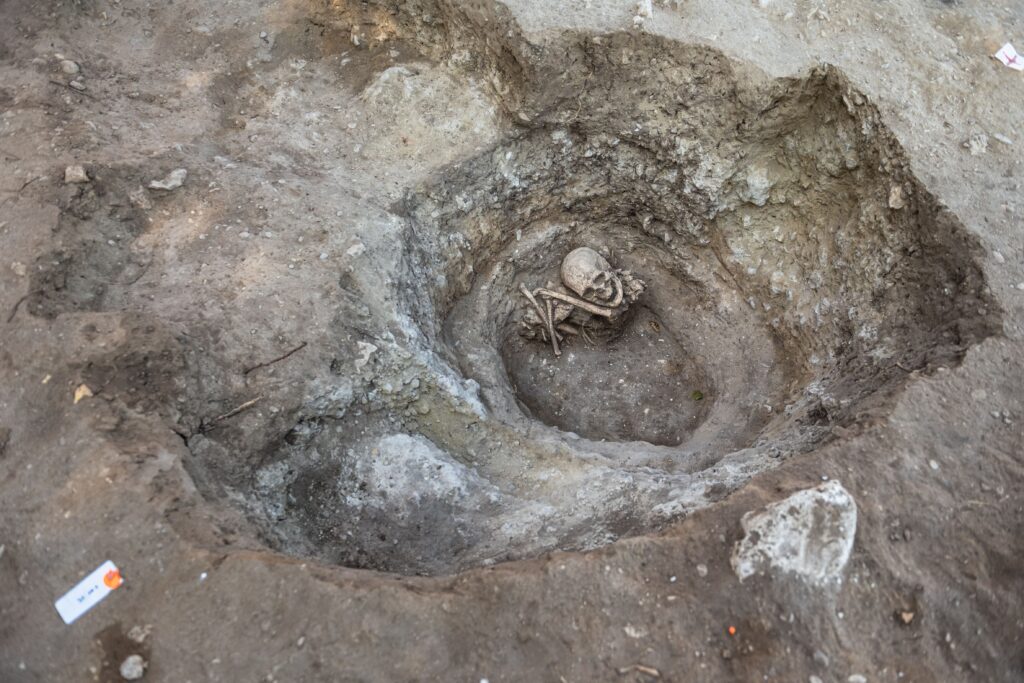
Objects associated with the dead included stone blades, projectile points, a sandstone axe made from local material, and other stone implements. Two graves also contained worked bone objects. One burial was particularly unusual: inside a narrow circular pit resembling a well, archaeologists found an adult in a seated position, with the lower legs and feet completely encased in calcite. Inrap has not established why this individual was buried differently from the others.
A Mysterious Monument Without a Grave
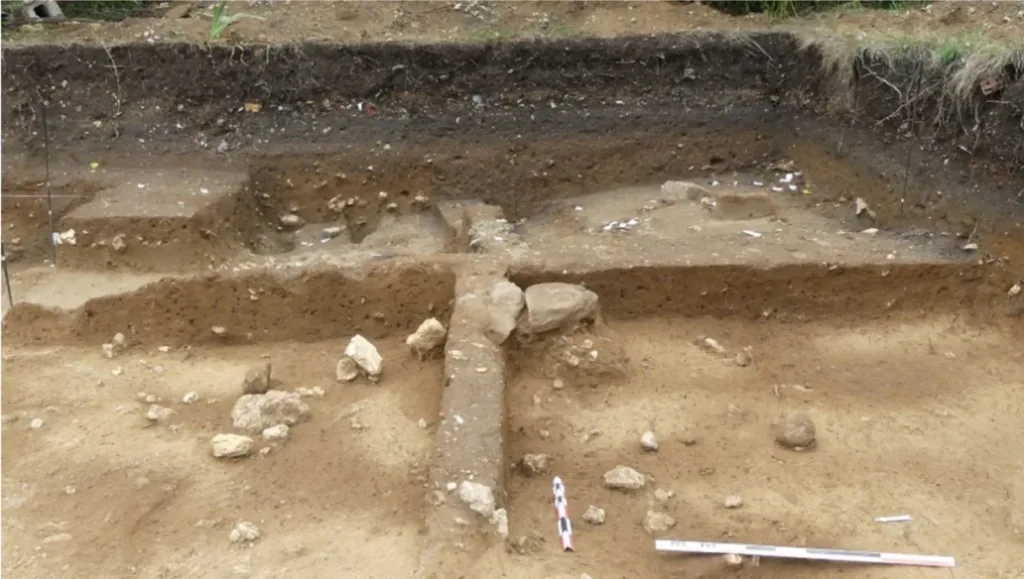
In the southeastern part of the excavation, archaeologists identified a dome-like accumulation of brown silt covering approximately 30 square metres. A small stele, broken into two pieces, stood above a complex arrangement of pits, palisaded ditches, stone blocks, and wooden posts.
The structure resembled a burial mound, but unlike a tumulus, it contained no grave beneath it. Its purpose remains uncertain, and researchers have raised the possibility that it served as a landmark in the landscape. Its position near the graves suggests that it formed part of the wider funerary complex, although its precise function has yet to be determined.
Neolithic Builders Used a Primitive Form of Cement
The excavation also revealed an unexpected aspect of Neolithic construction. Archaeologists identified a hardened building material made by combining locally available carbonate-rich sandy and silty sediments with gravel and water. Once dry, the mixture functioned as a primitive cement, helping to construct and stabilize elements of the funerary complex.
Researchers found evidence of this prepared material along grave edges, in pits supporting the standing stones and other megalithic blocks, and within the dome-like structure. The builders combined it with less-processed materials, including beige sand and brown silt, as well as wooden elements. This mixture of prepared and natural materials suggests that the cemetery’s construction required deliberate choices about how different components would work together.
Carbonate-rich building materials have previously been identified at Neolithic and later prehistoric sites in Western Europe, particularly in Mediterranean settlements and domestic structures. Their discovery at Champigny-sur-Marne shows that similar techniques were also used in the construction of burial monuments in the Paris region, extending the evidence for these practices beyond domestic architecture.
DNA Analysis May Reveal Who Was Buried Here
The archaeological investigation has documented an unusual combination of graves, monumental stones, wooden structures, and prepared building materials. Yet important questions remain about the people who created and used this burial ground. Planned ancient DNA studies and isotope analyses may help establish their ages, biological sexes, health, diets, geographical origins, and movements during their lives.
For a region where Middle Neolithic funerary sites remain relatively rare, Champigny-sur-Marne offers an important opportunity to examine the relationship between burial practices and monumental construction. Future analyses may help researchers understand the communities behind the cemetery and how they organized a funerary landscape that included both individual graves and massive stone monuments.
