
Neolithic builders near Jerusalem mastered dolomitic lime plaster nearly 8,000 years before its first known Roman use
Motza Neolithic plaster floors have revealed one of the earliest and most surprising examples of advanced construction chemistry in the ancient world. At the Pre-Pottery Neolithic B settlement of Motza, west of Jerusalem, researchers found that early builders were not simply covering their homes with ordinary lime plaster. They were burning local dolomite and limestone in separate kilns, then using the material to create durable floors and installations.
The discovery, reported in a study titled Neolithic plaster floors at Motza: Earliest case of burning dolomite for plaster, pushes the known use of dolomitic lime plaster back by almost 8,000 years. Before this research, the earliest documented evidence for dolomitic lime in plaster and mortar belonged to the Roman period. Motza now suggests that Neolithic communities in the southern Levant were experimenting with a technically demanding material long before written architecture, cities, or imperial building traditions.
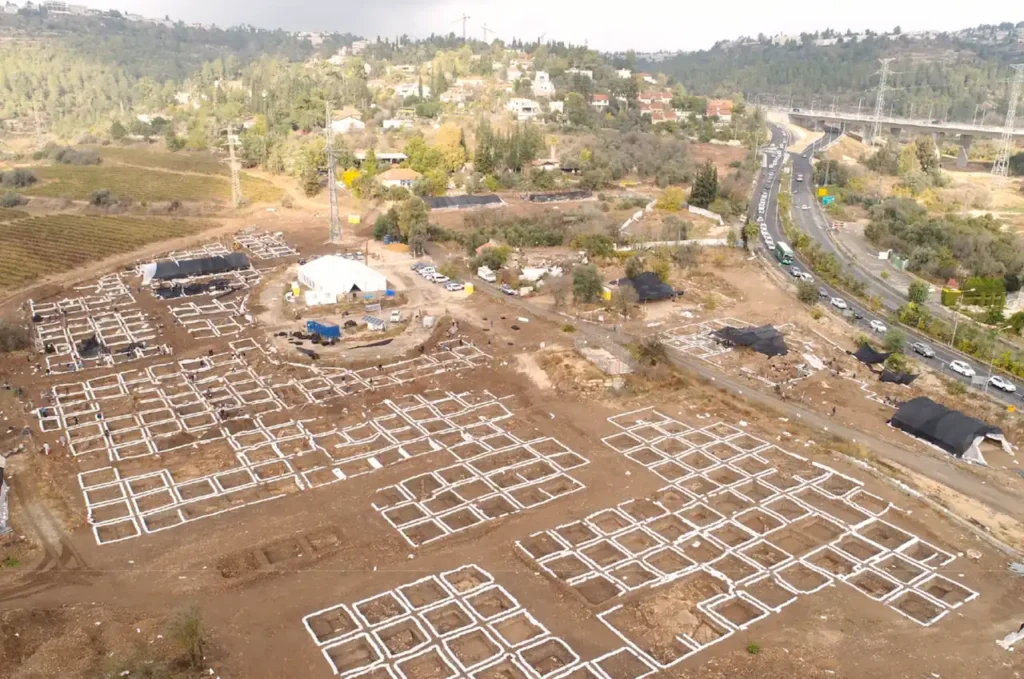
The site lies about five kilometers west of Jerusalem, between the Nahal Motza and Nahal Soreq streams. Excavations carried out ahead of highway construction between 2015 and 2021 exposed more than three hectares of archaeological remains. Among them was a large Pre-Pottery Neolithic settlement, with its most extensive construction phase dated to roughly 7100–6700 BCE.
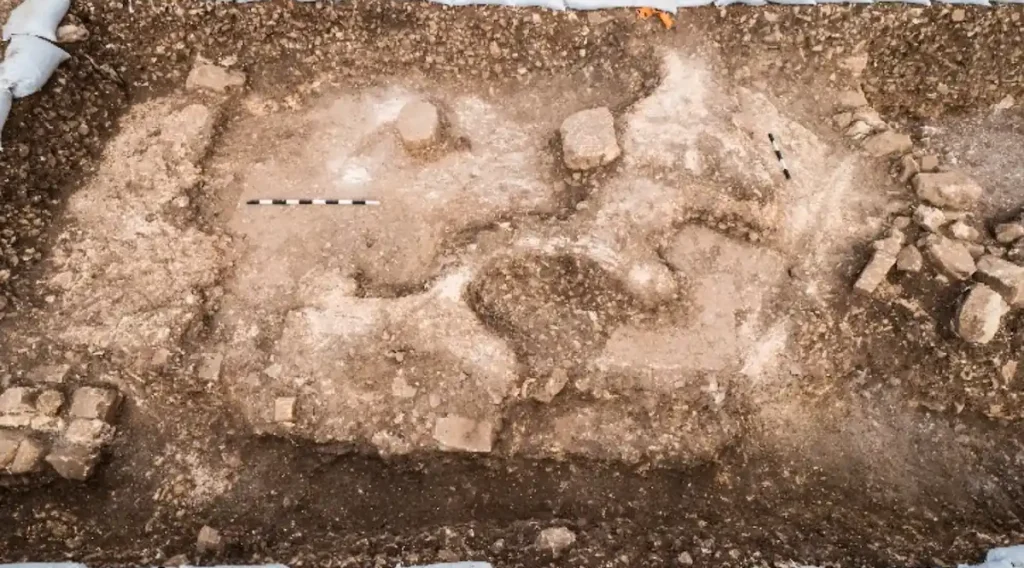
Archaeologists uncovered more than 100 plastered floors across the settlement. Several of the earlier floors were especially well preserved, and some still carried traces of red pigment. Yet the most important clue was not visible to the naked eye. Chemical and microscopic analysis showed that some of these floors contained pyrogenic dolomite, meaning dolomite that had been transformed by fire as part of the plaster-making process.
Separate kilns point to deliberate technical control
Plaster was a major achievement in the Neolithic world. Producing it required collecting stone, firing it at high temperatures, slaking the burned material with water, mixing it, applying it, and controlling the setting process. This was not casual household work. It demanded planning, fuel, labor, and shared technical knowledge.
At Motza, researchers found shallow fire pits filled with carbonate stones. Some contained limestone. Others contained dolomite. The distinction matters because these two rocks do not behave in the same way under heat.
Limestone, made mostly of calcium carbonate, was widely used in prehistoric plaster production. When burned, it creates quicklime, which can then be slaked and turned into plaster. Dolomite is different. It contains both calcium and magnesium carbonate. When fired, it can produce a more complicated mix of calcium and magnesium compounds. If the process is not carefully controlled, the result may be weak, unstable, or unsuitable for high-quality plaster.
The presence of separate firing pits suggests that Motza’s builders understood the difference between the stones and adjusted their treatment accordingly. This is one of the most striking parts of the discovery. The Neolithic craftspeople were not merely using whatever rock was available. They appear to have selected, fired, and combined materials with a clear understanding of performance.
Dolomite offered practical advantages. Motza sits in a dolomite-rich area, so using local stone reduced the need to transport limestone from elsewhere. Dolomite also calcines at a lower temperature than limestone, which may have reduced fuel demand. More importantly, dolomitic plaster can be stronger and more water-resistant than standard calcitic lime plaster when produced correctly.
A mystery inside the floor
The Motza floors contained two kinds of dolomite. Some appeared as larger crushed stone particles, likely added as aggregate. But researchers also found tiny, evenly dispersed dolomite crystals inside the binder itself. These fine crystals were too regular to be explained simply as crushed rock dust.
That detail led to the central interpretation of the study: some of the dolomite in the plaster was not just ground stone. It may have re-formed after firing and slaking, completing a dolomite-lime cycle similar to the well-known limestone-lime cycle.
This is highly unusual. In historic and modern dolomitic lime, burned dolomite usually does not recombine neatly into dolomite. Instead, it forms other magnesium-rich minerals and amorphous compounds. At Motza, however, the floors were dominated mainly by dolomite and calcite. The expected suite of magnesium minerals was largely absent.
To test the idea, researchers analyzed archaeological plaster, kiln remains, and experimental materials using infrared spectroscopy, X-ray diffraction, thermogravimetry, scanning electron microscopy, and light microscopy. Their results support the possibility that Motza’s plaster makers created conditions that allowed dolomite to survive or recrystallize in the binder.
The exact mechanism remains open. One possibility is that the Neolithic builders fired the dolomite at carefully controlled temperatures, leaving some original crystals intact as nuclei for recrystallization. Another is that the transformation occurred slowly over thousands of years. Either way, the floors preserve a process rarely documented in archaeology and still difficult to reproduce experimentally.
A Neolithic craft tradition more sophisticated than expected
The discovery changes how Motza should be understood. This was not only a large Neolithic settlement with impressive architecture. It was also a place where communities invested in specialized material production.
The floors themselves reveal a practical logic. The thicker base layers were rich in dolomite and stone aggregate, creating a stronger structural surface. The thinner upper finish layers were lighter and often more calcitic, giving a smoother surface that could be painted or maintained. This layered approach resembles much later building principles, including distinctions between structural mortar and finishing plaster.
The comparison with Roman architectural tradition is especially striking. Vitruvius, writing in the 1st century BCE, discussed different stones for lime production, and later historical builders used dolomitic materials in parts of Europe and beyond. Yet Motza shows that similar material intelligence existed thousands of years earlier, without written manuals or formal engineering schools.
That does not mean the Neolithic builders were “primitive scientists” in a modern sense. Their knowledge was likely practical, transmitted through observation, repetition, and craft experience. But the outcome was technically impressive. They recognized local resources, managed firing conditions, and produced a plaster that may have been harder and more resistant to moisture than ordinary lime plaster.
The implications reach beyond archaeology. Because dolomite requires lower firing temperatures than limestone, understanding this ancient technology may also interest researchers studying lower-energy building materials. The study even touches on the geological “dolomite problem,” the long-standing question of why dolomite is abundant in ancient rocks but difficult to form under modern laboratory conditions.
For Motza, the broader message is clear. Nearly 10,000 years ago, communities living near Jerusalem were not simply building shelters. They were experimenting with chemistry, heat, stone, and architecture in ways that later vanished from common use. The plaster floors beneath their homes now preserve a lost technological path, one that briefly appears in the Neolithic and then disappears from the archaeological record for millennia.
Maor, Y., Yegorov, D., Kossoy, A., Feldman, Y., Khalaily, H., Vardi, J., & Asscher, Y. (2026). Neolithic plaster floors at Motza: Earliest case of burning dolomite for plaster. Journal of Archaeological Science, 190, Article 106557. https://doi.org/10.1016/j.jas.2026.106557
Cover Image Credit: Maor et al., Journal of Archaeological Science (2026)
