
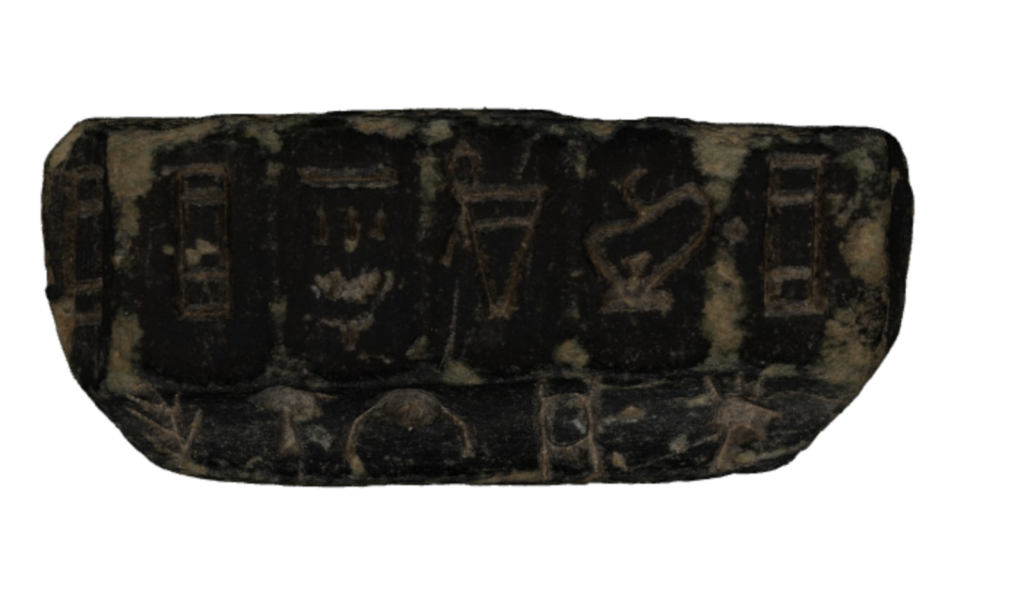
A tiny stone offering table from a Minoan mountaintop sanctuary may preserve something far larger than its size suggests: possible evidence that Dionysos and Demeter had religious predecessors on Crete centuries before they became familiar gods of the Greek world.
The object, known as IO Za 2, carries one of the longest surviving examples of the mysterious Linear A script. In a new study, researcher Michael Schümann proposes that its damaged inscription can be reconstructed as a structured ritual prayer naming divine figures he identifies as early forms of Dionysos and Demeter.
If that interpretation withstands scrutiny, the implications would extend well beyond the decipherment of a single Bronze Age inscription. It would suggest that at least some elements later associated with two major Greek deities were not created entirely within Greek religion, but developed from much older Minoan religious traditions.
That remains a significant “if.” Linear A has never been securely deciphered, and the proposed reading depends on Schümann’s own phonetic and linguistic interpretations. But IO Za 2 offers an unusual combination of archaeological context, repeated ritual formulas and potentially recognizable divine names.
A prayer written around a stone only 4.3 centimeters wide
IO Za 2 is a miniature libation table carved from dark green to black serpentinite. It measures just 4.3 centimeters across and 1.9 centimeters high, with a circular depression cut into its upper surface to receive liquid offerings such as wine, oil or honey. The object is now held in the Archaeological Museum of Heraklion under inventory number HM L3557.
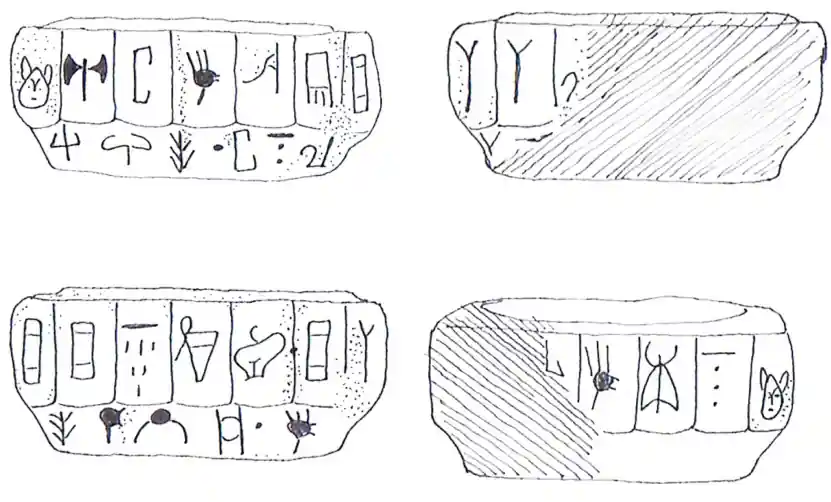
Because the basin occupied most of the upper surface, the inscription was instead engraved around the four vertical sides. Even more unusually, the scribe arranged the text in two continuous horizontal lines, a layout the study describes as unique among currently known inscribed libation vessels of this type.
Archaeologically, the table belongs to the Neopalatial period, roughly Middle Minoan III to early Late Minoan I. Yet Schümann argues that the shapes of the Linear A signs themselves appear older, assigning the handwriting to Middle Minoan II. If correct, that difference could mean the object remained in ritual use for a considerable period before it was finally deposited.
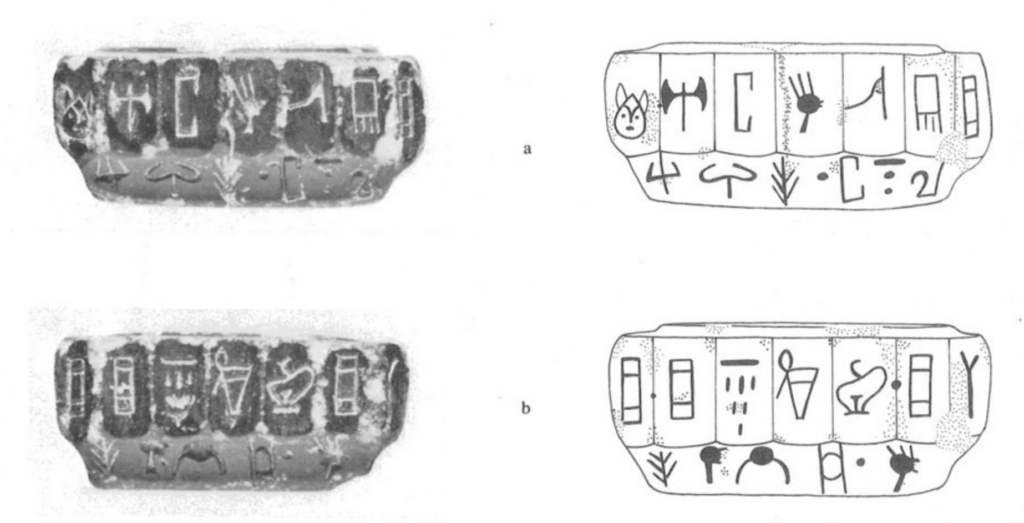
Found beside the altar of Mount Juktas
The setting is central to the interpretation.
IO Za 2 was excavated at the summit sanctuary of Mount Juktas, one of the most important religious centers of Bronze Age Crete. It came from the developed ritual zone surrounding a monumental open-air altar, where generations of worshippers carried out libations, sacrifices and other ceremonies.
Excavations found deep deposits of ash, charcoal, animal remains and large quantities of broken ritual pottery around the altar. The libation table itself appears to have entered this accumulated cult deposit after its period of use.
Nearby was another striking feature: a natural fissure descending into the limestone. Large quantities of vessels, human and animal figurines and other votive objects were deposited in and around it. The arrangement suggests that visible ceremonies around the altar existed alongside rites connected with the earth and the subterranean realm.
Against that ritual background, the inscription is interpreted not as a simple dedication but as a sequence of invocation, lamentation and libation.
“Weep the tears”
Schümann reads the opening expression, A-TA-I-JO-WA-JA, as a divine title meaning “Father of the Bull-Contest.”
The interpretation is particularly evocative in a Minoan context, where bulls occupy a prominent place in religious imagery and ceremonial scenes. The following expression, JA-DI-KI-TU, is interpreted as “from Dikte,” linking the invoked deity to another major sacred landscape of Crete.
The central section becomes more personal.
JA-SA-SA-RA-ŽA is interpreted as “the tears,” followed by U-NA-KA-NA-SI, read as the command “weep.” Together, the phrase becomes:
“weep the tears.”
It is followed by I-PI-NA-MA, interpreted as “the libation offering,” and SI-RU-TE, translated as “may it flow in streams.”
The study therefore reconstructs a ritual in which lamentation and the pouring of liquid are closely connected: tears and libation become parallel forms of religious offering. Schümann argues that comparable expressions appearing on other Linear A libation inscriptions strengthen the possibility that this was part of a standardized ritual formula.
But it is the damaged ending that carries the most provocative implications.
Tinu and Ida-Mate
Only part of the final sequence survives. Schümann reconstructs it as:
TA-NA-RA-TE-U-TI-NU I-DA[-MA-TE-QE]
Under his interpretation, TA-NA-RA means “sanctuary,” while TE-U means “of the god.” The sequence would therefore refer to “the sanctuary of the god Tinu and Ida-Mate.”
Tinu is compared with the Mycenaean Greek form di-wo-nu-so, the earliest written form associated with Dionysos. Schümann proposes that TI-NU could represent an earlier Aegean form of the divine name, before the longer form known from Linear B and later Greek developed.
The second name may be even more suggestive.
The surviving I-DA is reconstructed as I-DA-MA-TE, based on appearances of I-DA-MA-TE and DA-MA-TE in other Linear A inscriptions. In Schümann’s interpretation, the name represents a pre-Mycenaean form connected with the later goddess Demeter.
Taken together, the study translates the complete reconstructed prayer approximately as:
“Father of the Bull-Contest of Dikte, weep the tears; may the libation offering flow in streams in the sanctuary of the god Tinu and Ida-Mate.”
Could two Greek gods have begun in Minoan Crete?
This is where IO Za 2 becomes potentially important for the wider history of Mediterranean religion.
Dionysos and Demeter are central figures in later Greek religious tradition, associated respectively with wine, altered states, and fertility on one hand, and agriculture, grain, and the cycle of life and death on the other.
If Tinu and Ida-Mate really belong to earlier stages of those divine traditions, then their history may reach back into the Minoan religious world that existed before the emergence of the historical Greek religious system.
Rather than emerging entirely within later Greek religion, their identities may have developed through a much longer process in which older Aegean deities, names, rituals and sacred landscapes were inherited, reshaped or reinterpreted.
Schümann himself leaves the precise mechanism open. The paper notes that the apparent relationship could reflect direct inheritance, cultural adaptation or religious reinterpretation. What matters is the possibility of continuity between Minoan and later Greek religion.
Such continuity would not be surprising in principle: religious traditions rarely develop in isolation. But demonstrating it through a Linear A text would be exceptional because the language behind Linear A remains undeciphered.
That is also the reason for caution.
The proposed readings of individual signs, the linguistic comparisons used to translate words such as “tears” and “weep,” and the identification of Tinu and Ida-Mate all depend on Schümann’s broader reconstruction of Linear A. They should therefore be treated as a hypothesis rather than an established decipherment.
Still, IO Za 2 stands out because several lines of evidence converge on the same small object: a secure ritual setting, a recognizable libation formula, references to sacred geography and a concluding passage that may preserve divine names.
A stone table small enough to fit in one hand may therefore preserve a glimpse of a religious world that predates classical Greece, and perhaps a stage in the long transformation of Minoan gods into deities later known as Dionysos and Demeter.
Schümann, M. (2026). The Linear A inscription IO Za 2: A ritual invocation from the sanctuary of Tinu and Ida-Mate. Zenodo. https://doi.org/10.5281/zenodo.20698076
