
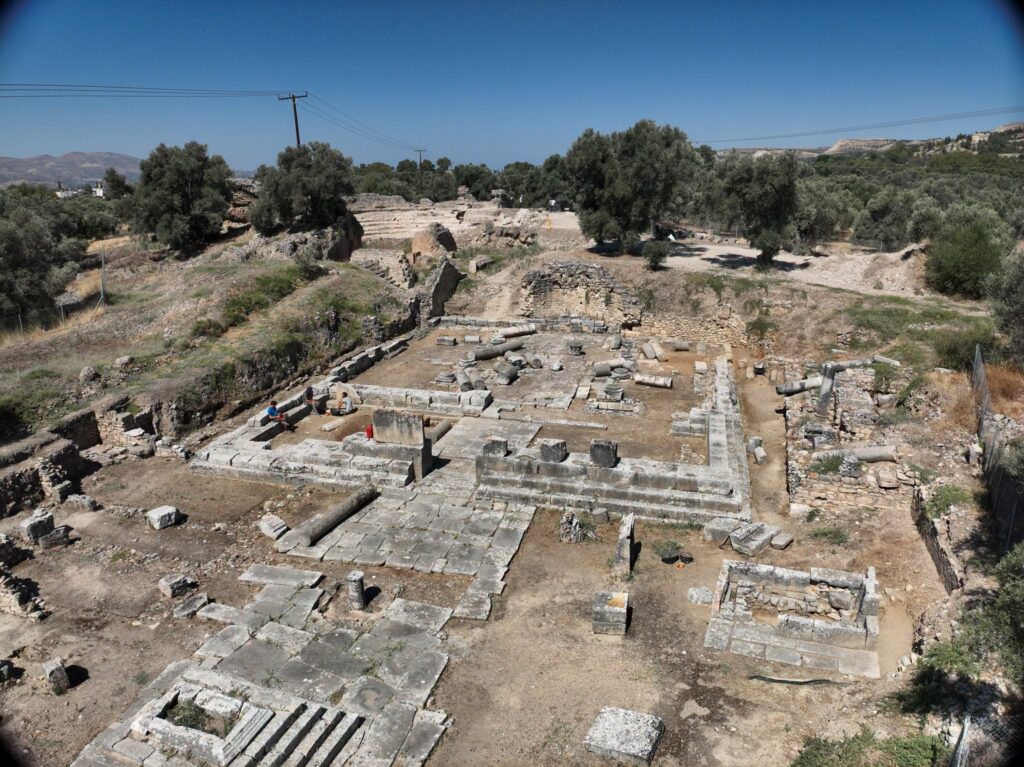
Archaeologists excavating the sanctuary of Apollo at Gortyn, Crete, have uncovered a votive deposit containing the remains of over 450 mice, pointing to a possible cult of Apollo Smintheus at the 7th-century BC site.
A summer excavation season at Gortyn, one of Crete’s largest and longest-inhabited archaeological sites, has produced an unusual clue about the religious life of the early Cretan city-states: the remains of more than 450 mice, buried as part of a votive deposit inside the sanctuary of Apollo.
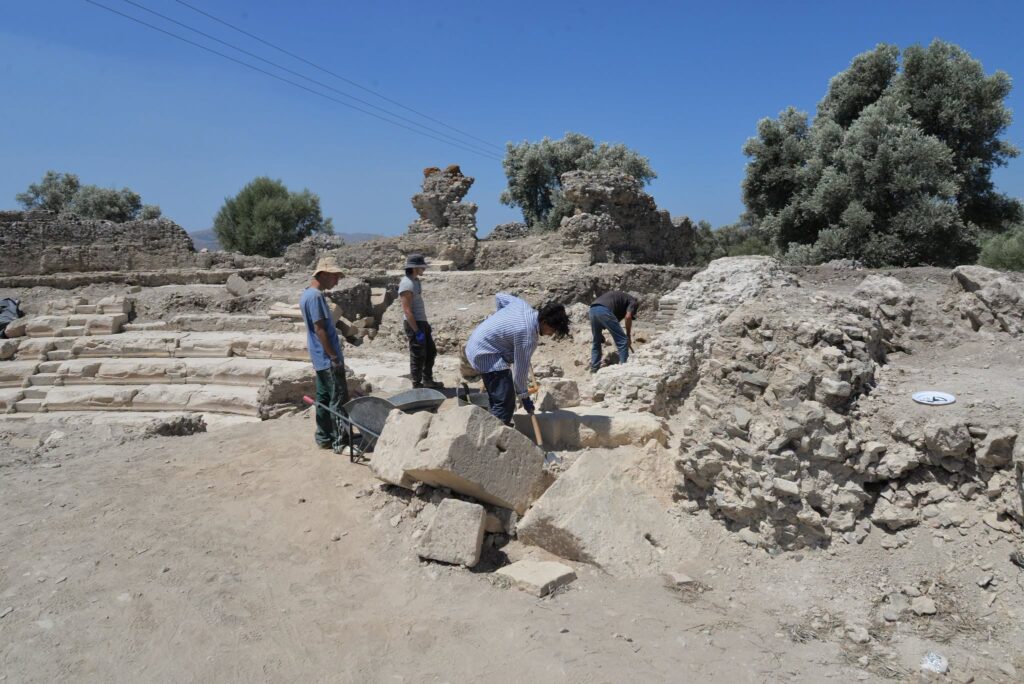
The fieldwork, carried out between July 19 and August 14, 2026, was led jointly by the Italian Archaeological School at Athens and the Department of Cultural Heritage at the University of Padua, continuing a long-running Italian research program at the site.
A Sanctuary Older Than the Polis Itself
The current excavations are focused on the sacred enclosure of Apollo, a walled precinct built around the middle of the 7th century BC.
Archaeologists describe it as one of the oldest and most architecturally complex cult buildings associated with the formation of the Cretan poleis, the city-states that were still taking shape in this period.
Three new trenches opened this season confirmed the dating of the enclosure and produced new evidence about the construction techniques used to build it, adding detail to a phase of Cretan history for which written sources are scarce.
By the Hellenistic period, the same sanctuary was associated with the cult of Apollo Pythios, and by Roman times it had grown into one of the city’s principal religious complexes.
The Mouse Deposit and the God “Smintheus”
At the center of this year’s research is a votive deposit first identified in 2025. Alongside a range of other offerings, it contained the skeletal remains of over 450 mice, a scale of rodent burial that is exceptional for a Greek sanctuary.
Researchers now believe the find may point to a cult of Apollo Smintheus, an epithet meaning roughly “mouse Apollo,” under which the god was worshipped as both a bringer and a queller of rodent-borne plague.
The best-documented sanctuary of this cult sits far from Crete, at Chryse in the Troad region of northwestern Anatolia, near modern Gülpınar in Türkiye. It is mentioned in the opening book of Homer’s Iliad, where the priest Chryses prays to Apollo Smintheus to send a plague on the Greek army besieging Troy.
Ancient tradition held that the Troad sanctuary kept live mice under its altar and fed them at public expense, and its 4th-century BC cult statue by the sculptor Skopas reportedly showed Apollo with his foot resting on a mouse.
The geographer Strabo later noted that several places across Asia Minor bore the name Sminthe and held festivals in the god’s honor, suggesting the cult was never confined to a single sanctuary.
The Gortyn material now raises the possibility that a parallel, previously unrecognized branch of this cult existed on Crete as well, potentially worshipped alongside Apollo Pythios at the very same sanctuary in the later Hellenistic period.
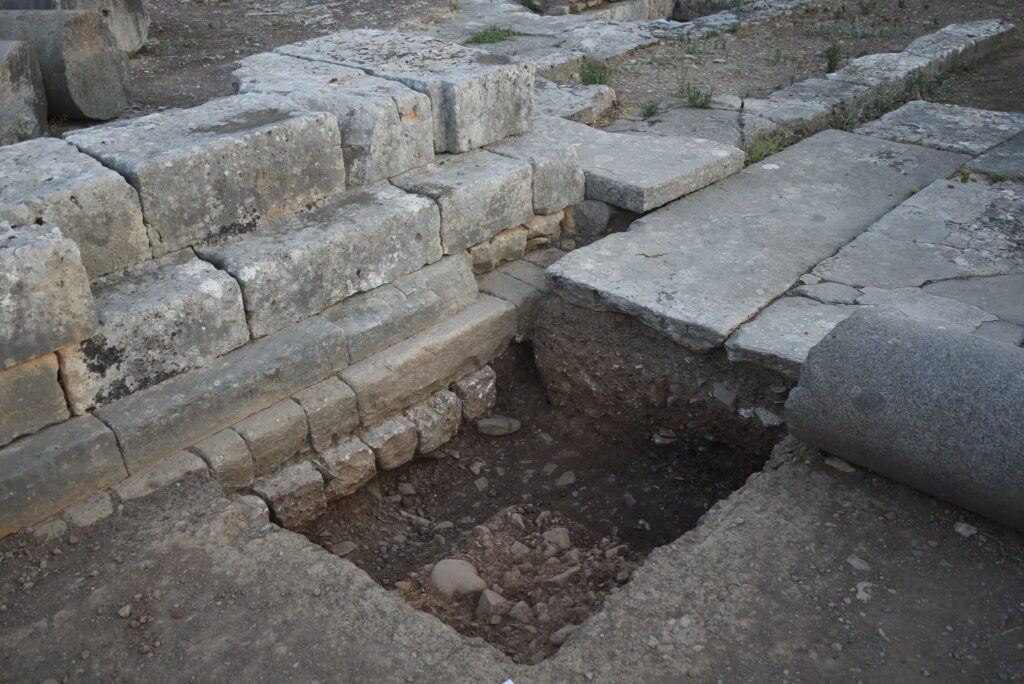
A newly opened test trench among the architectural remains of the Sanctuary of Apollo at Gortyn, Crete. Credit: Italian Archaeological School Athens via Facebook
New Finds at the Theater of the Pythion
Excavation this season also continued at the theater that stands immediately beside the sanctuary, known to archaeologists as the Theater of the Pythion. Built in the 2nd century AD during the Roman Imperial period, it is considered the best-preserved of Roman Crete’s theaters.
Its semicircular cavea, divided by a central walkway, could seat an estimated 2,000 spectators, and the theater complex was fronted by a large colonnaded portico measuring roughly 76 by 36 meters, with staircases along its outer sides giving access to the seating area.
This season’s work uncovered substantial new sections of the building’s scaenae frons, the elaborately decorated stage front that closed off the back of the performance space.
Ancient descriptions indicate this facade ran about 50 meters long, built with rectangular platforms flanking a central doorway and fronted by black-and-white Doric columns, with marble inlay decorating parts of the stage walls.
Alongside these architectural remains, archaeologists recovered material from the building’s collapse, including fallen structural elements and carved decorative fragments, which specialists will use to reconstruct how the facade originally looked.
The theater has been under systematic investigation by the Italian Archaeological School and the University of Padua since the early 2000s, specifically to clarify the physical and architectural relationship between the stage building and the neighboring sanctuary of Apollo.
An International Team
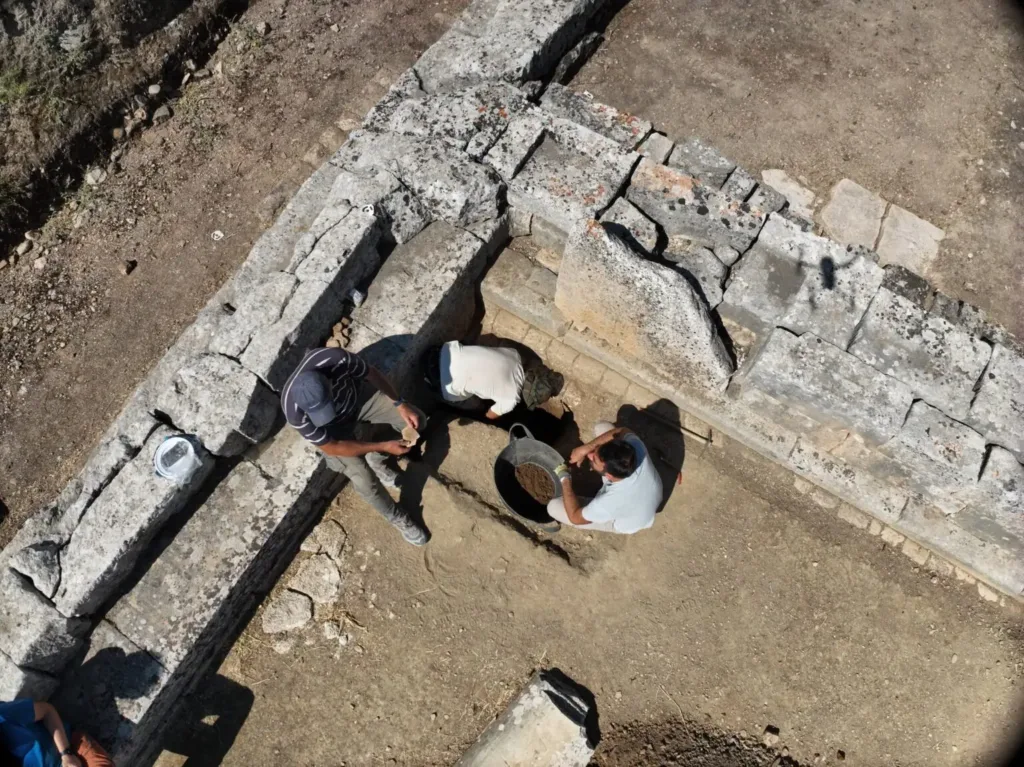
The project brings together students and researchers from the Universities of Padua, Rome Sapienza and Pisa in Italy, along with Germany’s Ruhr-Universität Bochum. Taken together, the season’s findings suggest that a full picture of religious practice at Gortyn is still emerging — one in which several hundred small rodent bones may end up reshaping the understanding of a major Cretan sanctuary, even as new architectural finds continue to fill out the story of the theater built beside it.
A City With Three Thousand Years of History
Gortyn lies on the fertile Mesara plain in southern Crete, roughly 45 kilometers south of modern Heraklion. Archaeological evidence shows the area was already settled in the Neolithic period, and by the Late Bronze Age a fortified settlement stood on the city’s acropolis, initially overshadowed by the nearby Minoan palace at Phaistos.
Over the following centuries Gortyn grew into one of the most powerful city-states on Crete, at times allied with and at times rivaling Knossos for dominance of the island.
Its most famous archaic monument, the Gortyn Law Code, was inscribed around the 5th century BC and is the oldest substantially complete law code surviving from the Greek world, covering matters such as property rights, inheritance and marriage.
The city’s fortunes rose further after 67 BC, when Rome conquered Crete and, a few decades later, made Gortyn the capital of the joint province of Crete and Cyrenaica. Roman-era Gortyn expanded well beyond its earlier core, gaining a praetorium, baths, an odeon, temples to Egyptian deities such as Isis and Serapis, and the sanctuary and theater of Apollo now under excavation.
The city remained an important administrative and religious center into the Byzantine period, when it became the seat of Crete’s first bishop, before a major earthquake and, later, an Arab invasion in the 9th century AD brought its long history as a major urban center to an end.
