
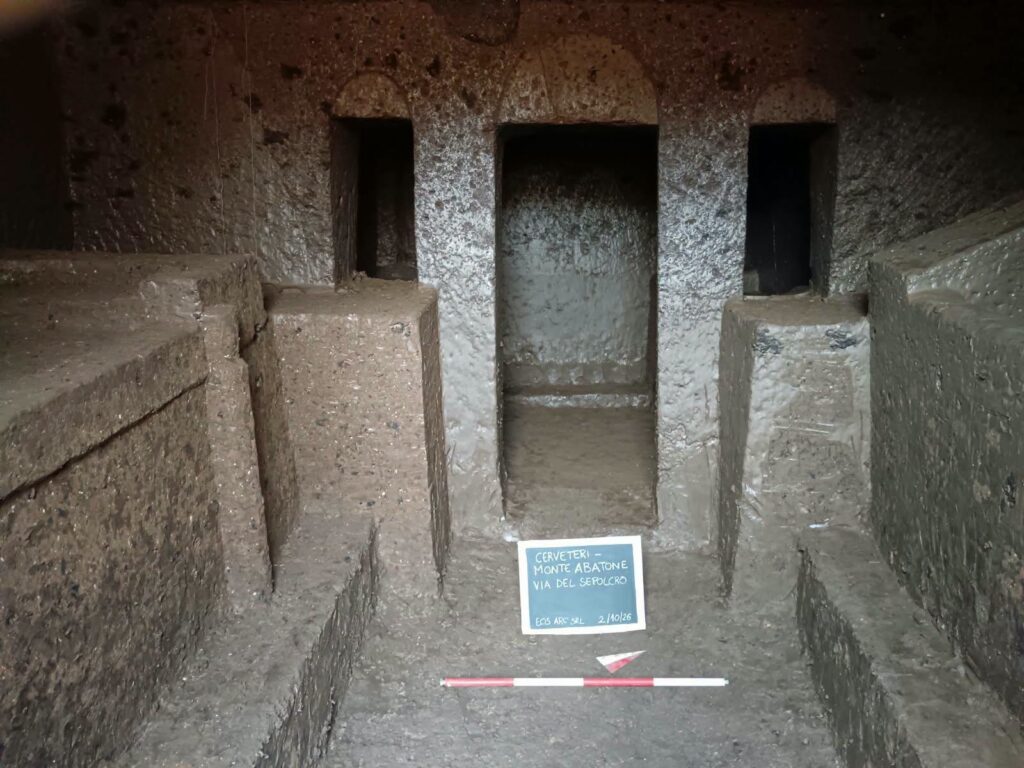
Archaeologists have uncovered rock-carved thrones, red wall paintings, and a decorated ceramic vessel in ancient Etruscan tombs at Cerveteri, Italy. The discoveries emerged during conservation work at the Monte Abatone necropolis, where damaged burial chambers required urgent archaeological investigation.
Italy’s Soprintendenza Archeologia Belle Arti e Paesaggio per l’Etruria Meridionale announced the findings on November 3, 2026. The work has revealed architectural details and funerary objects that help researchers examine the burial customs of ancient Caere, one of the most important cities of Etruscan civilization.
Rock-Carved Thrones Inside the Burial Chambers
Structural damage and unstable conditions prompted archaeologists to investigate several tombs at the Monte Abatone necropolis. Teams cleared blocked entrances and carefully removed accumulated deposits before examining the burial chambers.
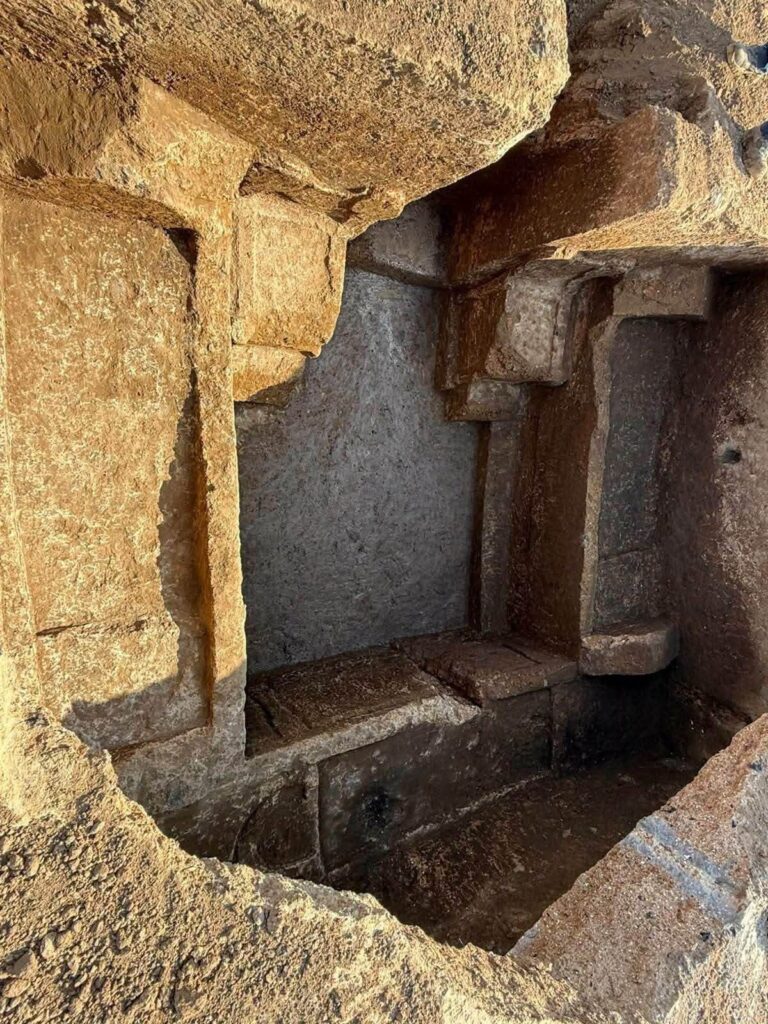
The work exposed several chambers with different architectural features. One retained much of its original vaulted ceiling, while another contained funerary furnishings carved directly into the volcanic tuff, including throne-shaped seats.
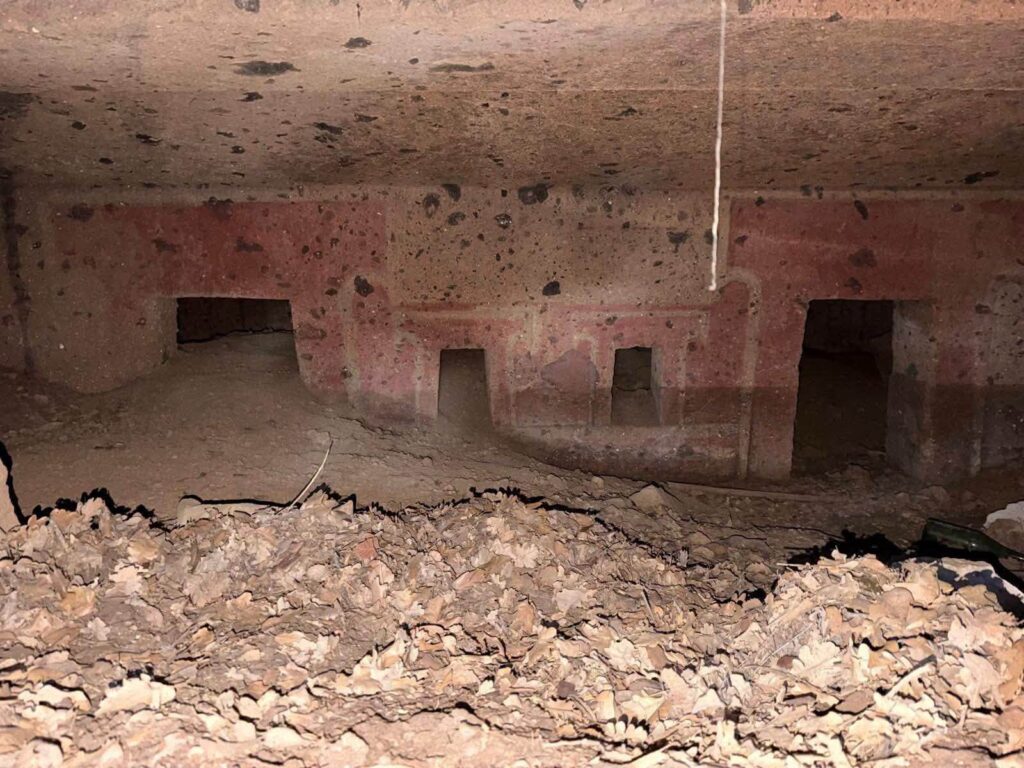
Another chamber preserved extensive traces of red paint across its walls. These remains provide evidence of how the Etruscans decorated their burial spaces, although further examination will be necessary to establish the original appearance and chronology of the paintings.
The combination of carved furniture and painted surfaces demonstrates the attention given to the interior arrangement of the tombs. Rather than treating the chambers as simple spaces for burial, their builders incorporated architectural and decorative elements into the surrounding rock.
An Etruscan Vessel Decorated with Animal Figures
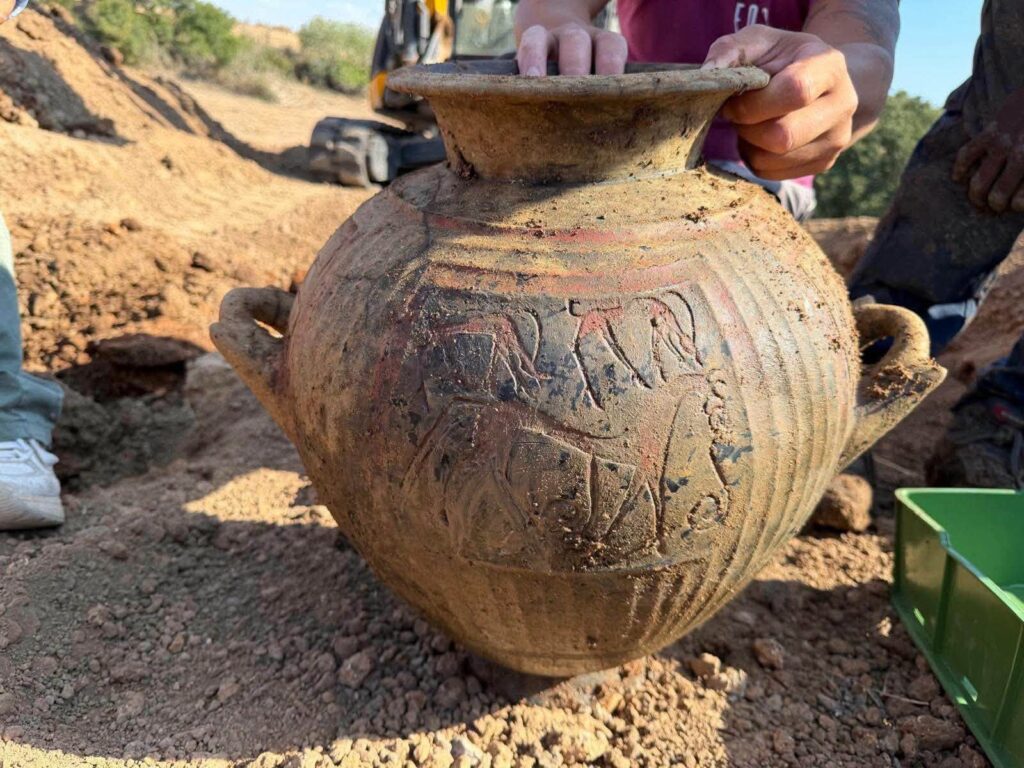
Among the objects archaeologists recovered, a nearly complete ceramic vessel stands out for its unusual decoration and condition.
The vessel is an olla with a stamnoid form, meaning its shape resembles that of a stamnos, a wide-bodied container associated with ancient Mediterranean ceramic traditions. Its surface carries engraved animal figures alongside details painted in red.
The Soprintendenza has not yet identified the animals represented in the decoration or provided a precise date for the vessel. Specialists expect cleaning and restoration to clarify its manufacture, decorative features, and archaeological significance.
Despite previous disturbance within the tombs, the vessel survived almost intact. Following cleaning and restoration, the Soprintendenza plans to put it on public display.
Monte Abatone and the Ancient Etruscan City of Caere
The Monte Abatone necropolis belonged to ancient Caere, the Etruscan city that occupied the area around modern Cerveteri, northwest of Rome. Caere developed into an influential urban centre with extensive burial grounds that preserve evidence of changing funerary customs over several centuries.
According to Italy’s Ministry of Culture, the Monte Abatone necropolis was in use from the late eighth century BCE until the first century BCE. Investigations carried out during the twentieth century identified hundreds of tombs, establishing the cemetery as an important area for studying Etruscan burial architecture.
More recent archaeological research has added details about its development. Excavations conducted between 2018 and 2021 examined burial groups dating to the first half of the seventh century BCE, including graves arranged in parallel rows.
Researchers have also studied the cemetery’s spatial organization, architectural features, and ceramic assemblages. A 2024 study by Fernando Gilotta, Luca Lucchetti, and Teresa Patriziano discussed archaeological documentation, digital mapping, and the restoration of ceramic material from Monte Abatone.
These earlier investigations provide a broader context for the latest discoveries. However, the Soprintendenza has not yet announced precise dates for the newly investigated chambers, so their relationship to previously studied burial phases remains uncertain.
Discoveries Survive Earlier Tomb Robbing
The conservation team also encountered evidence of earlier illegal excavations. Tomb robbers had disturbed the chambers before archaeologists began the recent intervention, but they had left behind architectural features and objects of considerable archaeological interest.
The surviving material includes the decorated vessel, carved funerary furnishings, and painted wall surfaces. Their preservation demonstrates why archaeologists must investigate damaged burial contexts carefully, even when earlier disturbances have removed part of their contents.
The Soprintendenza reports that teams have now investigated, documented, and stabilized all the tombs involved in the intervention. Conservators will clean and restore the recovered objects, while further study will address their dates, production methods, and significance.
Once restoration is complete, the decorated vessel will go on public display. For now, the latest work at Monte Abatone has expanded the archaeological record of Caere without requiring new excavations beyond the areas that urgently needed protection.
Sources
Soprintendenza Archeologia Belle Arti e Paesaggio per l’Etruria Meridionale. (2026, November 3). Archeoscoperte a Cerveteri: Necropoli di Monte Abatone. Official Facebook announcement.
Gilotta, F., Lucchetti, L., & Patriziano, T. (2024). Esperienze da Monte Abatone a Cerveteri. https://doi.org/10.19282/ac.35.1.2024.05
