
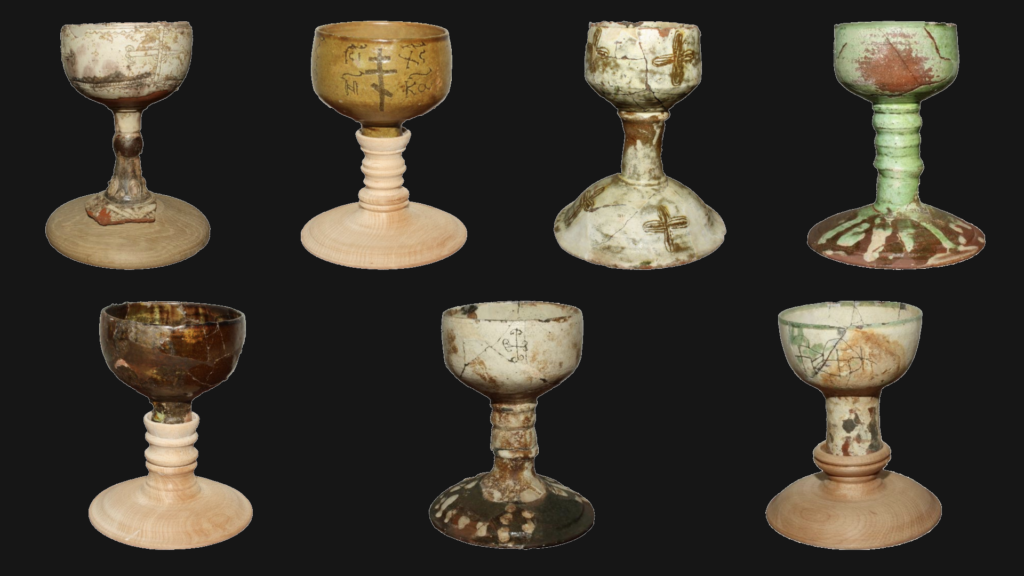
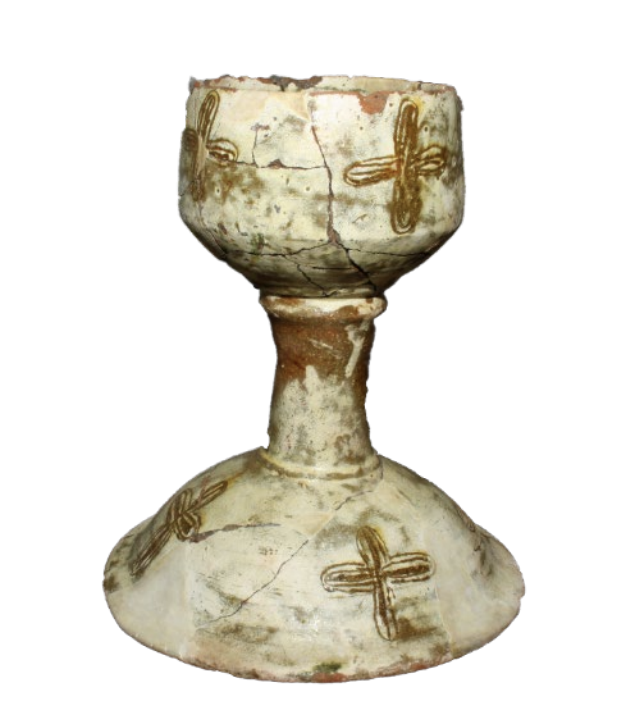
An old tradition at Vatopedi Monastery on Greece’s Mount Athos tells of monks who hid sacred vessels in the Well of the Virgin Mary to protect them from plundering pirates. Among the objects recovered from the nearly eight-meter-deep well, however, were 19 sacred chalices made not of gold or silver, but of fired clay. Some bear carefully engraved crosses, while others carry Greek inscriptions proclaiming “Sacred Chalice” and “Jesus Christ Conquers.”
Used in the celebration of the Eucharist, these ceramic vessels are attracting scholarly attention not only for their religious inscriptions and distinctive decoration but also for their age. Some bear striking similarities to Byzantine ceramics produced during the 13th and 14th centuries, suggesting that the chalices may be considerably older than previously believed.
Perhaps the most remarkable aspect of the discovery is why these objects ended up at the bottom of a well. Rather than a temporary hiding place for treasures threatened by pirates, archaeological evidence suggests that the well served a more enduring purpose: preserving religious objects whose sacred significance survived the end of their practical use.
Sacred Chalices Older Than Previously Thought
Archaeological excavations conducted around the monastery’s principal church in 2000 and 2001 examined the interior of the well, which had long been filled with material accumulated over successive centuries. Following conservation and restoration, many of the recovered vessels became part of the monastery’s collection.
A comprehensive 2026 study by Stavros Zachariadis, undertaken as a master’s thesis at Aristotle University of Thessaloniki, reexamines more than 100 ceramic vessels, including 19 sacred chalices. The research challenges earlier interpretations concerning the age, origins and deposition of these religious objects.
The chalices had previously been collectively dated to the 15th and 16th centuries. Their differences in shape, glazing techniques and decoration, however, suggest that they were manufactured over a much longer period and may have originated in several production centers.
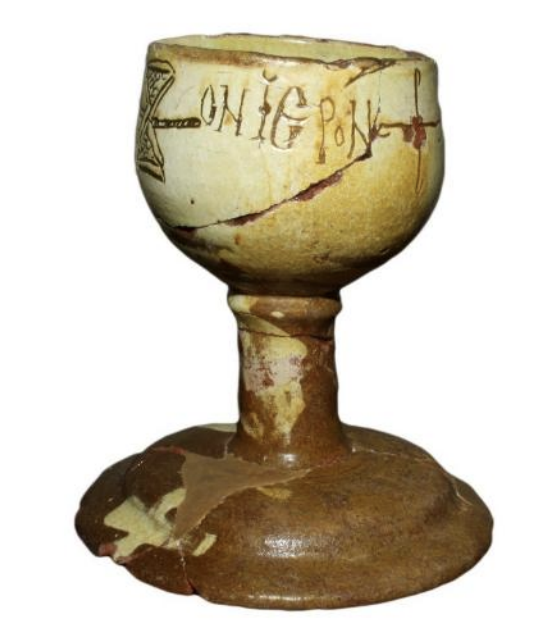
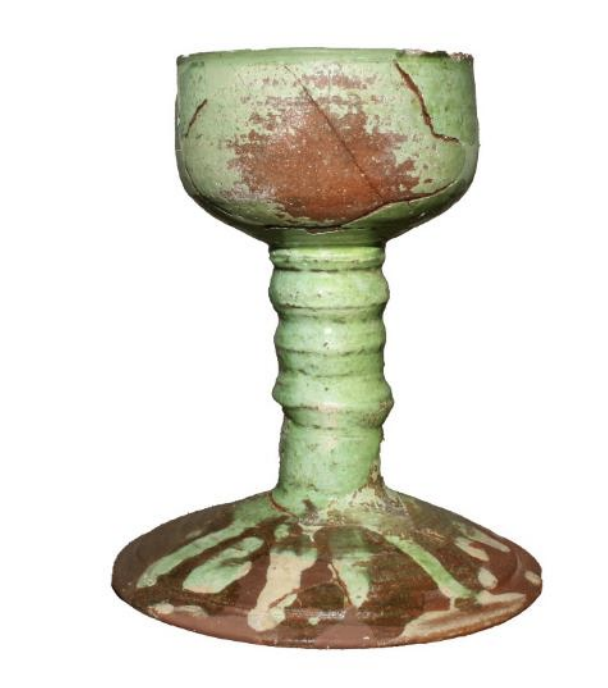
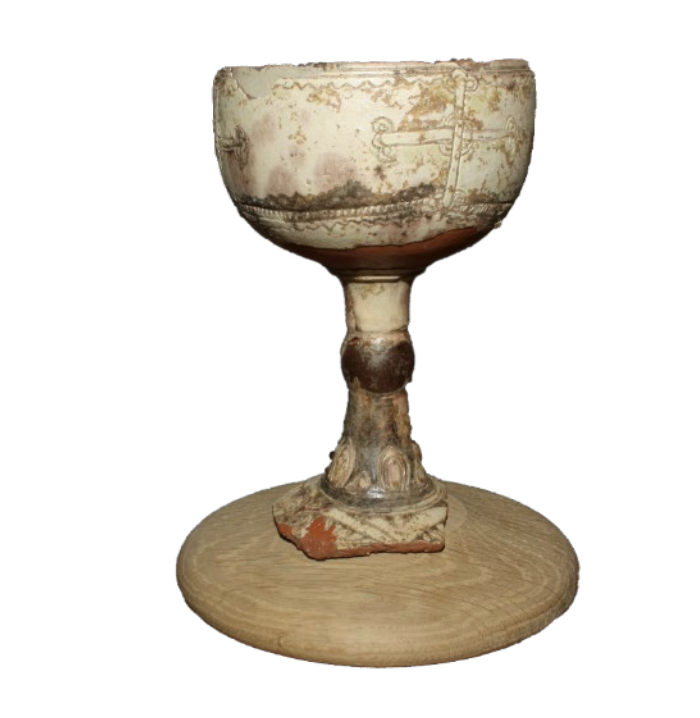
One particularly elaborate yellow-glazed chalice displays strong similarities to ceramics produced in Thessaloniki during the 13th and 14th centuries. Other examples resemble Late Byzantine pottery from Thrace, while two chalices decorated with green bands and irregular patches of color share characteristics with 15th-century ceramics from the island of Lemnos.
These findings suggest that ceramic chalices formed part of monastic worship throughout much of the Late Byzantine and post-Byzantine periods, rather than representing a relatively short-lived tradition.
Sacred Messages Engraved in Clay
The religious inscriptions and symbols decorating several chalices provide compelling evidence of their intended purpose. Craftsmen engraved these details into the clay before firing, demonstrating that the vessels were specifically manufactured for religious use.
One particularly striking chalice bears the Greek inscription «ΠΟΤΗΡΙΟΝ ΙΕΡΟΝ», meaning “Sacred Chalice.” Engraved crosses surround the inscription, while additional white crosses decorate the vessel’s foot. Another example carries the letters «IC XC NIKA», a familiar Christian formula meaning “Jesus Christ Conquers.”
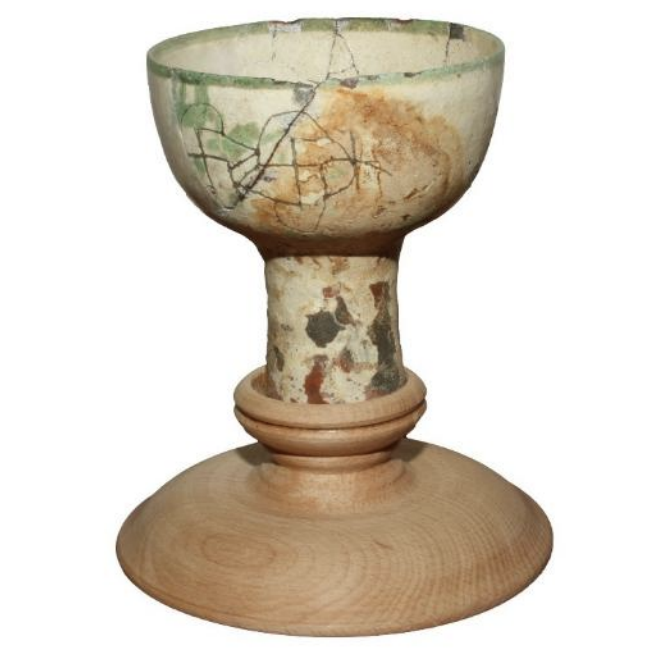
A further chalice features decorative Solomon’s knots alongside a Greek inscription referring to the holy sanctuary. Other vessels display elaborate crosses, colored glazes or simple geometric patterns, while some remain entirely undecorated.
Given the numerous churches and chapels associated with Vatopedi, Zachariadis suggests that ceramic chalices offered an economically practical alternative to precious metal vessels. Some may have been commissioned by monasteries, although the researcher considers offerings from worshippers another likely explanation for their presence.
Comparable ceramic chalices have been documented elsewhere on Mount Athos, in Thessaloniki and even in burial contexts at Nicaea, modern-day İznik in Türkiye.
When Sacred Objects Outlived Their Purpose
What makes the Well of the Virgin Mary particularly significant is the religious practice behind the accumulation of its contents. According to Zachariadis, the well was not simply a temporary repository created in response to an attack, disaster or major renovation. Instead, it appears to have formed part of a deliberate, centuries-long tradition of preserving objects associated with worship.
At the heart of this practice was the understanding that an object’s sacred character did not disappear when its practical usefulness came to an end. Although made from relatively humble materials, the ceramic chalices had acquired religious significance through their use in the Eucharist. Their retirement from service did not mean that they could simply be discarded alongside ordinary household refuse.
The presence of other ceramic vessels potentially associated with worship and the cleaning of sacred spaces suggests that this practice extended beyond the chalices themselves. The well provided a dedicated place where objects connected with religious life could remain protected after they were no longer needed.
This distinction between material worth and spiritual significance makes the discovery particularly revealing. While precious metal objects were valuable in their own right, the preservation of ordinary ceramic vessels demonstrates the importance that the monastic community attached to their religious function.
Seven Centuries of History Beneath the Monastery
The oldest ceramic vessel identified in the well dates to approximately the middle of the 12th century, while the latest examples belong to the 19th century. Based on this extensive chronological range, Zachariadis proposes that the sacred repository remained in continuous use from the 13th through the 19th century.
Besides the chalices, archaeologists recovered plates, bowls, jugs, and numerous ceramic fragments. Other notable discoveries included a silver plaque depicting the Virgin Mary in the Hodegetria tradition and a small vessel bearing representations of Saint Demetrius and Saint Theodora of Thessaloniki.
The archaeological layers inside the well had been extensively disturbed, possibly by people searching for hidden treasure. Previously attributed to the late 18th century, this intervention is now tentatively placed in the 19th century, potentially after the Greek Revolution of 1821.
The disturbed deposits make it impossible to determine precisely when individual chalices were placed inside the well. Although their gradual deposition appears more likely, the researcher cannot exclude the possibility that vessels of different ages were deposited together. Their sacred character may also have encouraged the monks to retain them considerably longer than ordinary ceramic objects.
From Byzantine Workshops to Ottoman Ceramic Centers
The ceramics recovered from the Well of the Virgin Mary also document Vatopedi’s connections with a remarkably diverse network of pottery-producing centers across the Mediterranean.
The collection includes vessels associated with workshops in Thessaloniki, Serres, Lemnos, İznik, Kütahya, Çanakkale and Didymoteicho, alongside examples of Italian maiolica. Their presence reflects the commercial relationships, economic activities and exchanges that connected the monastery with communities beyond Mount Athos during the Byzantine and Ottoman periods.
Not every vessel’s origin has been conclusively established. In the absence of archaeometric analyses, several proposed production centers remain based on comparisons of manufacturing techniques, decorative patterns, and stylistic characteristics.
Yet the significance of the collection extends beyond reconstructing historical trade networks. By preserving religious vessels long after their useful lives had ended, generations of monks inadvertently created an archaeological record of ceramic craftsmanship and devotional practices spanning centuries. The humble clay chalices that once served at the monastery’s altars now offer a tangible connection to the beliefs and religious traditions of its former inhabitants.
Zachariadis, S. (2026). Βυζαντινή και μεταβυζαντινή κεραμική από τη Μονή Βατοπεδίου [Byzantine and post-Byzantine pottery from Vatopedi Monastery] [Master’s thesis, Aristotle University of Thessaloniki]. https://qa.auth.gr/el/thesis/600036130
