
Archaeologists at Derbent’s Naryn-Kala Citadel in Dagestan discovered an ultra-rare 13th-century Avar coin linked to ruler Bayar, son of Suraka.
Archaeologists excavating the Naryn-Kala Citadel in Derbent, Dagestan, have discovered an exceptionally rare 13th-century coin issued by a ruler of medieval Avaria, adding a new piece of evidence to the poorly understood history of coin production in the mountainous eastern Caucasus.
Only part of the coin survives, and its unusual shape initially made identification difficult. Researchers eventually recognized it as belonging to a small group of copper coins associated with Nutsal Bayar, son of Suraka, a ruler of the medieval Avar polity centered in the highlands of present-day Dagestan. Fewer than ten examples of Bayar’s coins are currently known, according to expedition director Vladimir Koval of the Institute of Archaeology of the Russian Academy of Sciences.
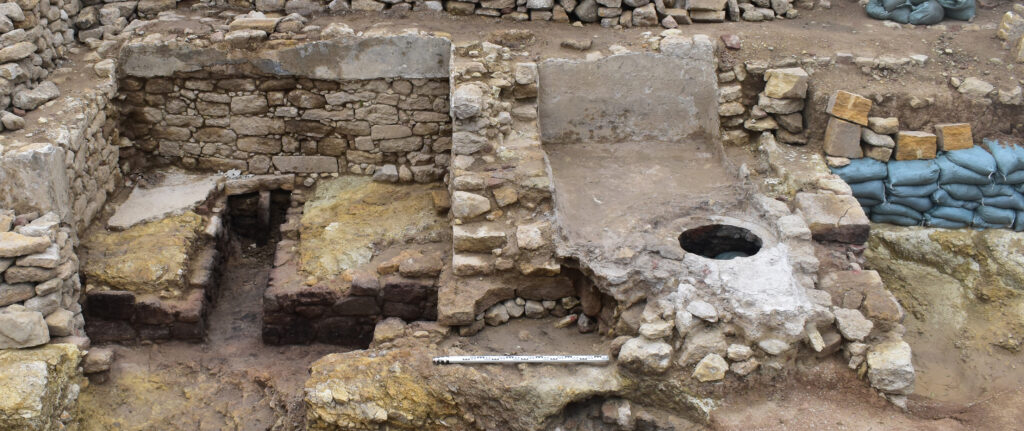
The discovery was made during the third season of a major archaeological project inside Naryn-Kala, part of Derbent’s UNESCO World Heritage complex on the western shore of the Caspian Sea.
A coin from a little-known medieval ruler
“Nutsal” was the title used by the rulers of medieval Avaria, whose political center was at Khunzakh, deep in the mountainous interior of Dagestan. Koval identifies Khunzakh as the likely place where Bayar’s coins were produced.
The coinage is particularly striking because it combines Georgian and Arabic writing, reflecting the overlapping political, religious and cultural worlds of the medieval Caucasus.
Published numismatic research reconstructs the Arabic legend on coins of this type as identifying the issuer as “Malik Bayar, son of Suraka, Christian.” The Georgian elements of the design have led scholars to connect Avar coin production with the strong influence of Georgian monetary traditions in the region.
The surviving fragment found at Naryn-Kala represents only part of what would originally have been an elongated coin rather than the familiar circular form. Earlier research on comparable specimens has interpreted these unusual issues as multiple copper denominations, a phenomenon that appeared in parts of the Caucasus during periods when supplies of silver coinage were restricted.
Exactly how much the coin was worth, or what it could have purchased, remains unknown. The relationship between Bayar’s rare issues and more common currencies circulating in the 13th-century Caucasus has not yet been established.
The coins may nevertheless have carried meaning beyond their monetary value. Koval suggested that issuing coinage in his own name could also have served as a political statement by Bayar—an assertion of independent authority expressed through one of the most visible instruments of medieval rulership.
With so few examples surviving, the new Naryn-Kala find is significant even though only half of the object remains. Each securely excavated specimen can provide information unavailable from coins whose archaeological contexts are unknown, including clues about where and how Avar currency circulated.
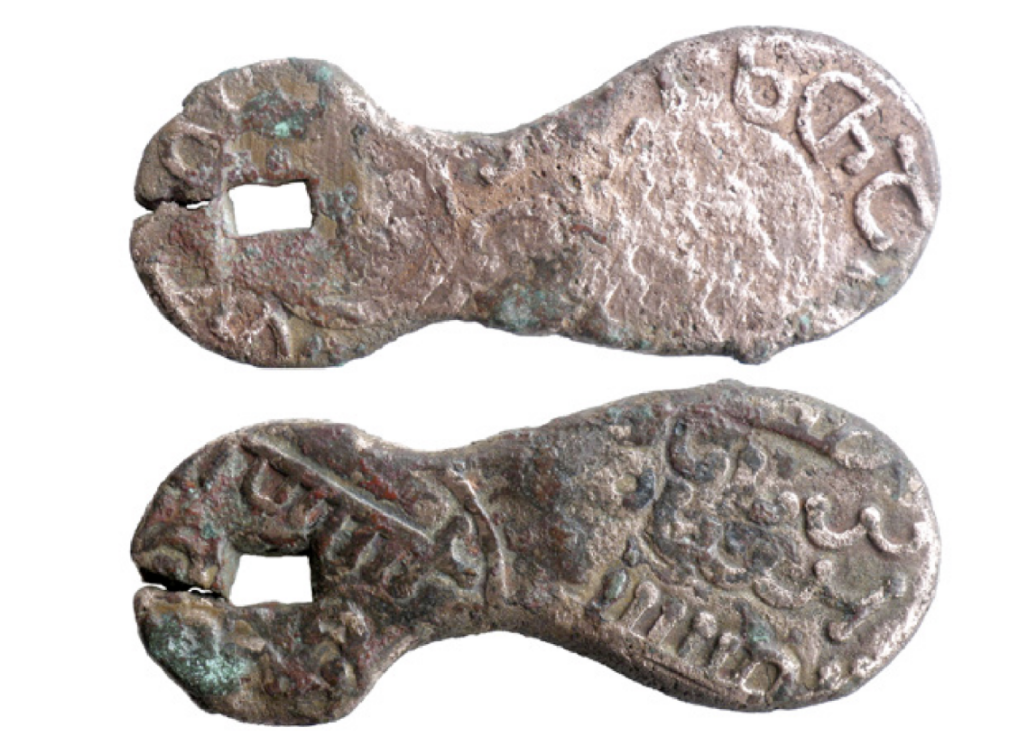
The rare Avar coin in its entirety, a fragment of which was found in Derbent, looked like this. Credit: Akopyan A. V. and Goncharov E. Yu., Orientalistics, 2019, Vol. 2, No. 2
A craftsman left his name on a ceramic dish
The Avar coin was not the only unusual discovery from the excavation.
Archaeologists also recovered part of a large glazed ceramic dish bearing a scratched Arabic inscription beneath its glaze. Researchers interpret the surviving text as meaning that the vessel was made by a craftsman named Matan.
Part of the inscription disappeared when the vessel broke, meaning the original text may have contained further information. The possibility that it once included the craftsman’s place of origin or another identifying detail remains speculative.
Preliminary analysis dates the vessel to the 17th century, possibly as early as the end of the 16th century, and identifies it as a rare type of marbled ceramic probably produced within the Ottoman Empire, potentially in its European territories. A maker’s signature on pottery of this period is itself unusual.
Its presence in Derbent is consistent with the city’s turbulent political history. Ottoman forces controlled Derbent during the Ottoman-Safavid struggles of the late 16th century, while the city’s position on the Caspian corridor repeatedly brought it into networks stretching between Iran, the Caucasus and territories farther west.
Archaeologists are reconstructing centuries of life inside Naryn-Kala
The finds come from the largest single excavation yet opened inside the citadel, currently covering about 750 square meters. The present research program began in 2024 and is led by the Derbent Expedition of the Institute of Archaeology of the Russian Academy of Sciences.
The work is not primarily a search for individual artifacts. Archaeologists are attempting to reconstruct how the northwestern sector of Naryn-Kala was organized and repeatedly rebuilt over centuries.
During the 2024–2025 seasons, researchers were able to connect their excavation with trenches opened in 1974–1977 and document the layout of roughly 1,000 square meters of the fortress. Around 100 stone structures or wall sections and ten ceramic-pipe water lines were recorded around a large cross-shaped underground structure.
That structure was used as a reservoir supplied by mountain springs during the 18th and 19th centuries, although the function and age of its lower sections remain debated.
The 2025 season also produced several discoveries that substantially changed archaeologists’ understanding of this part of the fortress. They uncovered a previously unknown 17th-century hammam, complete with a furnace and an underfloor heating channel, as well as five graves belonging to a 15th–16th-century Muslim cemetery—the first evidence that a burial ground once existed inside the citadel.
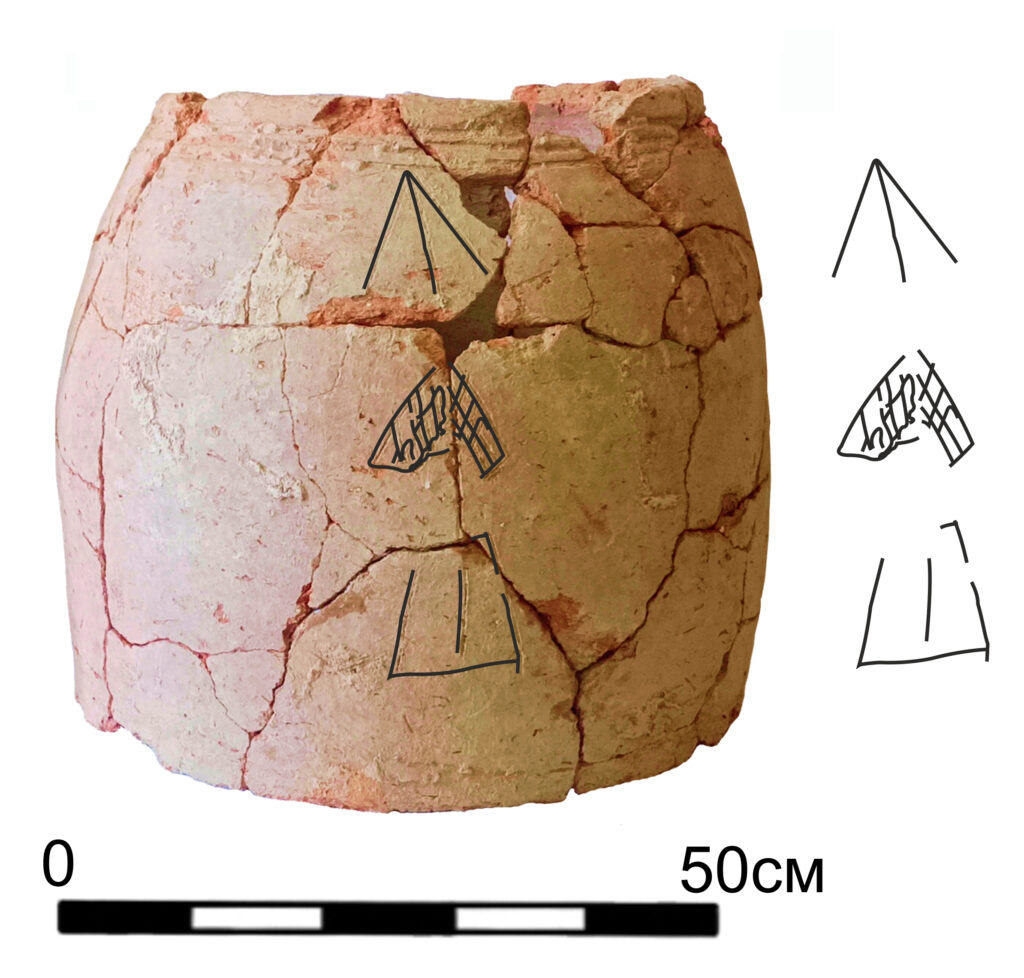
Among the more distinctive finds was a 15th–16th-century ceramic tandyr oven engraved with tamga-like signs. The markings provide another small but unusually personal trace of the people who occupied and worked within Naryn-Kala centuries before the later reservoir system transformed the area.
Researchers also discovered that part of the excavation crosses the original limestone ridge on which the fortress was constructed, allowing them to reconstruct a landscape that was gradually buried beneath meters of human occupation.
A fortress at the gateway of the Caucasus
Derbent owes much of its long history to geography. The city stands where the Caucasus Mountains approach the western Caspian coast, leaving a narrow north-south corridor that linked the Eurasian steppe with the South Caucasus and the Middle East.
The surviving fortress system was developed on a monumental scale under the Sasanian Persian Empire, with parallel stone walls extending between the mountains and the Caspian Sea. The route remained strategically important under successive Persian, Arab, Mongol, Timurid and later powers. Derbent’s citadel, ancient city and fortress buildings were inscribed on the UNESCO World Heritage List in 2003.
The fragmentary coin of Bayar now adds another chapter to that history. Small enough to be easily overlooked and rare enough that fewer than ten examples are known, it connects the great fortress of Derbent with a medieval ruler based far inland in the mountains—and with an Avar monetary tradition that archaeologists are only beginning to understand.
