
8 December 2025 The Future is the Product of the Past

2,800-Year-Old Hallstatt Dagger Found on Baltic Coast— A True Work of Art

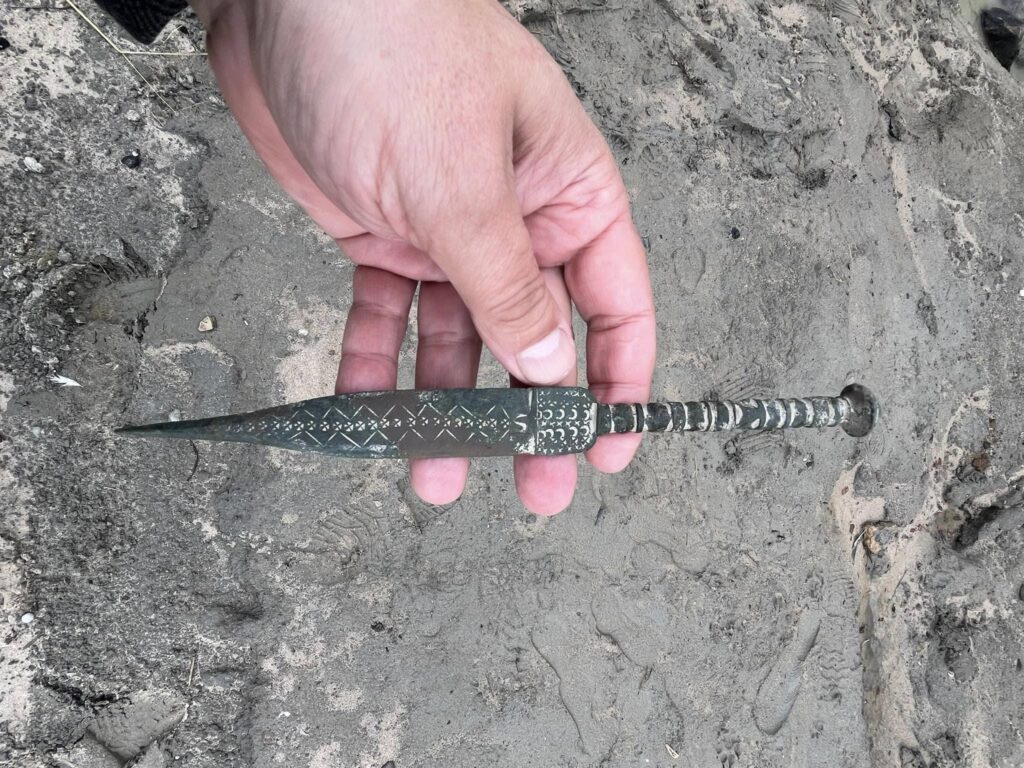
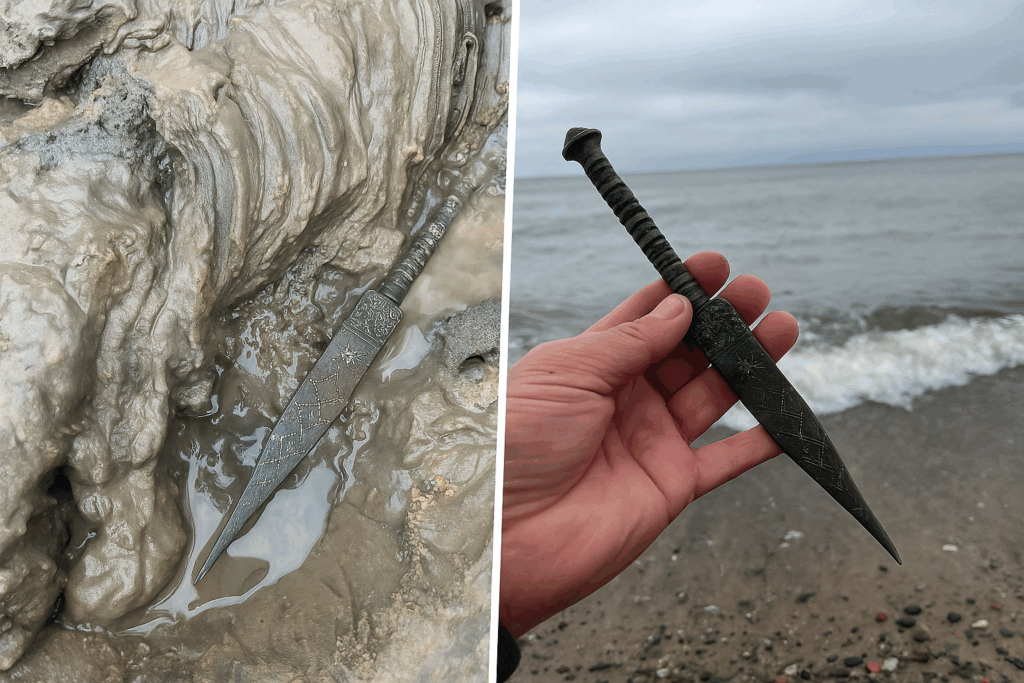
After powerful storms eroded a coastal cliff along Poland’s Baltic shoreline, nature itself unveiled a secret buried for nearly three millennia — a meticulously decorated Iron Age Hallstatt dagger. The discovery, announced by the Museum of the History of Kamień Land (Muzeum Historii Ziemi Kamieńskiej) on its official Facebook page, has been described as “a true work of art from thousands of years ago.”

A Discovery Shaped by the Sea

The extraordinary artifact was found embedded in a lump of clay dislodged from the cliff near Kamień Pomorski in West Pomerania. Local history enthusiasts Jacek Ukowski and Katarzyna Herdzik made the find while scanning the storm-stricken beach. Recognizing its potential importance, they immediately contacted the museum’s director, Dr. Grzegorz Kurka, who arrived on site to secure and evaluate the object.

The museum’s statement praised the pair’s swift response, calling their actions “a model of responsible heritage stewardship.” Without their intervention, the dagger might have been washed away or lost to private collectors.
Credit: Museum of the History of Kamień Land (Muzeum Historii Ziemi Kamieńskiej)

A Masterpiece of Early Iron Age Metalwork

Measuring roughly 24 centimeters (10 inches) in length, the weapon is lavishly ornamented with crescents, crosses, and geometric motifs etched along the blade. The handle terminates in a pointed pommel, decorated with alternating patterns that flow seamlessly toward the cutting edge. According to Dr. Kurka, the workmanship stands among the finest ever recovered in Poland:

“It is a true work of art — beautifully ornamented and of extremely high quality. Each engraved element is unique; I have never seen a dagger of this kind in our country.”


📣 Our WhatsApp channel is now LIVE! Stay up-to-date with the latest news and updates, just click here to follow us on WhatsApp and never miss a thing!!


As reported by Ancient Origins, the blade’s iconography — crescents and star-like crosses — may represent constellations or solar symbols, suggesting a ritual rather than purely martial function.

The museum notes that such symbolic designs were common during the Hallstatt period, a cultural horizon spanning roughly 800–450 BCE, recognized as the dawn of the European Iron Age.
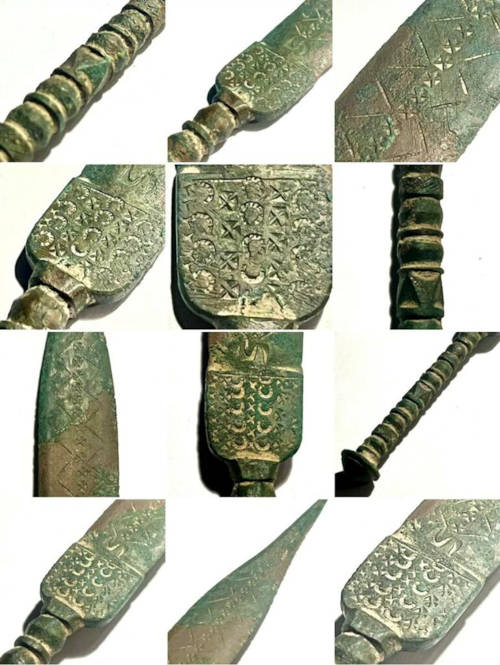
Detailed view showing the intricate celestial patterns on the Hallstatt dagger. Credit: Museum of the History of Kamień Land (Muzeum Historii Ziemi Kamieńskiej)

Ritual Object or Warrior’s Pride?

Scholars remain divided on the dagger’s intended use. Its elaborate surface decoration and lack of combat wear indicate it may have served as a ceremonial weapon, perhaps linked to solar or celestial worship prevalent in early Indo-European belief systems. Yet its sturdy form and balanced proportions could equally signify the possession of a high-status warrior, symbolizing both authority and divine favor.

Future laboratory analyses — including metallurgical composition testing and use-wear studies — will clarify its origin and purpose. The museum confirmed that upcoming tests will determine the alloy’s metal ratios and the casting method employed, offering insight into whether the piece was locally produced or imported through ancient trade networks.

Possible Southern European Origin

Given its artistic sophistication, Dr. Kurka has suggested the dagger might be an import, possibly cast in one of the established Iron Age workshops of southern Europe, such as northern Italy, Austria, or the Balkans. During the Hallstatt period, extensive trade routes connected Central Europe with the Baltic, enabling the exchange of amber, metal goods, and elite craftsmanship.

If this theory proves accurate, the artifact could represent tangible evidence of long-distance cultural interactions between Mediterranean and Baltic communities nearly 2,800 years ago.

Detailed imaging showing the intricate celestial patterns on the Hallstatt dagger. Credit: Museum of the History of Kamień Land (Muzeum Historii Ziemi Kamieńskiej)

Preservation and Next Steps

Remarkably, the dagger has survived almost intact, with its decorative patterns sharply preserved. Experts from the Provincial Conservator of Monuments in Szczecin are now overseeing conservation procedures before further public exhibition. While the precise location of the discovery remains undisclosed to prevent looting, the museum hopes to retain the piece for future study and eventual display in Kamień Pomorski.

For Poland’s archaeological record, the discovery marks one of the most artistically refined weapons ever found in the country and enriches the broader understanding of Iron Age metallurgy and ritual symbolism in northern Europe.

“This object not only testifies to the high level of ancient craftsmanship,” the museum’s statement concludes, “but also to the extraordinary history of the West Pomeranian region and its timeless connection to the wider ancient world.”

Museum of the History of Kamień Land (Muzeum Historii Ziemi Kamieńskiej)

Cover Image Credit: Museum of the History of Kamień Land (Muzeum Historii Ziemi Kamieńskiej)

Related Articles

1700-year-old weaving workshop discovered in southeast Turkey

4 December 2021

4 December 2021

Excavations carried out in the ancient city of Perre in the southeastern province of Adıyaman have unearthed a 1,700-year-old weaving...

Colossae Ancient City Excavation Works Begin

8 September 2021

8 September 2021

Excavations of the ancient city of Colossae, located in the Honaz district of Denizli province in western Turkey, are starting...

Rare Gold Coin from Reign of Byzantine Emperor Justin II Unearthed at Tuida Fortress in Sliven, Bulgaria

25 June 2025

25 June 2025

A rare gold coin dating back to the reign of Eastern Roman (Byzantine) Emperor Justin II (r. 565–578 CE) has...

World’s Oldest Murder

14 February 2021

14 February 2021

Researchers found a mass grave in a cave in Spain, now known as Sima de los Huesos, or the Pit...

409 silver coins, found in the Mleiha area of Sharjah, were inspired by Alexander the Great and the Seleucid dynasty

17 July 2021

17 July 2021

409 silver coins dating to the 3rd century have been found in the Mleiha area of Sharjah in the United...

Man-made Viking-era cave discovered in Iceland Bigger, Older Than Previously Thought

2 June 2022

2 June 2022

Archaeologists from the Archaeological Institute of Iceland have uncovered an extensive system of interconnected structures that are not only much...

Isotopic Evidence reveals surprising dietary practices of pre-agricultural human groups in Morocco

30 April 2024

30 April 2024

It has long been accepted wisdom that hunter-gatherer societies lived primarily off of meat. But fresh data from an innovative...

Unique Roman Cavalry Parade Helmet Recreated

6 April 2024

6 April 2024

Two replicas have been created of the gilded silver unique Roman cavalry helmet that amateur archaeologists found in 2001 while...

Two unique mid-14th-century shipwrecks discovered in Sweden

22 April 2023

22 April 2023

During an archaeological dig in western Sweden this summer, the remains of two medieval merchant vessels known as cogs were...

A Rare Design in Roman Military Architecture: Triangular Stone Tower Discovered Near Sofia

22 July 2025

22 July 2025

Bulgarian archaeologists have uncovered a triangular stone tower — a rare architectural form in Roman military design — at the...

An Ancient Site Found in UAE may be Sixth-Century Lost City of Tu’am

18 June 2024

18 June 2024

Ruins from the sixth century have been discovered during excavations in the United Arab Emirates Umm Al Quwain region, which...

Using Algorithms, Researchers Reassemble Jewish Text Lost Centuries Ago

27 January 2022

27 January 2022

Using new technology, researchers were able to comb a 19th-century text for the original study of a Bible interpretation attributed...

Archaeologists Uncover Large Roman-Era Complex Beneath Modern Melun

18 June 2025

18 June 2025

Archaeologists have uncovered significant remnants of the ancient Roman city of Metlosedum, now modern-day Melun, in a recent excavation revealing...

The Famous Cueva de Ardales cave in Spain was used by ancient humans for over 50,000 years

8 June 2022

8 June 2022

Cueva de Ardales cave in Málaga, Spain,  famed for the extensive prehistoric art on its walls was excavated for the...

How Evolutionary Biology Is Reshaping Our Understanding of the New Testament: The Case of the Missing ‘Son of God

5 August 2025

5 August 2025

In the remote wilderness of Egypt’s Sinai Peninsula, a forgotten room revealed one of the most significant biblical manuscript discoveries...