
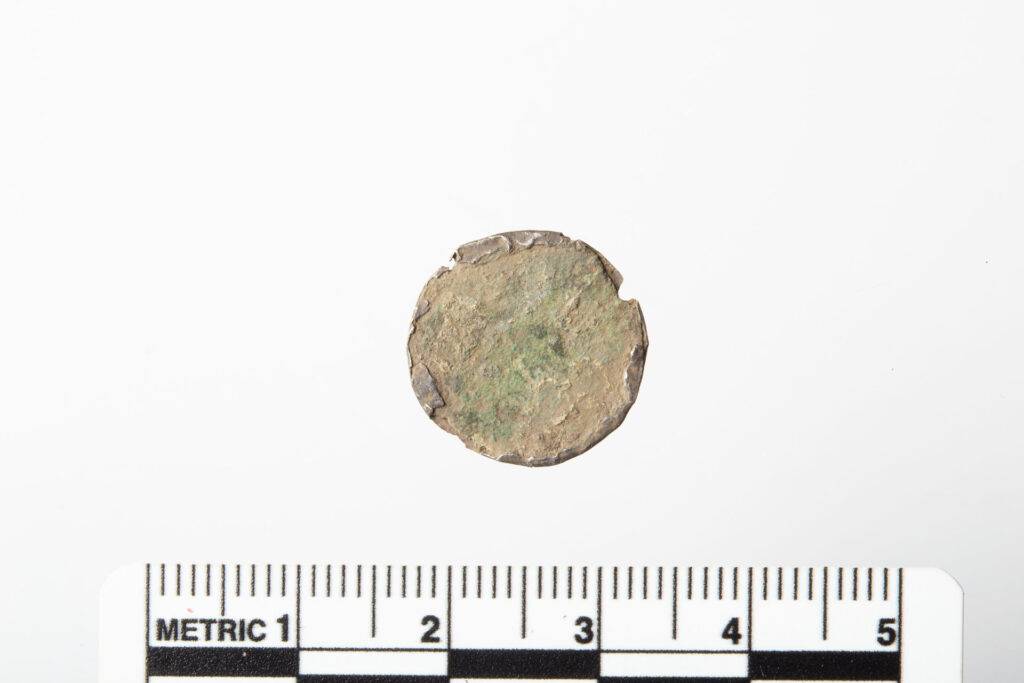
A small metal object found in a field near Utstein Abbey in southwestern Norway was first dismissed as a dirty button. Months later, it turned out to be something far rarer: a medieval silver coin minted under Magnus Barefoot, often described as Norway’s last Viking king.
The find was made by Morten Eek of Rygene Detector Club during a metal-detecting search near the abbey. The object came from the plough layer, only about 10–15 centimeters below the surface. At first glance it did not look especially promising. One side was bright and silvery, but the other appeared to be copper, making it resemble the kind of post-medieval clothing button frequently found by detectorists.
The “button” was put aside with other uncertain finds. Only months later, during a closer review, did Eek and other detectorists notice that the shiny side carried a clear cross motif. A comparison with older numismatic literature suggested that the object might be a coin rather than a button. Under magnification, it became clear that a copper plate had been attached to one side and that the coin’s edge had been folded around it.
Archaeologists at the Museum of Archaeology, University of Stavanger, later confirmed that the object was not an ordinary button. It was a rare medieval coin that had been altered, probably for reuse as an ornament.
A coin with a second life
According to archaeologist Linn Eikje Ramberg, the object had undergone what specialists call secondary modification. At some point after it was struck, a copper plate was placed against one side of the coin, and the coin’s outer edge was bent around it. Two small rounded notches on the rim may indicate fittings for a chain or loop.
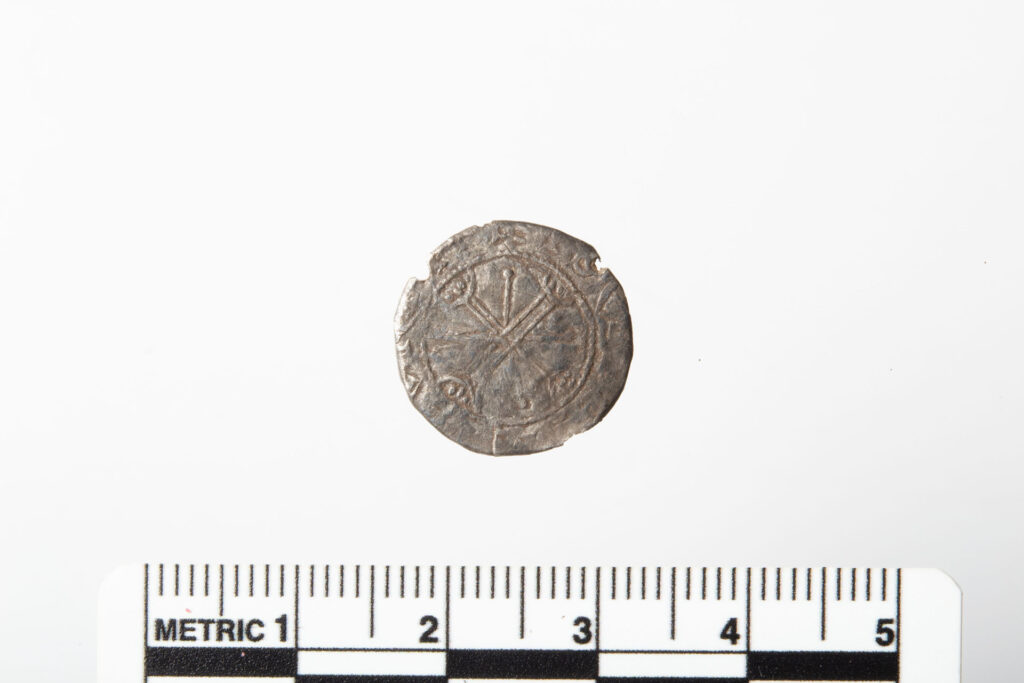
That alteration explains why the find was so easy to misread. Covered in soil, with copper visible on one side, it looked much more like a button than a coin. But the visible silver side carried a distinctive “cross over cross” design: a double-lined cross with curved or bowl-shaped endings, with traces of another cross-like form beneath it.
This motif was used on Norwegian coins from the late 11th century into the early decades of the 12th century. The inscription around the edge of the Utstein coin is too fragmentary to read securely, so the hidden side of the object became crucial.
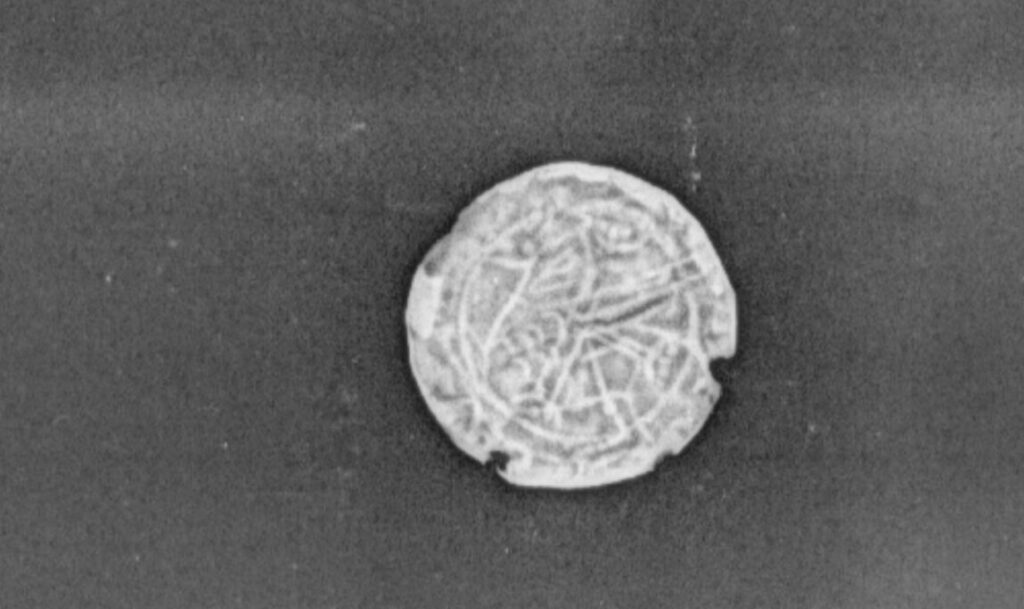
Removing the copper plate was not considered an option. The alteration itself is part of the object’s history. Instead, researchers used X-ray imaging. The image revealed that the coin was struck on both sides and that the concealed face carried a griffin-like creature.
That detail identified the coin as an issue of Magnus Barefoot, king of Norway from 1093 to 1103.
The reverse side of the object clearly shows the copper plate that was added, with the edge of the coin folded around it. Credit: Hege Hollund, Archaeological Museum, University of Stavanger
The last Viking king and his coin reform
Magnus Barefoot, known in Norwegian as Magnus Berrføtt, is often called Norway’s last Viking king because of his westward campaigns and his attempt to expand Norwegian power across the North Atlantic. He ruled after his father, Olaf Kyrre, and stood in sharper contrast to him. Olaf’s reign is remembered as relatively peaceful; Magnus pursued warfare and overseas expansion.
His campaigns extended Norwegian influence toward the western isles, the Hebrides, the Isle of Man, and parts of Ireland. He died in 1103, at about 30 years old, after being ambushed during a landing in Ireland on his second western expedition.
Magnus also carried out an important coin reform early in his reign. Earlier Norwegian coinage had seen major changes in silver content. Under Harald Hardrada, the silver percentage had been reduced sharply over time. Magnus reversed that trend in a striking way: he reduced the weight of the coins but used roughly the same amount of silver, raising their fineness to about 90 percent.
The Utstein coin therefore belongs not only to the political history of a king, but also to the monetary history of early medieval Norway. It was a small object, but it was part of a system through which royal authority, silver value and political ambition were made visible.
Only a handful of examples are known
Two-sided coins combining the griffin motif with the “cross over cross” design were already extremely rare. Before the Utstein discovery, only four examples were known: one from a hoard found at Sand churchyard on Sandoy in the Faroe Islands, and three from the Lundby Krat hoard near Aalborg in Denmark.
The newly identified Utstein coin appears to have been struck with the same die as one of the Danish examples. That matters because die links can help researchers understand the scale and organization of coin production. If a newly found fifth example shares a die with a previously known coin, it supports the idea that coinage under Magnus Barefoot was limited in volume.
In total, only around 100 coins struck under Magnus Barefoot are known, distributed across a small number of finds. Very few have been discovered within present-day Norway. Known finds in clude examples from Hjerkinn, Trondheim and now Utstein.
The Utstein discovery is therefore the first known example of this particular griffin and cross-over-cross type found on Norwegian soil.
The Coin and the Landscape Around Utstein
The find spot adds another layer to the story. Utstein Abbey is one of Norway’s most important medieval monastic sites, but the area around it was significant long before the abbey was established. It sits along a strategic coastal route between Stavanger and Karmsund, with access to the Ryfylke fjords and maritime connections westward.
Metal-detecting and geophysical work in the wider area have pointed to long-term activity, including possible Viking Age occupation and craft-related features. Archaeologists are cautious, however: the exact context of the coin is not yet secure, and the area has also produced later material and modern debris. Soil may have been moved in more recent times.
That caution is important. The coin does not prove that Magnus Barefoot himself was connected to Utstein, nor does it by itself identify the site as a royal center in his reign. What it does show is that a very rare coin from his period, later converted into an ornament, ended up in the landscape around one of southwestern Norway’s most historically layered places.
At just 0.81 grams, the object carries more than one story: a rare royal coin, a later piece of personal adornment, and a find nearly missed because it looked like a common button.
Cover Image Credit: The visible side of the coin, showing the “cross over cross” motif. H. Hollund, Archaeological Museum, University of Stavanger
