
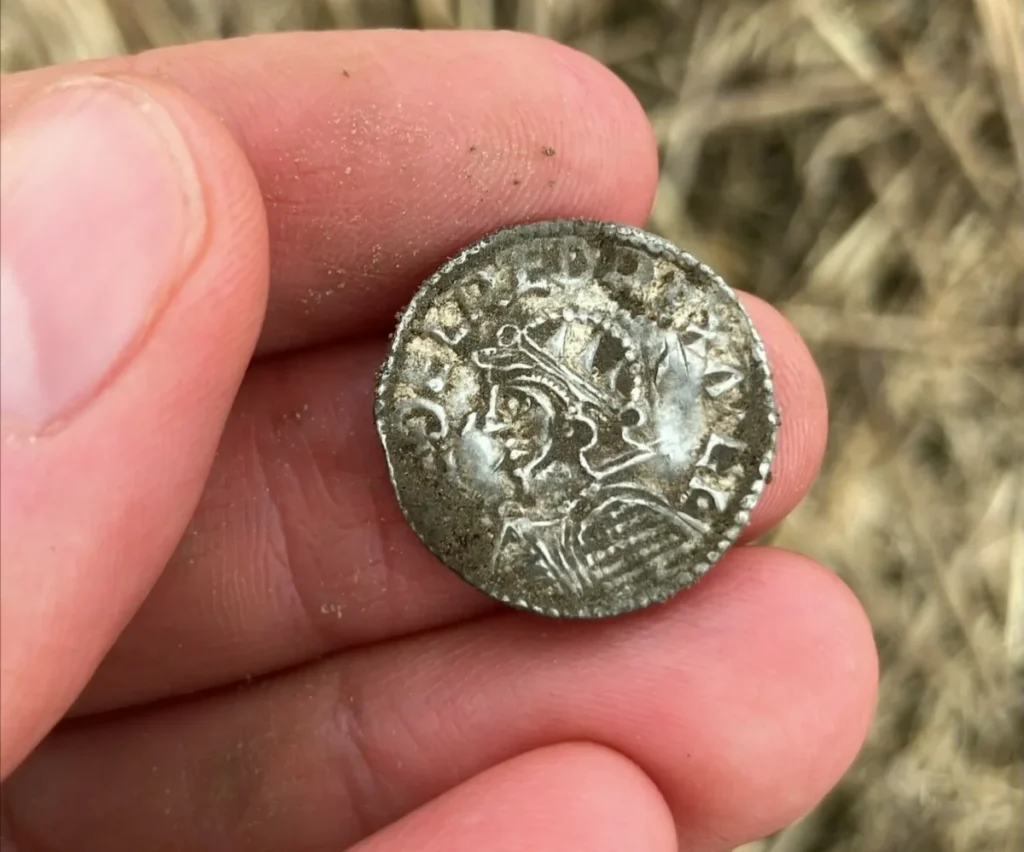
A quiet field near Rena in eastern Norway has produced a discovery unlike any other in the country’s Viking Age archaeology: more than 3,000 coins from a buried silver treasure that may have been hidden around the middle of the 11th century.
The find, now known as the Mørstad Hoard after the farm where it was uncovered, began with a signal from a metal detector. Detectorists Vegard Sørlie and Rune Sætre first recovered 19 silver coins on April 10. That was enough to stop the search and alert archaeologists. What followed turned a local discovery into a national archaeological event. As specialists joined the work, the number climbed first to 70, then far beyond earlier expectations. Within days, the field had yielded more than 3,000 coins, making it the largest Viking Age coin hoard ever found in Norway.
A discovery that kept growing
For archaeologists in Innlandet County Municipality, the scale of the find changed almost hour by hour. May-Tove Smiseth, the archaeologist responsible for metal detector finds in the county, described the discovery as “completely unprecedented.” The field had not previously been searched by detectorists, and the finders’ quick decision to report the coins allowed professionals to secure the area before the news became public.
A hoard of this size is scientifically valuable and vulnerable. Archaeologists and trained detectorists worked intensively to recover and document as much material as possible before the announcement. Most of the coins have since been delivered to the Museum of Cultural History in Oslo, where conservation and study will begin.
The condition of the coins has also surprised researchers. The soil at the site contains very little stone, which may have protected the silver from heavy abrasion during centuries of ploughing. Many pieces appear sharply preserved, offering experts a rare opportunity to study late Viking Age coin circulation.
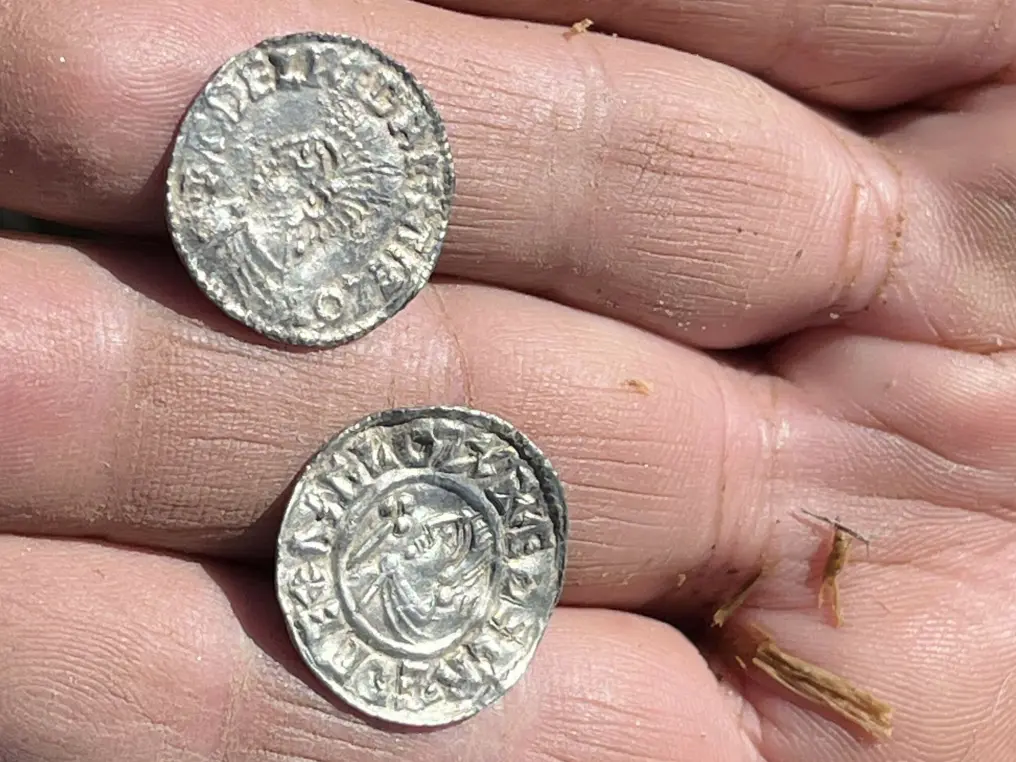
Two of the silver coins from the hoard, with a king’s head in profile. Credit: Anne Engesveen / Innlandet County Municipality
A silver economy connected to Europe
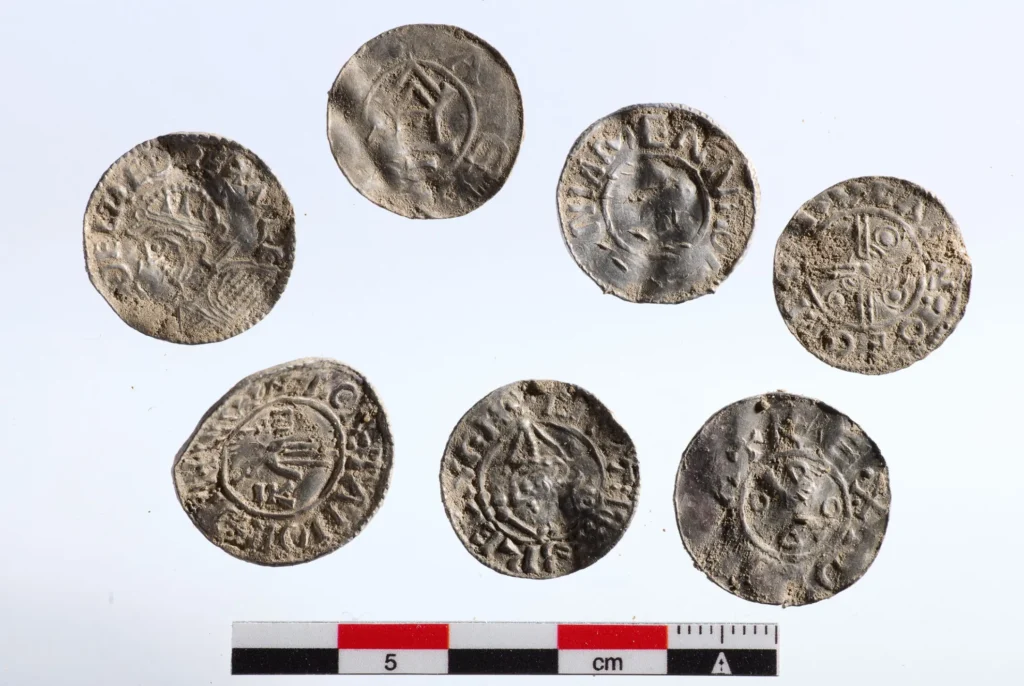
The Mørstad Hoard appears to date to the end of the Viking Age, probably around 1050. According to coin expert Professor Svein Harald Gullbekk of the Museum of Cultural History, most of the coins identified so far are German and English. That pattern fits what scholars know about money in northern Europe during the late Viking Age, when foreign silver coins moved through trade, tribute, raiding networks and political payments.
In practical terms, these coins functioned as a shared silver currency across broad parts of northern Europe. Their presence in an inland Norwegian field is a reminder that Viking Age Norway was not isolated. Coins minted far away could end up in Scandinavia, where they were valued both as money and as silver by weight.
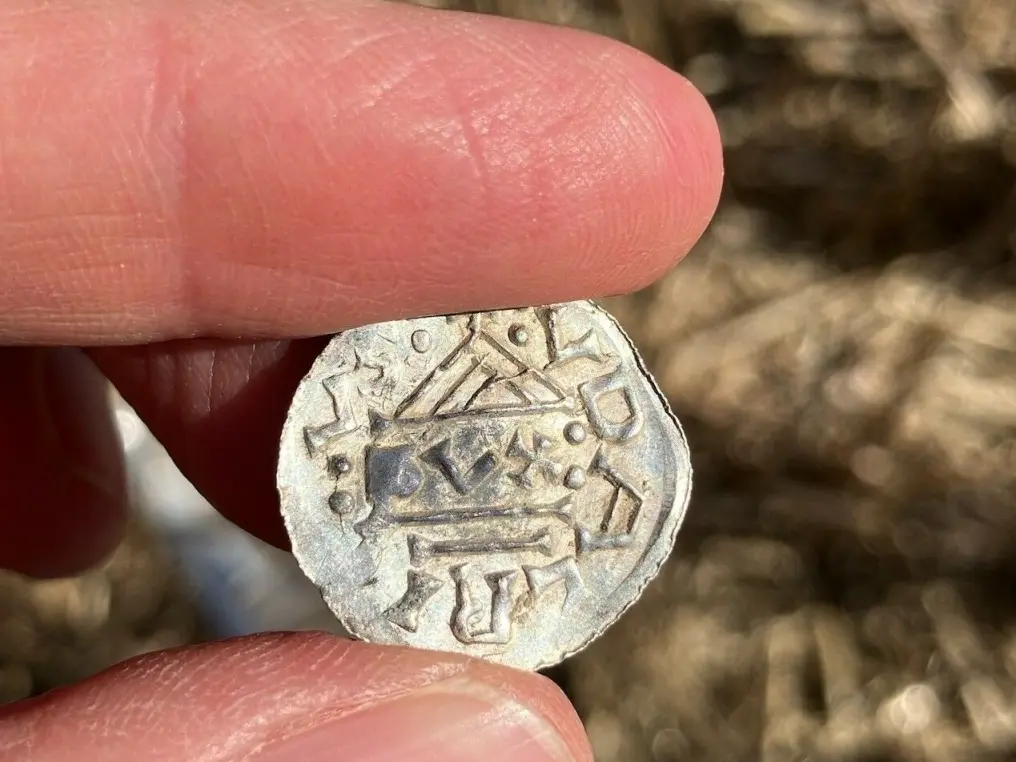
The hoard’s most historically sensitive element may be its Norwegian coins. Gullbekk has noted that these pieces must have been relatively new when they were placed in the ground. Their presence links the treasure to the period after Harald Hardrada returned from Byzantium and helped establish a Norwegian national minting system around 1045.
The discovery captures a turning point when Norway was moving deeper into royal monetary authority while still participating in the wider silver economy of the Viking world.
Why was the treasure buried?
Archaeologists believe the coins were probably buried in a leather pouch or another container made of organic material. Over time, the container decayed. Later ploughing scattered the coins across the field, which explains why detector signals continue to appear over a wider area rather than from one compact spot.
Surveys with ground-penetrating radar have not revealed buildings or other clear archaeological structures nearby. That does not mean the field was insignificant. Hoards were often placed in landscapes that made sense to the people who buried them, even if those markers have disappeared from modern view.
The reason for the burial remains uncertain. Viking Age people sometimes placed valuables in the ground as offerings, but many hoards also look like hidden wealth, stored for safety during periods of risk. Gullbekk has compared the practice to using the land as a safe deposit box. The owner may have intended to return. For reasons now lost, they never did.
The value of the Mørstad Hoard is difficult to calculate. Written price records from Viking Age Norway are scarce. Still, later medieval property records suggest that a treasure of this size may have represented enough wealth to buy a farm. Whether it belonged to one powerful individual, a household or a wider group, it was serious capital.
More coins may still be waiting
The search is not over. Archaeologists expect the field and surrounding area to remain under investigation for future seasons. Each time the soil is turned, more objects could come to the surface, including coins missed during the first recovery.
The Mørstad Hoard now gives researchers a major new dataset for studying the final phase of the Viking Age in Norway. Its coins may help clarify trade links, royal minting, silver movement and the ways families protected wealth in a politically changing world. Somewhere in the same soil, more fragments of that buried fortune may still be waiting.
Cover Image Credit: Museum of Cultural History / Innlandet County Municipality
