
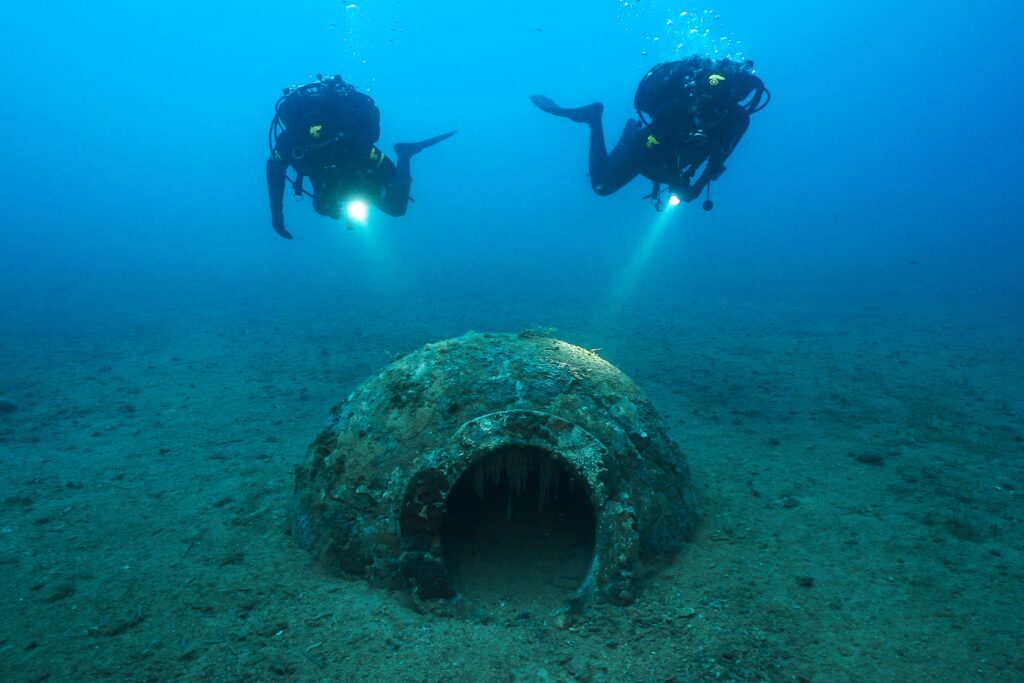
Underwater surveys off Italy’s Elba Island have revealed a large Roman dolium and the remains of a wooden vessel that archaeologists have not yet been able to identify or precisely date.
The discoveries were made during an underwater archaeological monitoring program led by the Soprintendenza Archeologia, Belle Arti e Paesaggio for the provinces of Pisa and Livorno, working with the Carabinieri Cultural Heritage Protection Unit in Florence and the Carabinieri Divers Unit in Genoa.
The program began in May 2026 and covers waters between the Piombino Channel and the islands of the Tuscan Archipelago. Archaeologists are checking previously recorded sites, updating underwater maps and investigating new reports of possible archaeological remains.
A Roman dolium once used to transport bulk goods
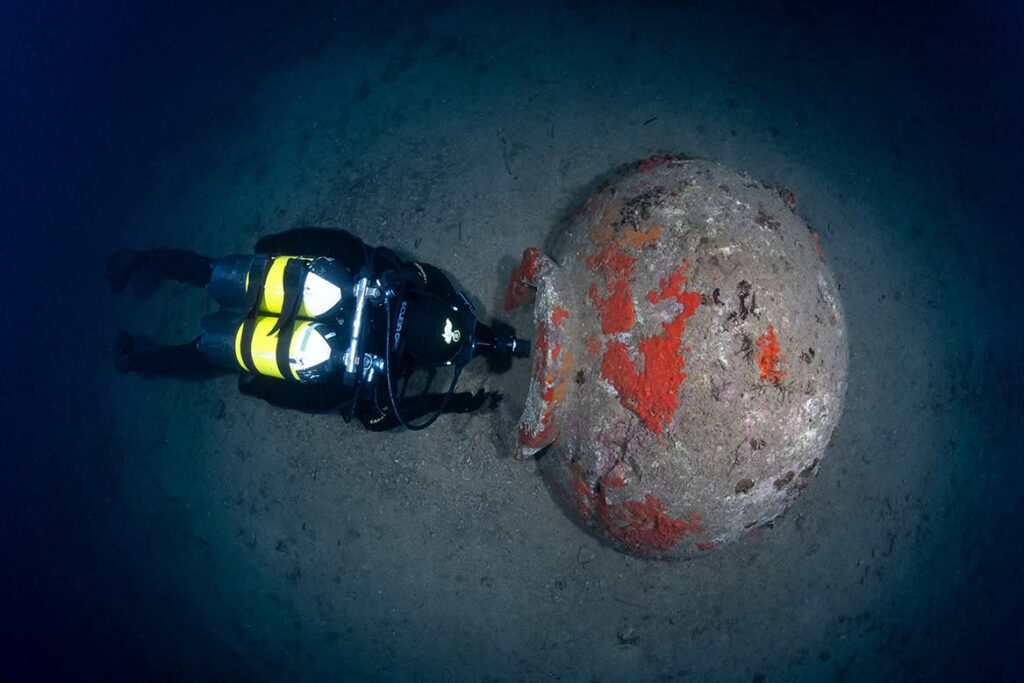
One of the most significant finds is a dolium, an exceptionally large terracotta container used in antiquity to store and transport commodities such as wine, olive oil and grain.
Unlike amphorae, which could be individually moved during loading and unloading, dolia could hold enormous quantities of liquid or foodstuffs. On some Roman merchant vessels, the containers were installed within the hull and effectively functioned as large storage tanks. Roman dolia varied greatly in size, with some large examples capable of holding around 2,000 liters—roughly the equivalent of 75 standard Roman amphorae.
According to the Soprintendenza, the characteristics and archaeological context of the newly discovered vessel suggest that it may have belonged to one of the so-called navi a dolia, merchant ships used particularly between the 1st century BC and the 1st century AD to carry bulk wine along major Tyrrhenian trade routes.
These vessels represented a very different approach to maritime transport from ships loaded mainly with amphorae. Large dolia required considerable space and careful positioning inside the hull, allowing merchants to move substantial quantities of wine without packaging the entire cargo in thousands of individual containers.
For now, however, archaeologists have identified only the single dolium. More evidence would be required before the site could be confidently interpreted as the remains of a Roman dolia carrier.
A second discovery may be the remains of a ship
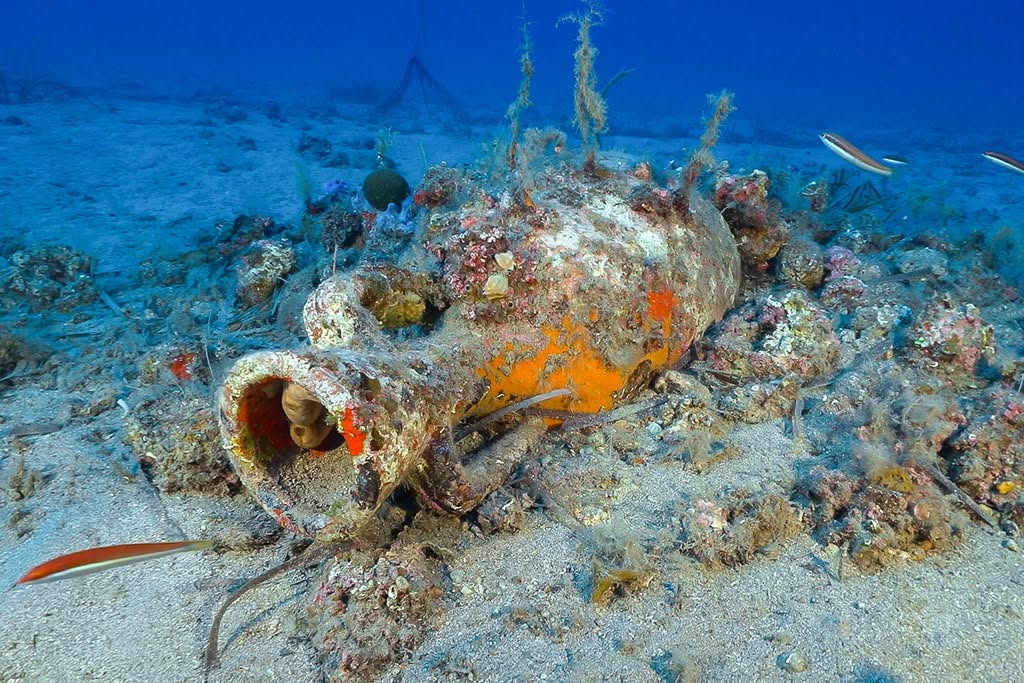
Nearby underwater investigations also revealed what appears to be part of a wooden wreck.
The visible structure measures roughly five meters long and two meters wide and is currently almost completely covered by marine mucilage, making detailed examination difficult.
Divers nevertheless identified sections of hull planking, other structural wooden elements, and numerous bronze nails.
Its age remains uncertain.
The Soprintendenza said the surviving construction could date anywhere between Late Antiquity and the Middle Ages. At this stage, researchers have not established whether the wooden remains and Roman dolium are connected to the same maritime event.
That distinction is important. A Roman-period container lying near a wooden structure does not necessarily mean that both reached the seabed at the same time.
A second underwater investigation campaign planned for autumn 2026 is expected to include exploratory archaeological testing aimed at establishing the nature, chronology and extent of the possible wreck.
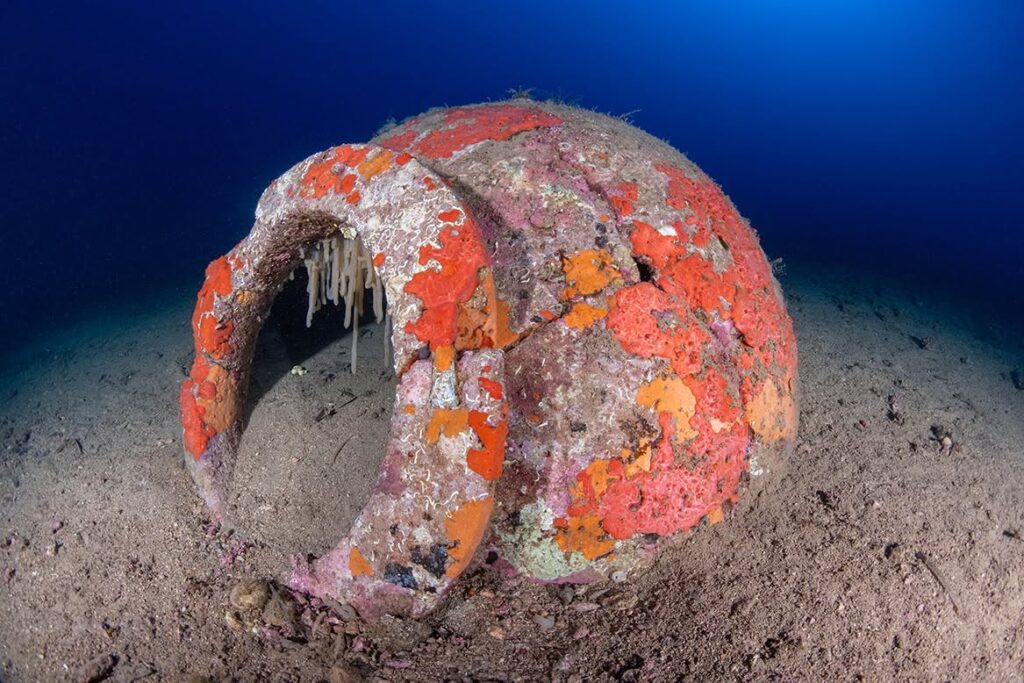
Roman dolia varied greatly in size, with some large examples capable of holding around 2,000 liters: roughly the equivalent of 75 standard Roman amphorae. Credit: Soprintendenza archeologia, belle arti e paesaggio per le province di Pisa e Livorno
Elba stood on important Tyrrhenian sea routes
The discoveries add to a long record of ancient maritime activity around Elba, an island positioned just off the Tuscan coast in the northern Tyrrhenian Sea.
Long before Roman rule, Elba was known for its rich iron deposits and had close economic links with the Etruscan center of Populonia on the mainland. During the Roman period, mining continued while agriculture, wine production, coastal settlements and maritime trade became increasingly important parts of the island’s economy.
Archaeological sites around Portoferraio and elsewhere on Elba have documented Roman agricultural and residential complexes, while the surrounding seabed preserves evidence of ships that once moved goods through this heavily traveled stretch of the Mediterranean.
One of the best-known examples is the Roman wreck discovered off Procchio in 1967, while other ancient maritime remains have been recorded around different parts of the island.
The newly discovered dolium therefore fits into a much broader archaeological landscape in which production on land and transport at sea were closely connected.
Archaeologists will return in autumn
Officials have not disclosed the precise location of the discoveries, a standard protective measure for vulnerable underwater archaeological sites.
The Soprintendenza is also seeking greater involvement from Italy’s National Superintendency for Underwater Cultural Heritage in future inspections of wrecks lying at medium and greater depths.
For Superintendent Valerio Tesi, the discoveries underline the archaeological importance of the waters surrounding the Tuscan Archipelago and the need for continued cooperation between archaeologists, law-enforcement diving units and local diving centers.
The next campaign will be particularly important for the unidentified wooden structure. Excavation may establish whether archaeologists are looking at a substantial section of a larger vessel, a smaller craft, or remains belonging to an entirely different period from the Roman dolium found nearby.
Until then, the two discoveries remain separate pieces of evidence from a seabed that preserves centuries of maritime traffic around Elba.
Soprintendenza archeologia, belle arti e paesaggio per le province di Pisa e Livorno
