
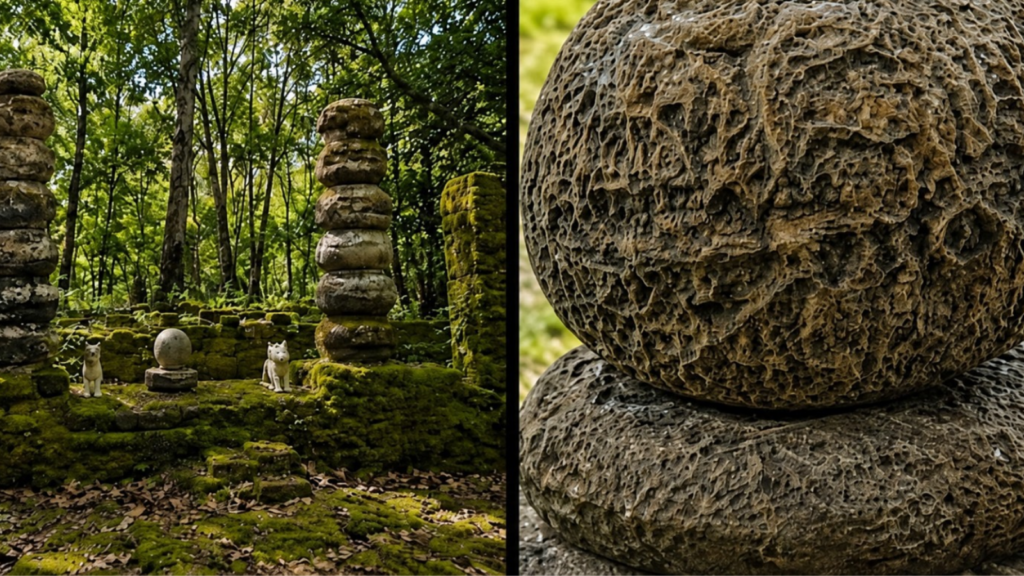
A stone revered for generations by the Baiga Indigenous community in the forests of central India has been identified as a rare 65-million-year-old coral fossil, revealing that a local sacred site had also been preserving an extraordinary remnant of deep geological time.
The discovery was made in the Dindori district of Madhya Pradesh, where officials from the state’s Directorate of Archaeology, Archives and Museums have been documenting the region’s largely unexplored archaeological and geological heritage. According to The Times of India, the unusual formation first caught researchers’ attention through photographs taken during that work, after repeated local reports pointed them toward a structure in the forest that, at first glance, resembled the layered stonework of a small temple.
Its layered surface and coral-like structure appeared sufficiently unusual to warrant a closer investigation. A team subsequently visited the site and carried out a series of tests, after which the formation was identified as an ancient coral fossil dating back approximately 65 million years — placing it near the boundary between the Late Cretaceous and Paleogene periods, the geological dividing line marked by the mass extinction that ended the age of dinosaurs. The precise testing methods have not yet been detailed publicly.
What makes the find particularly unusual, however, is not simply its age. Long before specialists recognized its scientific significance, the stone had already been singled out and protected by the people living around it.
A fossil preserved as a sacred place
The formation stands within a forest shrine associated with the Baiga community, for whom forests, plants, animals and features of the natural landscape have long held cultural importance.
Madan Kumar Nagargoje, Madhya Pradesh’s archaeology commissioner, who led efforts to document Dindori’s geological heritage, said the community could not have scientifically determined the stone’s composition or age. Yet, he noted, generations of local people understood that the object was unusual and worthy of protection — protection that, without any awareness of what lay beneath it, ultimately helped preserve a fossil whose origins predate human history by tens of millions of years.
The Baiga are officially recognized among Madhya Pradesh’s Particularly Vulnerable Tribal Groups, or PVTGs. Dindori forms part of the forested region traditionally associated with Baiga communities, where knowledge connected with local landscapes has been passed between generations. Madhya Pradesh government records also identify the Baiga as one of the state’s three PVTGs.
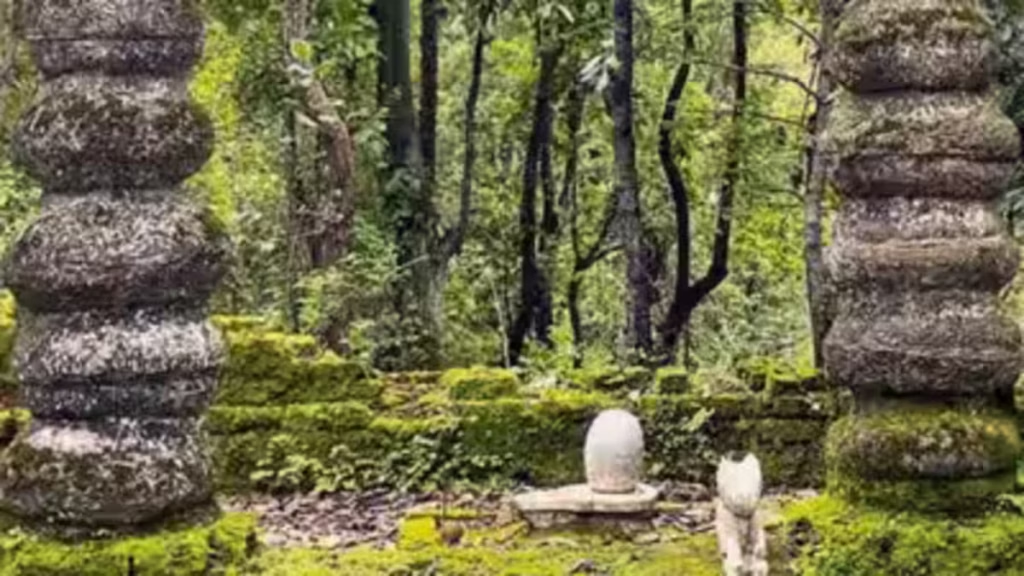
The forest shrine in Madhya Pradesh’s Dindori district, revered by the Baiga community for generations. Credit: Times of India
Could the shrine tradition be thousands of years old?
Archaeological Survey of India archaeologist Dr. Manoj Kumar Kurmi suggested that the tradition surrounding the natural shrine could potentially extend back 8,000 to 10,000 years, although this has not been established through direct dating of the worship practices themselves.
Kurmi pointed to a period before monumental temples became part of the region’s built landscape, when rocks, trees, mountains and other striking natural features could become focal points for belief and ritual.
His interpretation does not mean that archaeologists have demonstrated continuous worship at this particular stone for 10,000 years. Rather, it offers a possible cultural framework for understanding how an unusual natural formation might have acquired sacred significance and continued to be protected over long periods: a human timescale that remains a tiny fraction of the roughly 65 million years attributed to the fossil itself, and a reminder that the two dates rest on entirely different kinds of evidence.
Dindori’s landscape is revealing more than one kind of history
The fossil is part of a broader effort to document Dindori, an area whose forests conceal archaeological as well as geological evidence, and one that has already given up more than one prehistoric secret. The district is also home to Ghughua Fossil National Park, where plant fossils of a similar age, spanning the Upper Cretaceous to the early Tertiary, include ancient palms and dicotyledons once cited as evidence of the region’s links to the Gondwana supercontinent.
Not far away, in the Bagh region along the Narmada Valley, sedimentary beds have yielded fossilized dinosaur eggs and bones from the same Late Cretaceous window: stone eggs that local communities are said to have worshipped as a guardian deity for generations before their scientific significance was recognized, echoing the pattern now seen with the Baiga shrine.
The region has also produced prehistoric rock shelters. Priyanka Ghose, a physician who has worked with Indigenous communities in the area, was involved in documenting Stone Age rock shelters at the Ghodamada caves and described the latest discovery as another indication of how much remains to be investigated across Dindori.
Selected finds documented in the district are reportedly expected to be displayed in a new gallery at the State Museum in Bhopal, according to The Times of India.
For researchers, the newly identified coral fossil adds another piece to the geological record of central India. For the Baiga community, however, the stone had been important long before its age could be measured, and its formal identification now confirms what generations of local reverence had, without knowing it, already gotten right.
