
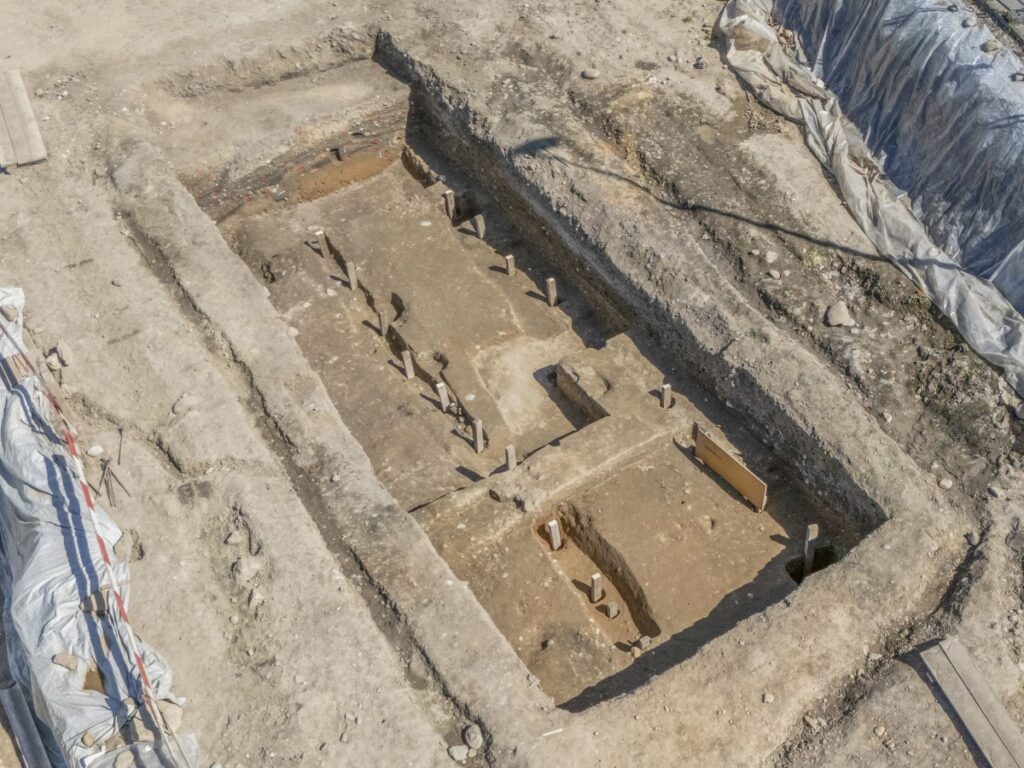
A major rescue excavation at Vindonissa in Switzerland has revealed the defences of the site’s earliest Roman military camp, along with a legionary barracks, a field forge, a possible bread oven and an exceptional collection of personal and medical objects.
Among the most remarkable finds are a gold aureus minted under Emperor Tiberius, a one-centimetre carnelian gemstone engraved with Victoria, the Roman goddess of victory, and two objects interpreted as possible handles from Roman scalpels.
The discoveries offer a rare view of Vindonissa during its formative military phase. They reveal not only how the first camp was defended and organized, but also how its soldiers worked, prepared food, received medical treatment and expressed ideas of victory, protection and imperial loyalty.
The Cantonal Archaeology Department of Aargau completed the eleven-month excavation on Zürcherstrasse in Windisch in mid-July 2026. Around 20 archaeologists investigated and documented 2,225 square metres before the site was released for construction.
The discoveries provide the clearest picture yet of how the military settlement developed during its earliest decades and how the area continued to be used from the first to the fourth century AD.
The excavation was carried out ahead of the construction of the “via romana” residential development. The archaeological remains were scientifically documented before they were removed by the building project.
The Missing Boundary of the Earliest Camp
More than 90 years ago, early researchers working in Königsfelden Park recorded a V-shaped defensive ditch belonging to Vindonissa’s first military camp. However, the precise route of its southern fortifications remained uncertain.
The new excavation has now identified both the associated ditch and the remains of a wood-and-earth rampart.
The fortification stood about 70 metres south of the wall belonging to the later legionary fortress. Just beyond the excavation area, it turned towards the northwest, giving archaeologists important evidence for reconstructing the size and layout of the earliest camp.
The rampart was probably constructed during the early reign of Emperor Tiberius, who ruled from AD 14 to 37, although the artifacts examined so far do not permit a more precise date.
Environmental evidence from the ditch produced another unexpected detail. Traces of pioneer vegetation suggest that the defensive system was neglected long enough for plants to colonize it before the fortification was repaired and returned to use.
A Legionary Barracks Beneath a Roman Road
The excavation also revealed buildings connected with the daily lives of Vindonissa’s earliest soldiers.
Beneath a later Roman road in the western part of the site, archaeologists documented a structure measuring nine metres wide and at least 30 metres long. Its regularly arranged rooms and antechambers indicate that it was probably a barracks occupied by legionaries.
The survival of the building beneath the later road provides a rare opportunity to examine Vindonissa before the establishment of the better-known permanent legionary fortress.
To the east, immediately inside the early camp wall, archaeologists found the remains of what may have been a bread oven. Its position suggests that this part of the camp functioned as a production or workshop zone.
Beside it, inside an even older building apparently dating from Vindonissa’s pioneering military phase, the team uncovered the carefully constructed hearth of a field forge.
Together, the barracks, oven and forge show that the early camp was not merely a temporary defensive enclosure. It contained organized residential and production areas supporting a permanent military community.
Bread, Gold and the Goddess of Victory
Large debris layers outside the later legionary fortress produced coins ranging in date from the Roman Republic to Late Antiquity.
Archaeologists also recovered blacksmithing equipment, leatherworking tools and the lower stone of a Roman hand mill. The objects appear to reflect the activities of both soldiers and civilians living beyond the camp walls.
Among the most striking discoveries was a gold aureus minted during the reign of Tiberius. As a high-value denomination, the coin stands apart from the more common bronze and silver currency generally encountered at Roman sites.
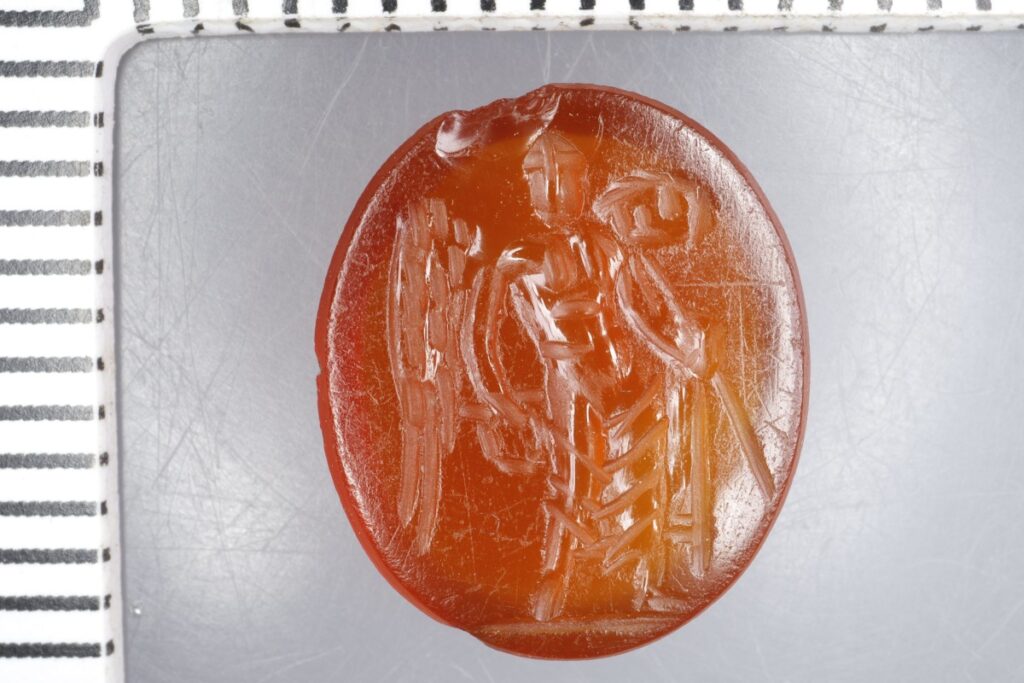
Another exceptional find is a carnelian gemstone measuring only about one centimetre. Its engraved surface depicts Victoria, the Roman goddess of victory, holding a staff and wreath—symbols associated with triumph and military success.
Such engraved gemstones were commonly mounted in rings and could function as personal ornaments, seals or symbols of identity. At a legionary base, the image of Victoria would have carried particular significance for soldiers serving the Roman Empire.
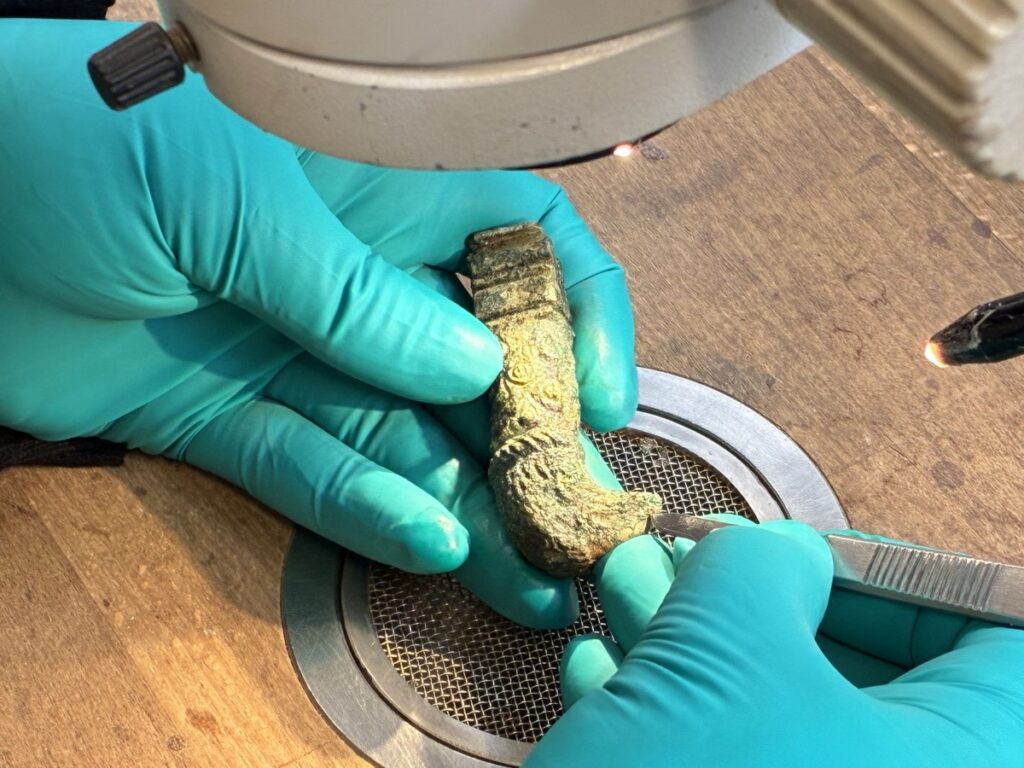
Archaeologists also recovered two objects that may have been handles belonging to Roman scalpels. One appears to end in a carefully shaped animal head.
Although further conservation and examination are required, the finds may provide evidence for medical activity within or around the military settlement.
Roman legions depended on trained medical personnel to treat wounds, illnesses and injuries. If the identification is confirmed, the handles would add an important human dimension to the excavation, showing that life at Vindonissa involved not only fortifications, weapons and workshops, but also surgery and organized healthcare.
Together with the Tiberian gold coin, the gemstone and possible surgical tools form one of the excavation’s most significant groups of finds. They connect the camp’s military history with the private beliefs, health and everyday experiences of the people who lived there.
These objects provide glimpses of several overlapping aspects of life at Vindonissa: military identity, specialized craftsmanship, personal adornment, economic activity and potentially medical care.
A Rare Roman Loaf Remains Under Study
The excavation had previously attracted attention with the discovery of a small, blackened circular object identified as a probable carbonized Roman bread.
Measuring approximately ten centimetres across and three centimetres thick, it resembles a small flatbread. It survived because it had been burned, a process that transformed the organic material into carbon and prevented its complete decomposition.
The object was removed together with the surrounding soil and transferred to the Cantonal Archaeology Department’s conservation laboratory. Specialist analysis is expected to determine its ingredients and confirm its identification.
If verified, it would represent the first Roman bread discovered in Switzerland.
Switzerland’s Only Roman Legionary Fortress
Vindonissa occupied a strategically important position near the confluence of the Aare, Reuss and Limmat rivers.
Roman soldiers established a military post there during the Alpine campaigns of Emperor Augustus around 15 BC. The installation developed into a permanent legionary base under Tiberius.
The camp eventually covered approximately 20 hectares and accommodated as many as 6,000 soldiers. The 13th Legion initially constructed its buildings from wood and earth before the 21st Legion gradually replaced and expanded them in stone.
The 11th Legion remained at Vindonissa until Emperor Trajan transferred it towards the Danube in AD 101.
A civilian settlement continued outside the fortress after the legionaries departed. Vindonissa remains the only Roman legionary camp known within the territory of modern Switzerland.
The Zürcherstrasse excavation adds a new chapter to this history by exposing the camp’s formative phase—the period when Vindonissa was evolving from an early military foothold into one of Rome’s most important bases north of the Alps.
