
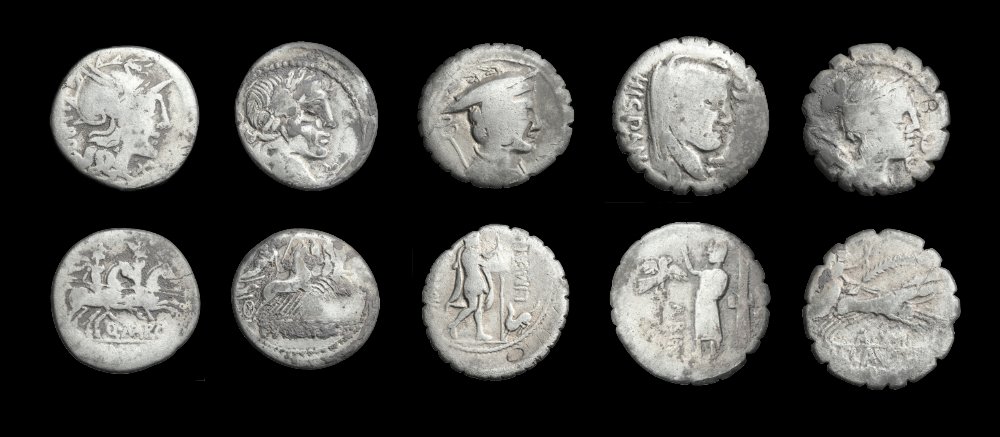
A group of five Roman Republican silver coins discovered in Halle, eastern Germany, has been identified as the first securely documented hoard of its kind in the state of Saxony-Anhalt.
The denarii were found in 2025 by volunteer archaeological heritage officer Dirk Braungardt during a survey of cultivated land. Although only five coins were recovered, their close distribution suggests that they once formed a single deposit, perhaps carried in a small purse that was deliberately buried or accidentally lost.
The discovery is particularly unusual because Roman Republican silver coins are extremely rare in northeastern Germany. Archaeologists believe the small hoard may have reached the Halle region around the beginning of the first millennium, offering new evidence for contacts between the Roman world and communities living beyond the empire’s borders.
Five coins from the final decades of the Roman Republic
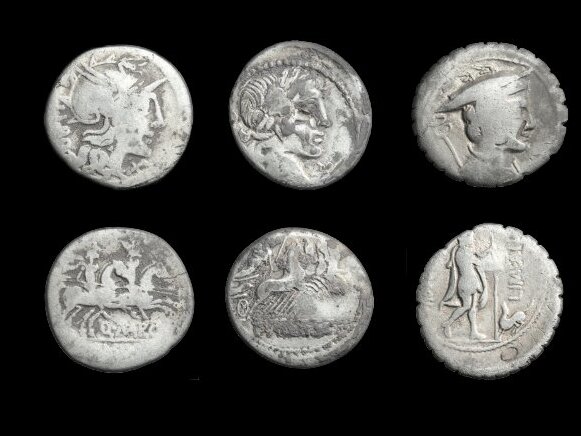
The earliest coin was minted in 148 BC, while the other four date from between 82 and 79 BC, during the turbulent final phase of the Roman Republic.
All five were recovered from a tightly restricted area. Researchers suspect that ploughing, erosion or animal activity gradually moved the coins apart after they entered the ground.
The original circumstances remain uncertain. The coins may have represented the contents of a small purse, but archaeologists cannot yet determine whether they were hidden intentionally or simply lost.
What makes the Halle discovery significant is its secure archaeological context. Only 19 Roman Republican coins had previously been recorded in the modern territory of Saxony-Anhalt, and almost all were isolated finds. Four additional coins from Großleinungen were acquired in 1897, but their original find circumstances can no longer be reconstructed.
The Halle group is therefore considered the first reliably identified small hoard of Roman Republican denarii in the state.
Rare evidence north of the Roman frontier
Roman Republican denarii are more frequently recorded farther west, particularly in Thuringia and Lower Saxony. Their distribution becomes much thinner toward northeastern Germany.
Apart from known hoards at Niemegk in Brandenburg and Zettemin in Mecklenburg-Western Pomerania, Republican silver coins remain scarce across the region.
Their presence so far beyond Roman-controlled territory indicates that long-distance exchange networks extended deep into the area Roman writers called the Barbaricum. The coins may have been valued not primarily as currency, but as portable pieces of silver carrying material and social prestige.
Archaeological surveys and the work of licensed detectorists have increased the number of recorded finds in recent decades. Even so, Republican denarii remain exceptional in northeastern Germany.
Graffiti and serrated edges
The five coins show heavy signs of wear, suggesting that they circulated for a long period before reaching Halle. Republican denarii remained valid inside the Roman Empire well into the first century AD, meaning coins minted decades earlier could continue moving through commercial and social networks.
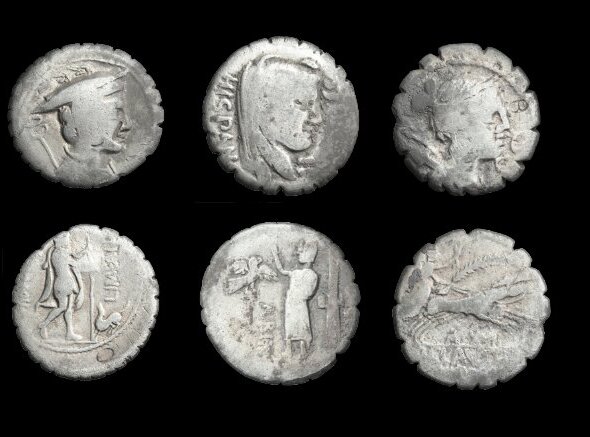
Three of the five examples are serrati—denarii with deliberately notched or serrated edges. Two also carry graffiti scratched into their surfaces.
The function of the serrated edge remains debated. Proposed explanations include demonstrating that the coin was made of solid silver, discouraging the clipping of metal from its edge or serving as a decorative feature.
The Roman historian Tacitus claimed that Germanic communities preferred serrated coins. However, the wider archaeological record of Roman coins in the Barbaricum does not provide clear support for such a general preference.
How did the Roman coins reach Halle?
The absence of Roman imperial coins from the deposit may provide an important chronological clue.
Researchers cautiously suggest that the denarii could have reached the Halle region around the turn of the era or shortly afterward. Had they arrived much later, they might be expected to appear alongside coins issued under Roman emperors. The interpretation remains hypothetical, particularly because the five coins may represent only part of a larger original group.
There was no Roman-style monetary economy in what is now Saxony-Anhalt at the time. The denarii therefore probably circulated as valuable silver objects rather than as everyday payment.
Possible routes into the region include long-distance trade, diplomatic gifts, subsidy payments, transfers through Germanic networks or military conflict.
Roman campaigns under Drusus in 9 BC, Ahenobarbus around 3 BC and the future emperor Tiberius in AD 5 brought Roman forces into central Germany. Coin discoveries found at intervals of roughly 20 kilometres—approximately a day’s march—have been linked to these movements, although recently identified Roman marching camps in Saxony-Anhalt are currently attributed to later campaigns.
The Halle hoard does not prove exactly how the coins crossed the Roman frontier. It does, however, add a rare piece of evidence to the history of exchange, mobility and political contact between Rome and the societies of central Europe more than 2,000 years ago.
Landesamt für Denkmalpflege und Archäologie Sachsen-Anhalt
Cover Image Credit: State Office for Heritage Management and Archaeology Saxony-Anhalt, O.S.C.A.R.
