
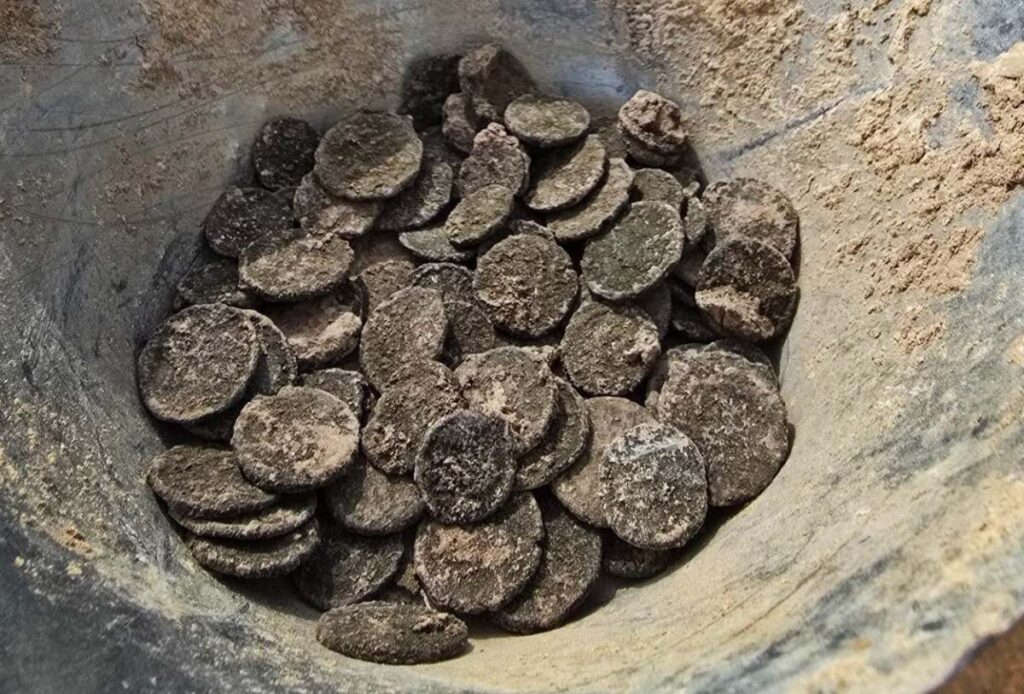
A cluster of 302 Roman coins found near Mohovo in eastern Croatia may preserve the final trace of a small military unit stationed along one of Rome’s most sensitive frontiers: the Danube Limes.
The coins were uncovered during archaeological investigations led by the Institut za arheologiju, Zagreb, which has been studying Roman defensive infrastructure in Vukovar-Srijem County. Found within roughly one square meter at the site of a Roman watchtower, the hoard appears to belong mainly to the 4th century CE, when the Danube frontier remained one of the empire’s most closely watched military zones.
A small post on a major imperial border
Mohovo lies close to the Danube, the river that marked one of the most important military boundaries of the Roman Empire. This was not a landscape of grand stone forts alone. Between larger camps, Roman control depended on smaller posts, patrol routes, timber watchtowers, and carefully placed observation points.
According to Siniša Krznar, assistant director of Croatia’s Institute of Archaeology, the wider area was controlled by major Roman camps at Ilok and Sotin. Between them, smaller watchtowers monitored crossings and ravines leading toward the river. These modest military points helped soldiers watch movement across the frontier and send warnings along the defensive chain.
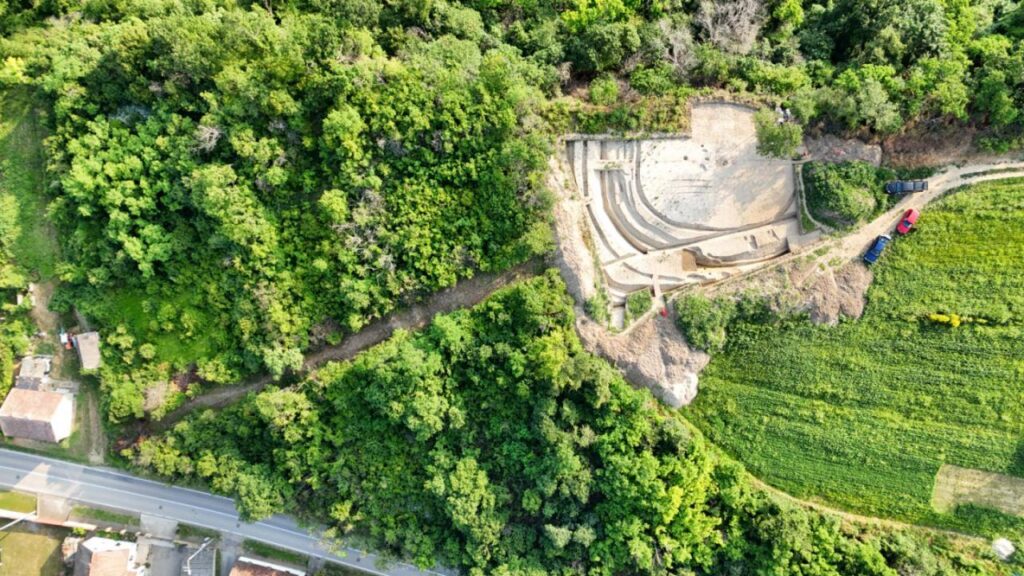
At Mohovo, archaeologists identified the remains of a wooden watchtower surrounded by defensive ditches. HRT reported that such structures were often built on posts, rising several meters above the ground, with V-shaped semi-circular ditches around the central area. The design was simple, but strategically effective: one watchtower could see another, creating a visible line of surveillance along the river.
Coins hidden in a moment of danger
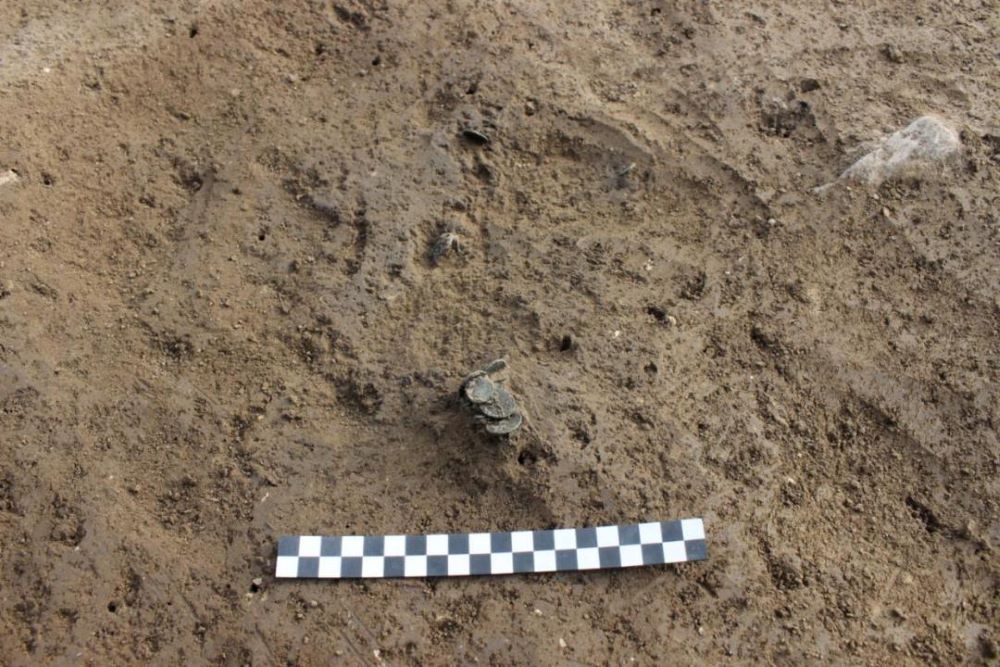
The 302 coins were recovered from a ditch during excavation. Damir Topić, a field technician involved in the work, described first noticing one coin while scraping the soil, then another. The concentration quickly suggested that the team had encountered something far more significant than scattered lost change.
Marko Dizdar, director of the Institute of Archaeology, suggested that the money may have belonged to the soldiers stationed at the Roman watchtower. One possible explanation is that the garrison buried the coins during an attack or emergency, intending to return once the danger passed. They apparently never did.
That interpretation gives the find its human force. The coins are not only archaeological data. They may represent a military payroll interrupted by violence, fear, or sudden withdrawal on Rome’s Danube border.
The Institute’s ongoing project on the Danube Limes in Vukovar-Srijem County has used geomagnetic surveys and trial excavations to identify Roman watchtowers and temporary military camps. The project is linked to wider efforts to document and protect the Roman frontier system in Croatia, including its potential inclusion in the UNESCO World Heritage framework.
The age of Valentinian I
Preliminary information suggests that many of the coins were minted during the reign of Emperor Valentinian I, who ruled the western half of the Roman Empire from 364 to 375 CE. That detail is especially important in eastern Croatia, because Valentinian was born at Cibalae, the Roman city beneath modern Vinkovci.
Cibalae was not a minor settlement. In late antiquity, it stood as an important urban and military center in southern Pannonia. Modern Vinkovci preserves this Roman inheritance beneath its streets, and the city is associated with two emperors, Valentinian I and his brother Valens.
Valentinian’s reign was marked by efforts to reinforce Rome’s frontiers, especially along the Rhine and Danube. The Mohovo coins fit into that broader world of late Roman defense, when imperial power was still formidable but increasingly stretched. Small frontier posts mattered because the empire could no longer rely only on large military bases. Control had to be maintained through local vigilance, rapid communication, and disciplined garrisons stationed at vulnerable points.
More than coins beneath the soil
The Mohovo site has produced other Roman-period finds, including fibulae, the brooches used to fasten clothing, and a fishing hook linked to daily life along the Danube. These objects broaden the picture. Soldiers at the watchtower were not only watching the frontier. They were living there, repairing equipment, fastening cloaks, eating, and using the river that shaped both military strategy and everyday survival.
Jere Drpić, senior assistant at the Institute of Archaeology, has also pointed to additional potential Roman military sites in the surrounding area. That means Mohovo may be one part of a wider defensive network still hidden under the fieland the Middle Ages. Mohovo is also known for Ice Age fossil discoveries, especially mammoth remains, which have given the area a second identity as a landscape of both ancient animals and ancient empires.
After conservation, restoration, and scientific analysis, the coins are expected to enter a museum collection. Their final value will not be measured only in metal or number. If the interpretation proves correct, the hoard may offer a rare look at the last anxious moments of a Roman garrison guarding the Danube frontier more than sixteen centuries ago.
Institut Za Arheologiju (Institute of Archaeology in Zagreb)
Cover Image Credit: Institut Za Arheologiju
