
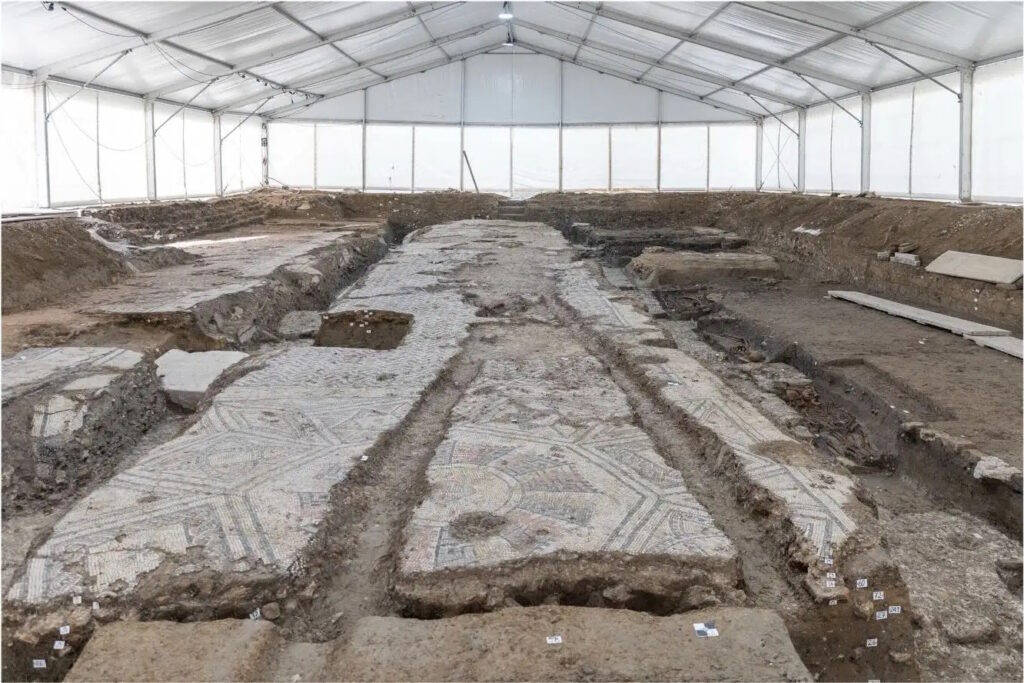
Archaeologists in northeastern Italy have uncovered the remains of an early Christian basilica beneath the former fish market of Oderzo, revealing polychrome mosaic floors, substantial wall foundations, and burials that may mark the city’s first known Christian place of worship.
The discovery was made in the historic center of Oderzo, in the province of Treviso, in the Veneto region. The site lies in the area of the former Pescheria, a short distance from the modern cathedral and below the present street level. Excavations began in November 2025 as preventive archaeological investigations ahead of a planned residential development. According to the Soprintendenza Archeologia, Belle Arti e Paesaggio for Padua, Treviso and Belluno, the work has exposed a major Late Antique context that is now reshaping the history of ancient Opitergium, the Roman predecessor of Oderzo.
A Church Beneath the Former Fish Market
The excavation has so far covered an area of nearly 30 by 30 meters, corresponding to the future building lot. What emerged was not a small chapel or isolated floor fragment, but the foundations of a large rectangular building divided into three naves. The structure measures about 23 meters in width, while its verified length is at least 30 meters. Its western front was probably cut away in the medieval period by the digging of a canal that still defines part of the area today, meaning the original length cannot yet be established with certainty.
The building’s foundations are preserved around three meters below the modern walking surface. Some walls are up to 1.20 meters thick and were made of bricks bonded with mortar. They were also set on wooden piles driven into the alluvial soil, a technique used to improve stability in wet ground. External pilasters or buttress-like projections appear at regular intervals along the perimeter walls.
Archaeologists identify the structure as a Christian place of worship because of its basilical layout, the presence of burials placed alongside the building, and architectural elements thought to belong to the liturgical area. Near the eastern limit of the excavation, small square bases may have supported low screens that separated the presbyterial area. The apse, however, has not yet been found and may lie beyond the current excavation limits.
Mosaics Point to the Late 4th or 5th Century
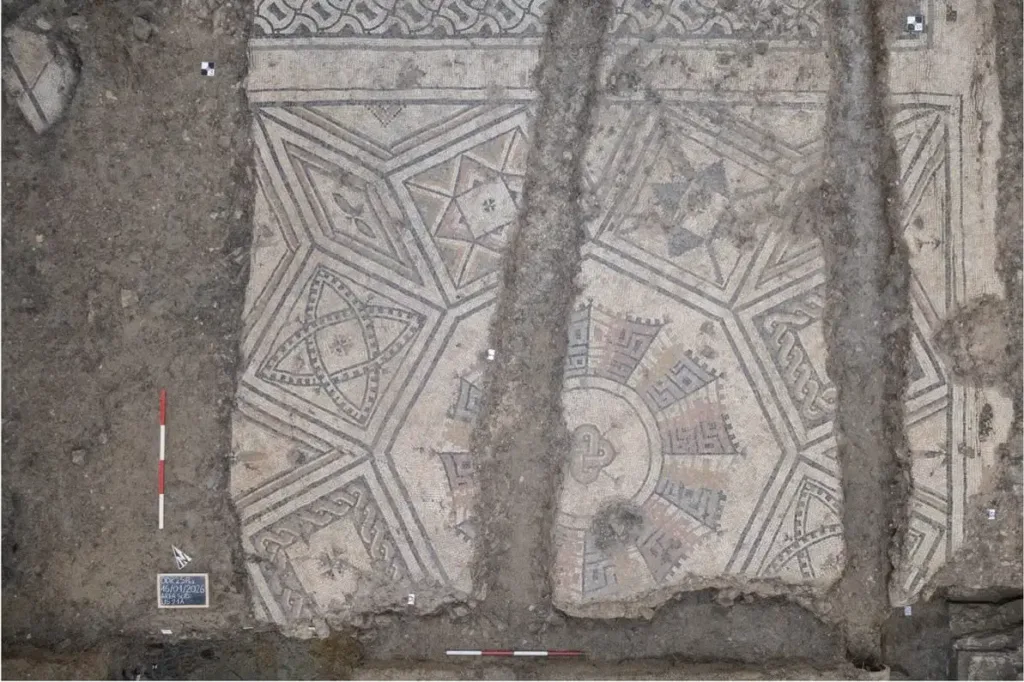
The most striking remains are the polychrome mosaic pavements, especially in the southern aisle and part of the central nave. Their decoration includes geometric and vegetal compositions typical of Late Antique northern Italy: octagons framed by guilloche bands, interlaced circles with acanthus leaves, ivy and pelta motifs, and lozenges with inscribed crosses.
One of the most elaborate panels contains a large central octagon with a velarium, or awning-like motif, surrounded by squares and lozenges bordered by double frames. The quality of the design and the presence of glass-paste tesserae suggest a building with a high decorative level, not merely a modest suburban shrine. On stylistic grounds, the Soprintendenza currently places the complex between the late 4th and the 5th century AD. Radiocarbon dating of bones and wooden piles is planned to refine the chronology.
The floors are not intact everywhere. Parts of the mosaics were damaged by modern construction from the 20th century and by earlier episodes of stone and material removal after the abandonment of the complex. Even so, the surviving pavements are extensive enough to show that this was a carefully planned and richly decorated building.
Burials Beside the Basilica
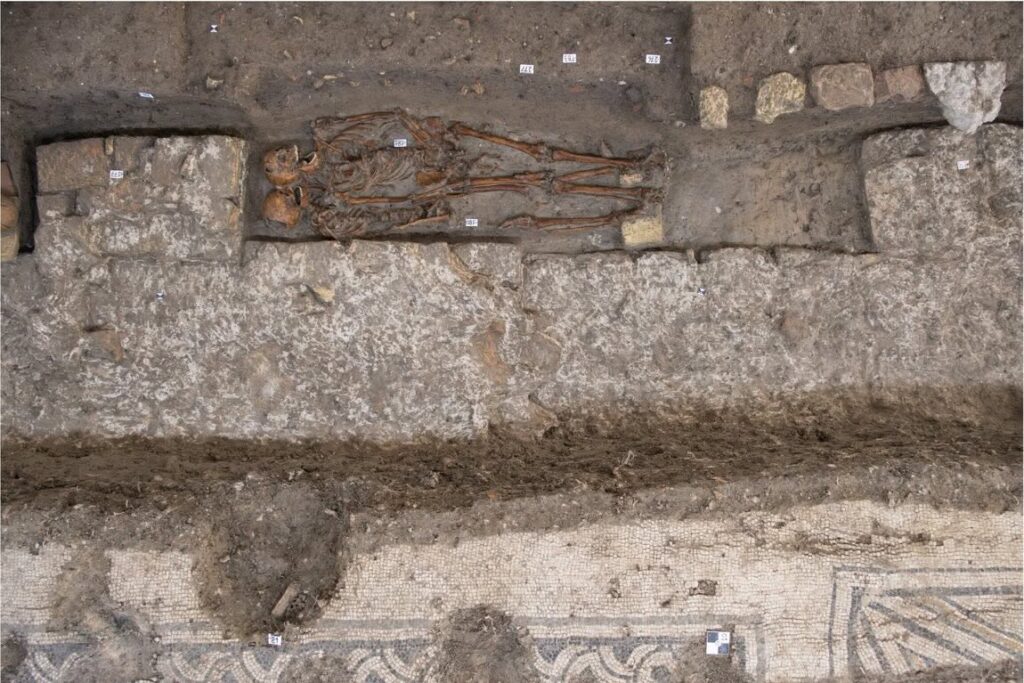
Four inhumation burials were also found along the southern perimeter wall, placed between the external projections of the building. Three of the graves contained two individuals each, and all were without grave goods. Seven individuals are now under anthropological study.
The burials are important because they strengthen the interpretation of the site as a Christian funerary or suburban ecclesiastical complex. At this stage, however, the exact status of the building remains open. The Soprintendenza notes that further study is needed to understand its hierarchy and its relationship to the early bishops of Oderzo, especially because the site lies about 100 meters south of the present cathedral.
Opitergium After Rome
Oderzo is already one of the most archaeologically important towns of the Veneto. Ancient Opitergium developed from earlier settlement in the region and became a major Roman urban center. The city’s Roman forum and domus area, excavated between 1983 and 1992, show a public and residential quarter with a paved forum, basilica, shops, a Capitolium, and richly decorated domestic floors. The Ministry of Culture dates the main forum complex to the Augustan period, between the late 1st century BC and early 1st century AD, with occupation continuing into the 6th and 7th centuries AD.
The former Pescheria site adds a different chapter to that story. It shows that the urban life of Opitergium did not simply end with the decline of the classical Roman city. Instead, the town’s sacred and social landscape was being reorganized in Late Antiquity, when Christianity was transforming cities across northern Italy. Nearby areas had already produced Late Antique and early medieval burials, a Byzantine fortified structure, and earlier mosaic discoveries, including a large polychrome mosaic reportedly found in Via Pescheria in 1883 and later reburied.
A Site Planned for Public Display
The excavation is now moving from discovery to documentation, analysis, and conservation. Specialists will study the human remains, date the wooden piles and burials, restore the mosaics, and define the building’s construction phases more clearly.
The site will not simply be covered again. According to the Soprintendenza officials, the municipality and the project owners are evaluating ways to keep the most significant remains visible. The future residential complex is expected to include a dedicated cultural and tourist space, allowing the basilica’s mosaics and architectural remains to become part of Oderzo’s archaeological itinerary.
For now, the find is best understood not as a complete answer, but as a rare opening into a poorly visible phase of the city’s history. Beneath a former fish market, archaeologists have found evidence for a large, decorated Christian building at the edge of ancient Opitergium — a place where mosaic art, burial practice and urban memory came together during one of the most transformative periods in northern Italy.
Soprintendenza Archeologia, Belle Arti e Paesaggio for Padua, Treviso and Belluno
Cover Image Credit: Soprintendenza ABAP for the provinces of Padua, Treviso, and Belluno.
