
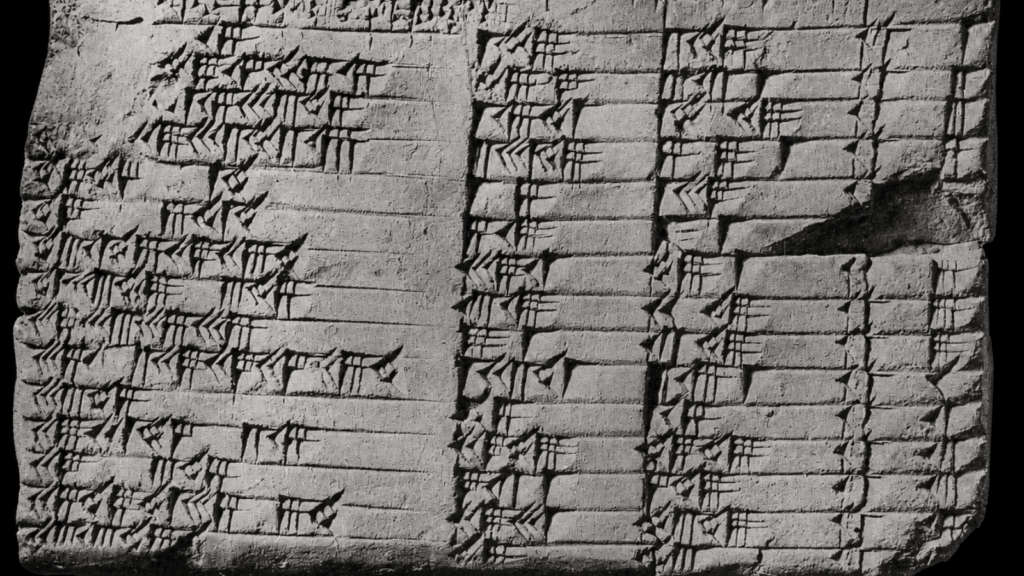
TabletCraft, a new open-source AI system for translating cuneiform, tackles a problem that has challenged archaeology for more than a century. Museums worldwide hold an estimated half a million ancient tablets containing royal decrees, epic poetry, trade receipts, and personal letters. Yet only a few hundred people alive today can read the script fluently, and scholars have translated only a small fraction of this vast archive.
AI has spent the past several years chipping away at the problem from one direction only, turning ancient Akkadian into modern English. TabletCraft, developed by Zhaohui Wang at the University of Southern California’s Viterbi School of Engineering, is the first open-source tool to open the door the other way as well.
TabletCraft was accepted to the 4th Workshop on Cross-Cultural Considerations in NLP (C3NLP), held alongside ACL 2026, and its authors have made the code, pretrained model, and pip-installable package freely available.
Translating in Both Directions for the First Time
Every prior Akkadian translation system, including the well-known Akkademia project and later neural machine translation work published in PNAS Nexus, moved in a single direction: cuneiform or its transliteration went in, English came out.
That leaves scholars able to read the ancient world, but no one — expert or amateur — able to write back into it. Wang’s paper presents this as a distinctive cultural barrier, unlike the challenges that multilingual NLP typically addresses. The problem does not separate two living communities that could eventually learn each other’s languages. Instead, it creates a one-way asymmetry across time: modern readers can use translation to access ancient texts, but modern users have no comparable way to produce text in the ancient script.
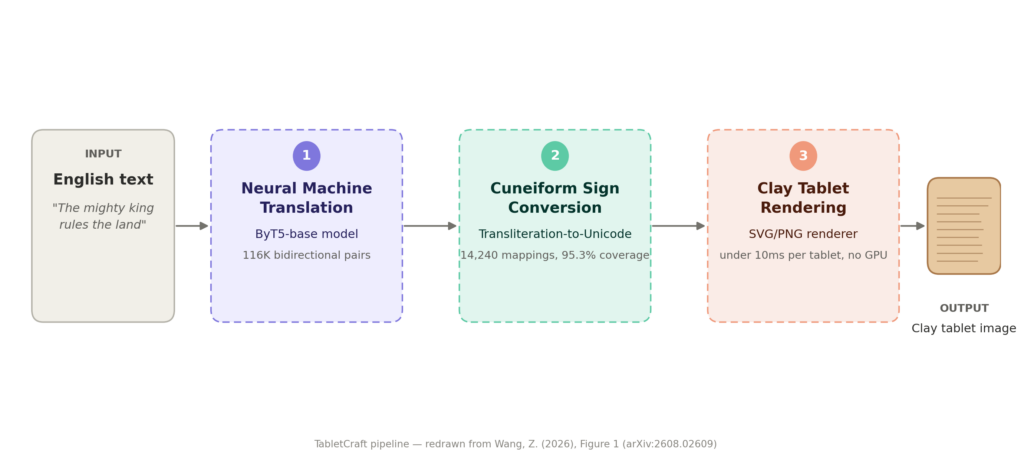
TabletCraft closes that loop. A user types a sentence in English, the system translates it into Akkadian, converts the result into cuneiform signs, and renders the whole thing as an image of an inscribed clay tablet. The reverse direction, reading an existing tablet, still works as before.
Under the Hood
The translation engine is a fine-tuned ByT5-base model, a byte-level transformer chosen specifically because it can handle Akkadian’s diacritics and logograms without the vocabulary mismatches that trip up more conventional tokenizers.
It was trained on 116,000 bidirectional sentence pairs, built by combining the existing Akkademia dataset with a more recent shared translation task and additional sentence-aligned data, then training the model to translate in both directions using task prefixes.
A second component, the cuneiform converter, is a lookup table of over 14,240 transliteration-to-Unicode sign mappings compiled from major digital Assyriology resources, including the Open Richly Annotated Cuneiform Corpus (ORACC) and the Cuneiform Digital Library Initiative (CDLI).
On 1,000 sampled transliterations from the Akkademia test set, the converter achieved 95.3 percent token coverage. The remaining 4.7 percent, consisting of uncovered determinatives or rare logograms, are passed through verbatim. A third component, the tablet renderer, lays the converted signs out on a stylized Neo-Assyrian clay tablet background in under 10 milliseconds, with no GPU required.
How Good Is the Translation?
On a held-out Akkademia validation set of 2,812 Neo-Assyrian samples, TabletCraft scored 49.1 BLEU for Akkadian-to-English translation. That exceeds the 37.5 BLEU reported for Akkademia, although the paper cautions that the two figures come from different test splits and domain mixes. For the new English-to-Akkadian direction, TabletCraft scored 48.5 BLEU, which the paper describes as the first published quantitative result in the reverse direction at this scale.
| Direction | System | BLEU | chrF++ |
|---|---|---|---|
| Ak→En | Akkademia* CNN | 37.5 | — |
| Ak→En | TABLETCRAFT | 49.1 | 63.1 |
| En→Ak | TABLETCRAFT | 48.5 | 55.6 |
Why the Reverse Score Needs Context
The lower chrF++ score in the reverse direction largely reflects the flexibility of Akkadian writing. Writers can often represent the same word or phrase in several valid ways, including different syllabic spellings or a logographic sign in place of a syllabically spelled form. Because chrF++ compares the model’s output with a single reference string, the metric can penalize a valid alternative spelling even when the model produces linguistically and Assyriologically sound Akkadian.
Wang therefore frames the reverse-direction score as a conservative estimate rather than a precise measure of correctness. The paper includes side-by-side examples in which the model uses a different spelling from the historical reference but preserves the same underlying meaning. In one example, the model writes a king’s title with MAN instead of the historical reference’s LUGAL: the model output is MAN KUR—aš-šur, while the reference is LUGAL KUR AŠ. Automatic scoring can therefore label a fluent translation as an “error” when the spelling differs from the reference even though the translation remains Assyriologically sound.
The translation quality also isn’t uniform across genres. Because the training data leans heavily on Neo-Assyrian royal inscriptions, the model handles that register more reliably than it does the terser, more abbreviation-heavy world of Old Assyrian merchant correspondence, a limitation the paper attributes to genre and dialect distribution rather than to the model architecture itself.
Designed Around Four Cultural Tensions
Rather than treating this as a purely technical translation problem, Wang’s paper lays out four design challenges specific to working with a dead, ceremonially and administratively loaded language. One is that Akkadian encodes concepts with no clean modern equivalent, such as joint-stock capital arrangements or dating systems tied to annually rotating officials, which the system preserves in their original form rather than smoothing into modern paraphrase. Another is what the paper calls “the reverse direction as cultural agency”: earlier tools positioned users purely as readers of a dead culture, while allowing composition invites them to participate in it, a shift the paper treats carefully by explicitly labeling all machine-generated Akkadian as approximate rather than authoritative.
A third tension is serving two very different audiences at once. Assyriologists and graduate students use the Akkadian-to-English direction to triage untranslated tablets, expecting rough drafts they will revise by hand, sign by sign. Museum staff, educators, and casual users approach the tool from the opposite end, rendering a name or short dedication as a tablet image for engagement rather than scholarship. The system exposes every intermediate step, from transliteration to sign mapping to the final rendered tablet, so neither audience is stuck with an opaque black box tuned for the other.
The fourth concern raised in the paper is more institutional: Mesopotamian heritage has historically been studied disproportionately by Western universities, even though the underlying material culture belongs to the modern nations, Iraq, Syria, Turkey, and Iran, whose territory once made up ancient Mesopotamia. The project presents the release of the toolkit as free and open-source software as a small step toward lowering that barrier for researchers and educators in those countries.
Tested With Real Users
Beyond benchmark numbers, the paper describes pilot use with three different groups. Undergraduate students in an introductory cuneiform course used the English-to-cuneiform pipeline to compose personal name tablets and short dedications, then read them aloud as a literacy exercise.
Museum educators are prototyping “write your name in cuneiform” kiosks for school visitor programs, which required sub-second rendering and safeguards against inappropriate input.
Assyriologists, meanwhile, used the Akkadian-to-English direction to speed up their preliminary review of newly photographed Neo-Assyrian tablets. They treated the output like OCR text: a draft they could check and correct against the original rather than a finished translation.
Potential Applications for TabletCraft
TabletCraft goes beyond a one-click translation system. Researchers, educators, and developers can access the toolkit through a command-line interface, Python API, or Gradio web demo and use different parts of the pipeline for their own needs. The authors describe TabletCraft as a “draft-and-revise” assistant rather than an authoritative translator. The system labels its Akkadian output as approximate and lets users inspect each intermediate step, from transliteration to sign mapping. When the system detects low-confidence material, it can fall back to transliteration instead of automatically generating a rendered tablet.
The paper also highlights a less obvious research application: researchers can use English-to-Akkadian generation to augment datasets by creating additional training material from English glosses. This capability could make TabletCraft useful not only for reading ancient texts and engaging museum audiences, but also for expanding computational research on ancient languages.
Known Limitations and a Roadmap Beyond English
The paper is upfront about the system’s current limits. English is presently the only supported modern language; dialects outside the Neo-Assyrian-heavy training data are less reliable, and generated Akkadian should not be mistaken for authentic historical text or cited as a primary source.
Planned extensions include support for Sumerian, cuneiform optical character recognition, and translation pivots through languages other than English, aimed at opening the tool up to non-English-speaking communities with their own stake in Mesopotamian heritage.
Source: Zhaohui Geoffrey Wang. TabletCraft: Bridging a 4,000-Year Cultural Gap with Bidirectional Akkadian NMT and Cuneiform Rendering. In Proceedings of the 4th Workshop on Cross-Cultural Considerations in NLP (C3NLP 2026), pp. 132–136, Association for Computational Linguistics, July 2026. ACL Anthology
Preprint: arXiv:2608.02609
