
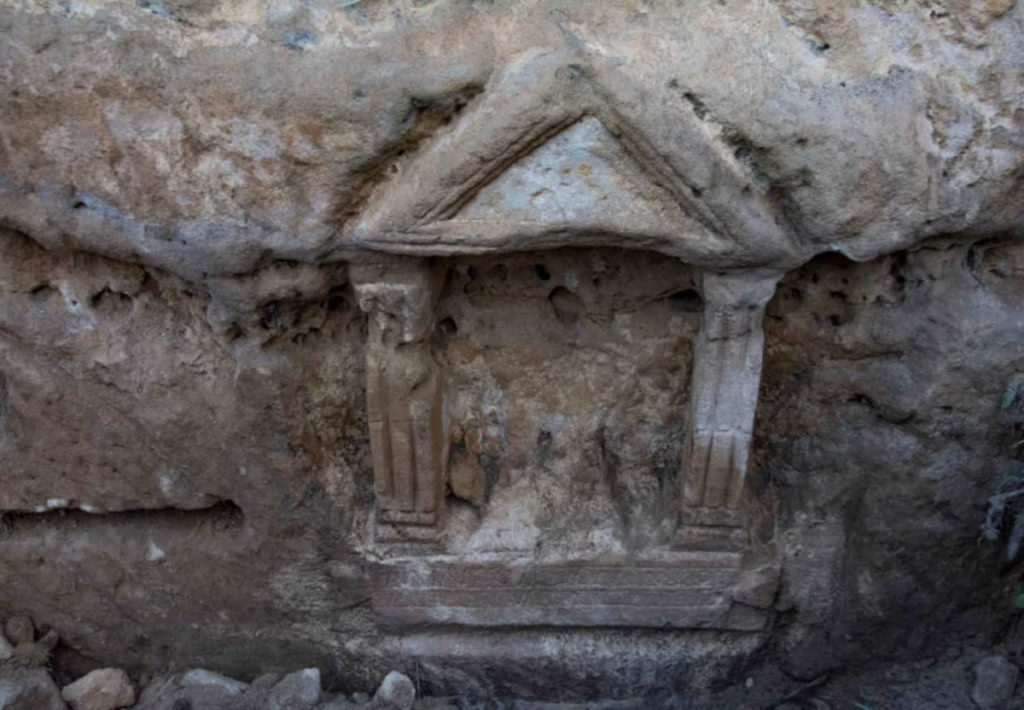
A Roman shrine to Minerva carved directly into an ancient quarry face in central Spain is changing how archaeologists understand religion in the working landscapes of Roman Hispania.
The rock-cut sanctuary was identified at Carrascosa del Campo, in the municipality of Campos del Paraíso, Cuenca. Researchers date the shrine to between the mid-second and early third century A.D., a period when this part of central Hispania was closely connected to Segóbriga, one of the most important Roman cities in the region.
The discovery was published in the journal MANTVA by archaeologists María José Bernárdez Gómez and Juan Carlos Guisado di Monti, from the Don Felipe de Borbón y Grecia Mining History Museum at the Polytechnic University of Madrid.
A miniature temple carved into stone
The shrine was not built as a freestanding structure. It was cut into the vertical face of a sandstone quarry, turning a working extraction area into a small sacred space.
At the centre of the find is an aedicula, a temple-like niche measuring about 70 centimetres wide and 50 centimetres high. Despite its modest size, the carved structure imitates classical architecture, with a triangular pediment, lateral supports and fluted semi-columns framing the central figure.
The quarry itself was part of a wider Roman industrial landscape. Nearby Segóbriga became wealthy partly through the exploitation of lapis specularis, a transparent gypsum mineral used in Roman windows before glass became more common. The area also contained roads, villas, rural settlements and other mining or quarrying zones.
Who was Minerva?
Minerva was one of the major goddesses of Roman religion and was closely associated with the Greek Athena. She was linked with wisdom, strategy, crafts, technical skill, medicine in some contexts, and warfare.
That combination makes her presence in a quarry especially meaningful. Minerva was not only a goddess of thought and learning. In Roman culture, she could also protect artisans, skilled workers, technical activity and organized labour. In this case, her image appears in a place where stone was extracted, shaped and moved through a highly organized Roman economic system.
The figure is badly worn by erosion, but researchers identify Minerva through surviving elements of her classical iconography. She appears standing frontally, wearing a long garment and helmet, holding a spear and shield. The aegis, a protective emblem often associated with the goddess, is also part of the composition.
On the shield, archaeologists identified an owl, the bird most closely connected with Minerva and Athena. In the ancient world, the owl symbolized intelligence, vigilance and clear sight.
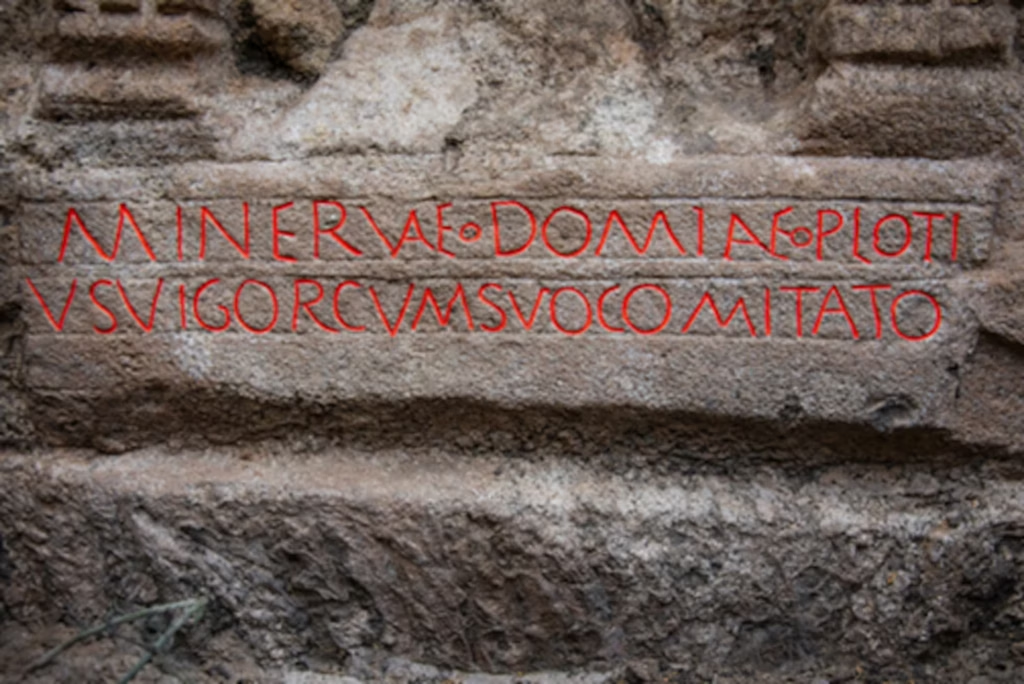
The inscription names Plotius Vigor
Below the relief, the researchers documented a two-line Latin inscription. It reads:
MINERVAE DOMINAE PLOTI / VS VIGOR CVM SVO COMITATO
The text can be translated as: “To Minerva Domina, Plotius Vigor with his entourage.”
This inscription is one of the most important parts of the discovery. It gives the sanctuary a named dedicator and suggests that the act of devotion was not entirely private. The phrase cum suo comitato indicates that Plotius Vigor was accompanied by a group, possibly a working crew, a military group, an administrative retinue or a community connected with quarrying and mining.
The researchers note that the family name Plotius, or Plautius, is known elsewhere in the Roman world and in Hispania. Members of this wider family are attested in several cities, including Tarraco, Gades, Emerita Augusta and Carthago Nova.
A quarry turned into a sacred place
A small carved cavity beside the shrine may have held a shelf for offerings or votive objects. This detail strengthens the interpretation of the site as a functioning cult place rather than a simple decorative carving.
The sanctuary is important because it shows that Roman religious practice was not limited to urban temples, forums or large ceremonial complexes. Sacred spaces could also appear in rural and industrial settings, especially where people sought divine protection in daily work.
For archaeologists, the Minerva shrine adds a new example to the study of Roman rock-cut sanctuaries and cult spaces associated with quarries. It also deepens the picture of religious life in the territory of Segóbriga, where mining, stone extraction, roads and rural settlements formed part of the same Roman landscape.
In this case, a quarry was more than a source of building material. It became a place where labour, authority and devotion met in the same carved surface.
Bernárdez Gómez, M. J., & Guisado di Monti, J. C. (2026). El santuario rupestre de Minerva en Campos del Paraíso (Cuenca): Un nuevo espacio cultual en cantera en el territorio del lapis specularis. Revista MANTVA, 8.
Cover Image Credit: Rock-cut shrine of Minerva discovered at Campos del Paraíso in Cuenca, Spain. Maria José Martínez Hernández
