
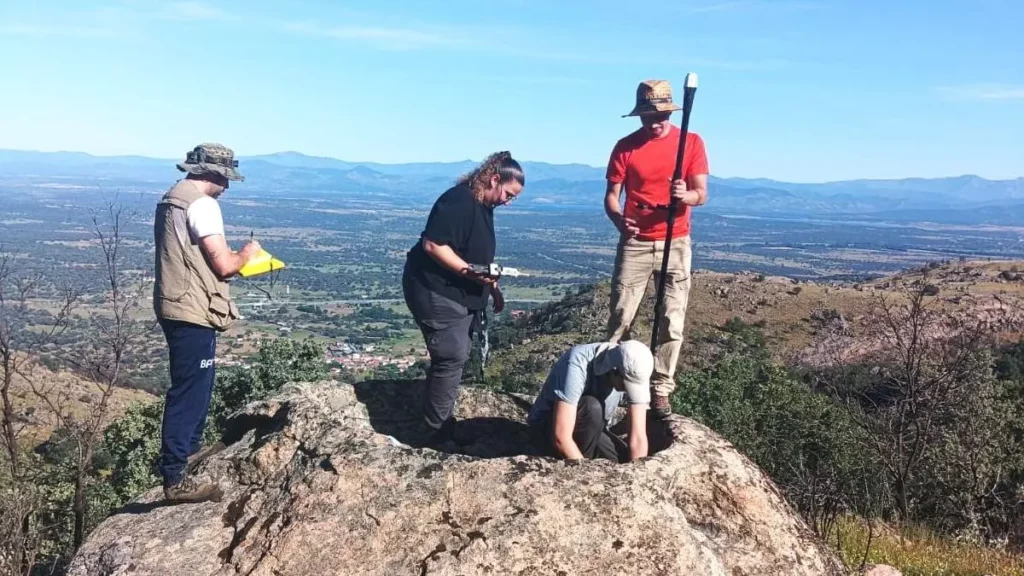
Archaeologists in Cabezabellosa, in Spain’s Extremadura region, have documented 37 rock-cut presses carved into the landscape, revealing a far larger group of ancient production structures than previously known. Until now, only five examples from the municipality had been listed in the Archaeological Charter of the Junta de Extremadura.
The newly recorded sites, identified during a May survey by the LAGARIS project, suggest that the Montes de Tras la Sierra may preserve one of the most important concentrations of rock-cut presses in western Iberia. Yet their purpose is still not fully settled. Although such structures have long been associated with wine production, researchers are now testing whether some may have been used for other rural industries, from tannin extraction to plant pitch or metallurgical processes.
The work was carried out between May 18 and 22 as part of LAGARIS, a research and heritage project devoted to the study, reinterpretation and public promotion of lagares rupestres, or rock-cut presses. The project is led by Pedro Trapero Fernández of the University of Cádiz and David Sánchez Serrano of Rey Juan Carlos University.
The results place Cabezabellosa and the Montes de Tras la Sierra among the most important known concentrations of rock-cut presses in the western Iberian Peninsula. But the central question is not simply how many have been found. It is what they were actually used for.
A landscape carved for production
Rock-cut presses are among the most intriguing rural features of Iberian archaeology. They usually consist of platforms, basins, channels or collection tanks carved directly into stone outcrops. For generations, many were explained through local memory as wine presses, places where grapes were crushed and must was collected before fermentation.
That explanation remains plausible for some examples. Wine production has deep roots across the Roman and post-Roman landscapes of Hispania. In the countryside, carving a press into available bedrock offered a practical advantage: the stone was fixed, durable and easier to clean than temporary wooden installations.
Yet LAGARIS is approaching the Cabezabellosa structures with caution. The team is not treating every carved basin as automatic evidence of winemaking. Some may have been linked to other rural industries, including tannin extraction for leatherworking, plant pitch or resin production, or even activities associated with metallurgical processes.
Science will test the wine hypothesis
To test the traditional wine-press interpretation, researchers collected samples from the surfaces of the presses. One of the key targets is tartaric acid, a compound strongly associated with grapes and widely used in archaeological residue studies as an indicator of wine or grape processing.
If tartaric acid is detected, it would strengthen the case that some structures were used for grape pressing. If it is absent, the result will not automatically rule out wine production, since residues can disappear over time. But it would make alternative interpretations more important, especially when combined with wear marks, landscape position and tool traces.
The team will also study microscopic wear using high-precision silicone moulds. Under magnification, working surfaces can preserve traces caused by repeated crushing, pounding, trampling or friction. These marks may help distinguish between a press used for grapes, a basin used to process bark or plants, and a surface involved in harder mechanical activity.
Mapping the presses in 3D
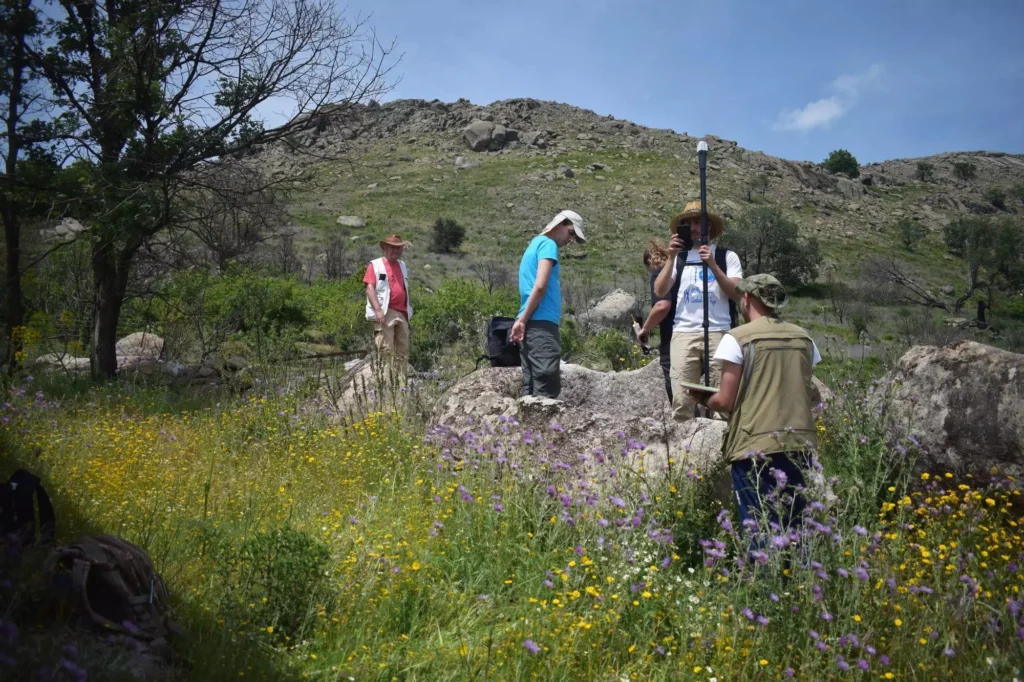
The Cabezabellosa campaign also stands out for its digital documentation. Each press was geolocated with high-precision GPS, and researchers recorded its measurements, shape and relationship to nearby features such as slopes, watercourses and historic paths.
This spatial information will be integrated into a WebGIS platform, allowing the team to study the presses as part of a working landscape rather than as isolated objects. Their placement may reveal how past communities used water, movement routes, cultivated land and access to raw materials.
The structures were also documented through photogrammetry. By taking overlapping photographs, researchers can create accurate 3D models of each press. These digital replicas will support future study and may also be used in educational materials and cultural tourism projects.
Local memory led archaeologists to hidden sites
One of the most important results of the campaign came from the residents of Cabezabellosa. Local people helped identify structures known through oral tradition, place names and family memory. That participation allowed researchers to locate far more sites than would likely have been found through conventional survey alone.
On May 21, a public workshop brought together researchers and residents to share testimonies, toponyms and knowledge connected to the presses. This collaboration is especially valuable for rural archaeology, where many features survive outside monumental sites and depend on community memory for their identification.
From research to cultural tourism
LAGARIS is not only an archaeological project. It also aims to turn neglected rural heritage into a resource for education and sustainable cultural tourism. During the Cabezabellosa campaign, the team held public presentations and educational activities involving pupils from El Torno and Rebollar.
For Cabezabellosa, the newly documented presses offer more than a larger archaeological inventory. They give the municipality a chance to build heritage routes around a distinctive form of rural technology.
For now, the laboratory results remain pending. Until they arrive, the 37 rock-cut presses of Cabezabellosa sit between two possibilities: they may be evidence of an old wine-making landscape, or they may point to a more complex world of rural production that has left only its marks in stone. Either way, the discovery has made this small corner of Extremadura a key site for Iberia’s rock-cut press archaeology.
Cover Image Credit: JP Recio Cuesta – El Periodico
