
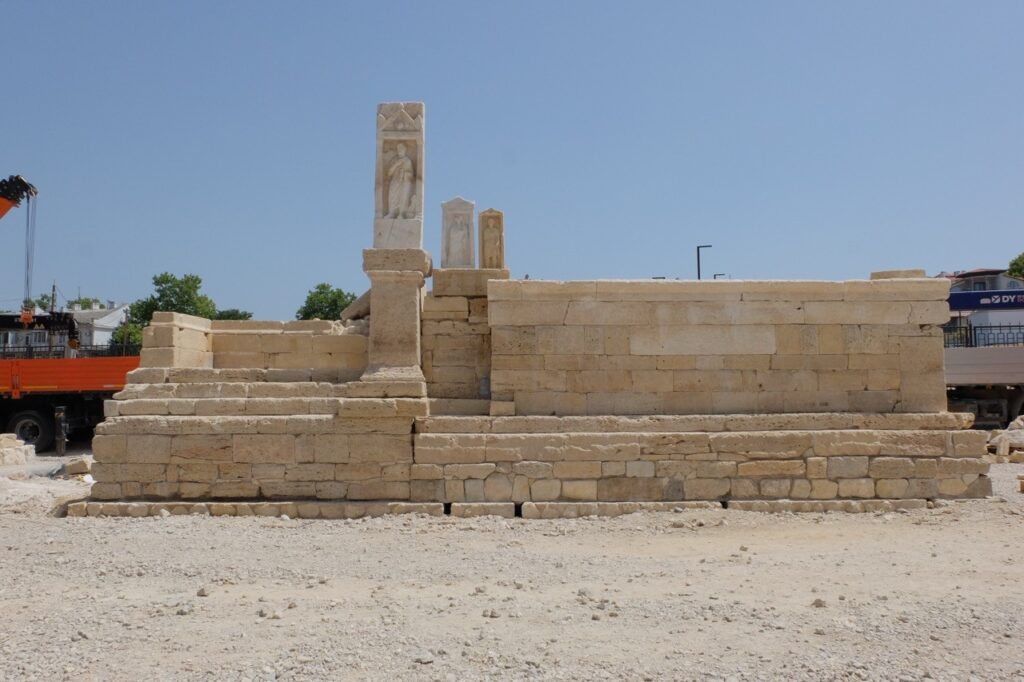
On the windswept southern edge of the ancient Greek city of Tauric Chersonesos, not far from where its gates once stood, archaeologists uncovered the undisturbed grave of a young woman named Annion, buried nearly two millennia ago with more jewelry, perfume, and personal belongings than almost anyone would expect to see intact after so much time. She was eighteen, and she came from one of the most powerful families in the city.
Now, after years of study and restoration, the team behind the discovery is ready to share the full story — not just of Annion herself, but of the larger family complex she belonged to, and of the work it took to bring her tomb back from the earth and into public view.
A Name Carved in Stone, Confirmed by a Bowl
The tomb was first excavated in 2022 in the Southern Suburb of Chersonesos, a UNESCO World Heritage site on the Crimean peninsula that has been continuously studied by Russian archaeologists for years. But the sheer scale of the find meant that cataloguing and interpreting everything inside it took much longer than the dig itself.
According to Viktor V. Vakhoneev, senior researcher at the Center for Rescue Archaeology of the Institute for the History of Material Culture of the Russian Academy of Sciences (IHMC RAS), and the archaeologist who led the study of the site, the tomb was built for a young woman named Annion — a member of what he describes as a genuinely powerful, ruling family in the city during the 1st–2nd centuries AD.
In an exclusive account shared with us, Vakhoneev explained that a grand tomb was raised for her just outside the city walls, decorated with a carved stela. The inscription, in ancient Greek, leaves no ambiguity about who lies within: “Annion, daughter of Aischines, son of Heroides, who died at the age of eighteen.”
What makes this discovery unusually certain — almost unheard of in archaeology — is that the name on the stone and the name on Annion’s own belongings match exactly. Among the grave goods was a red-glaze bowl bearing her name, a rare and moving detail that removes any doubt about whose story this tomb tells.
What Was Buried Beside Her
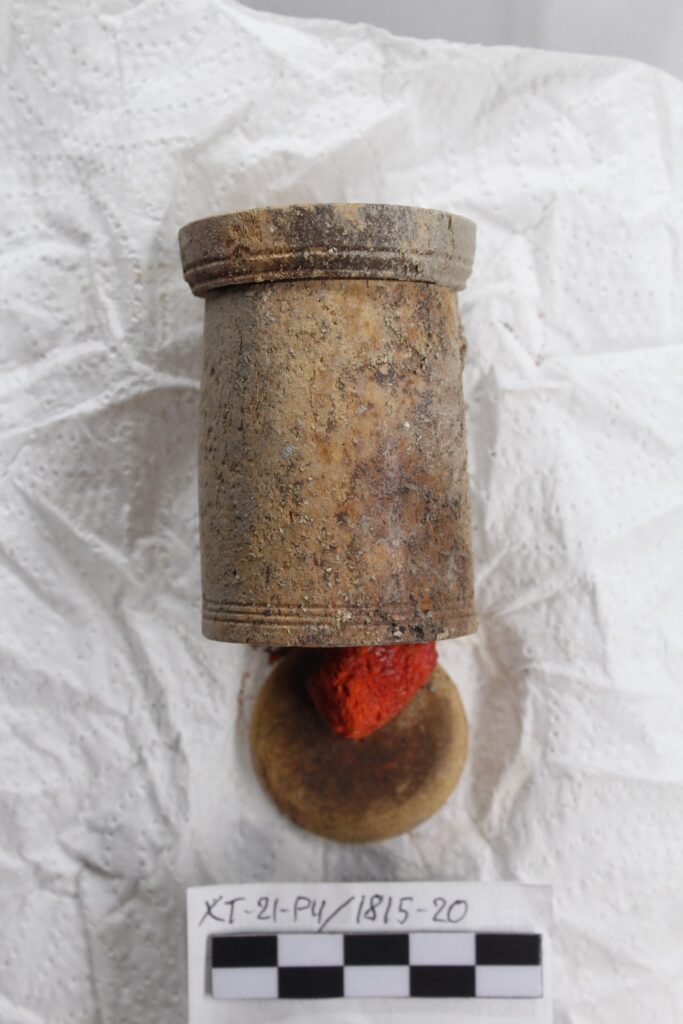
Few burials from this period have yielded a personal assemblage as rich, or as intimate, as Annion’s. According to the excavation findings, her grave contained an extraordinary range of jewelry and cosmetic items, clearly meant to accompany her into the afterlife exactly as she had lived: gold ornaments, rings, pendants and decorative appliqués once sewn onto clothing, alongside a collection of glass vessels used for oils and perfumes.
Some of those glass containers were shaped with striking artistry — one modeled after a date fruit, another in the form of a cluster of grapes. Archaeologists also recovered bone pyxides, small boxes once used to store cosmetic rouge, and, remarkably, traces of the rouge itself, preserved for nearly two thousand years in the Chersonesos soil. Hairpins, two spindles, and a large quantity of beads — enough, researchers say, to eventually be restrung and reconstructed — rounded out what is unmistakably a deeply personal, distinctly feminine set of funerary belongings.
Anthropological analysis confirmed that the remains inside the tomb do indeed belong to a young woman, roughly twenty years old at the time of death — closely matching the eighteen years recorded on her memorial stela. The precise cause of her death has not yet been determined, though researchers note that broader scientific work on the necropolis, including bone-sample analysis using modern methods, has shown that seasonal respiratory illness was among the most common causes of death in the city during that era.
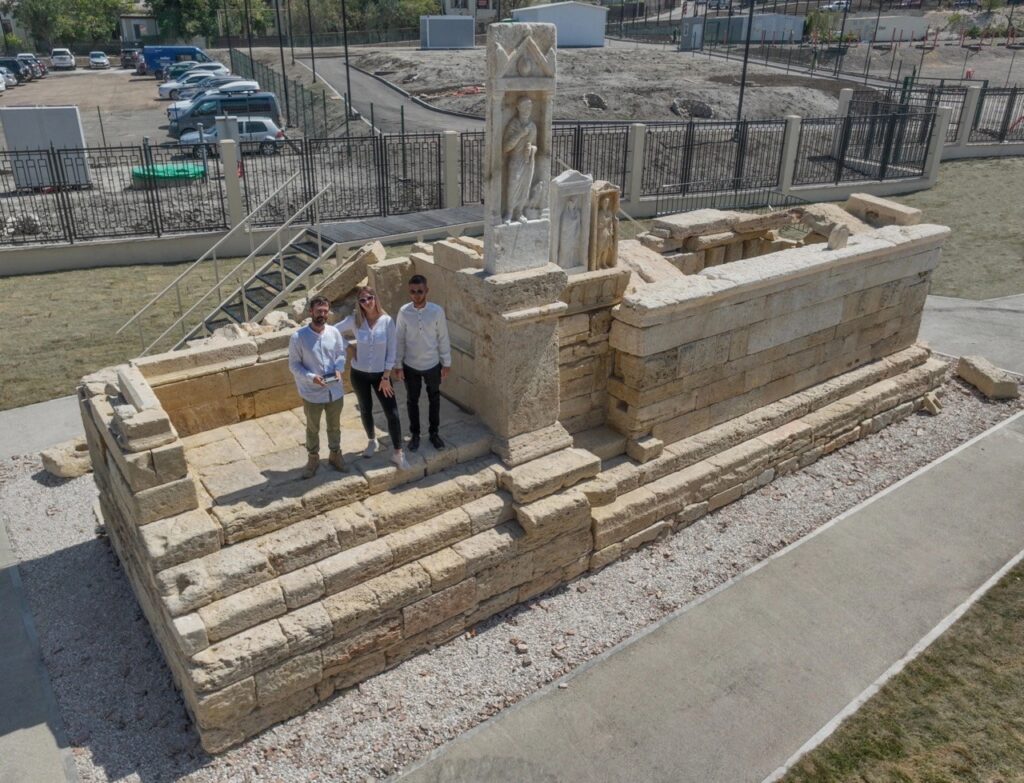
Today, Annion’s tomb stands on public display at the southern facade of the Museum of Antiquity and Byzantium in New Chersonesos, with one of its stelae bearing a carved image of the young woman herself.
Not Just One Tomb — A Family’s Memorial to Its Own
While the initial discovery captured attention as the story of a single, richly furnished grave, Vakhoneev was careful to clarify a crucial point that easily gets lost in a shorter retelling: Annion’s tomb was never an isolated burial. It was one part of a considerably larger Roman-period funerary and memorial complex, built and used by the same family across generations, located in the necropolis of the Southern Suburb near the ancient city gates.
That complex, as Vakhoneev described it, brought together several distinct structures: a slab-built, above-ground tomb; a crypt-columbarium designed to hold multiple burials within niches; and a number of funerary stelae carrying inscriptions and portraits. Alongside Annion’s name, these inscriptions also commemorate members of the Ariston family — meaning the site should be understood not as a single grave, but as a shared burial ground built to honor several relatives over time.
This distinction matters. It is tempting, when a name appears twice in a necropolis, to assume a simple pairing — a husband and wife, perhaps, sharing one final resting place. Vakhoneev addressed that assumption head-on, cautioning against the idea that Annion and a man named Ariston were buried together in a simple double tomb. Ariston, he explained, is present in the complex’s memorial program through funerary stelae, with the name recurring more than once across the family group — but the human remains actually recovered from the excavated burial chamber tied to Annion belonged to a young woman and a child of about six or seven years old, not to an adult man.
The chamber, in other words, holds a young woman and a child laid to rest together — a detail that adds a quieter, sadder dimension to a discovery already defined by loss.
Based on the material recovered, researchers date the main grave assemblage to the late 1st to early 2nd century AD, while the wider memorial complex — including its stelae — appears to have remained in use into the first half, or perhaps middle, of the 2nd century AD. The burial chamber associated with Annion was uncovered in 2022, but the study of the full funerary ensemble and its finds has continued in the years since.
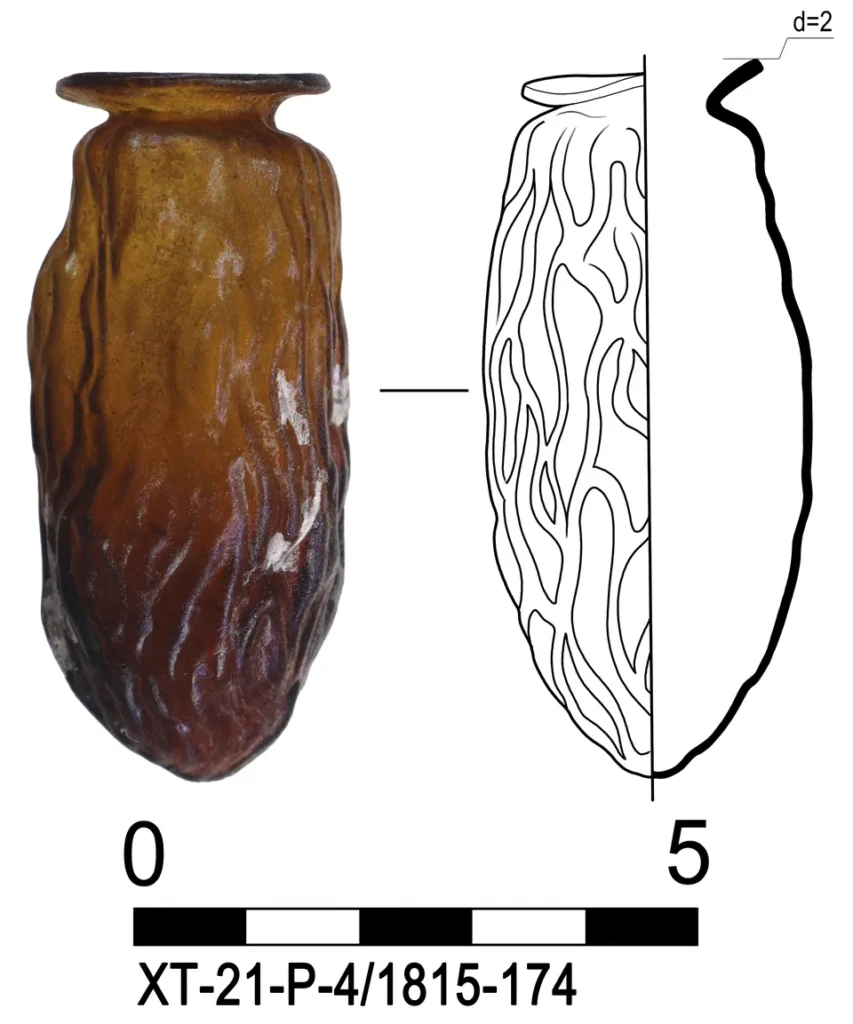
Date-shaped glass vessel. Credit: Photo courtesy of Viktor V. Vakhoneev
From Waterlogged Ravine to Museum Centerpiece: The Restoration Effort
Perhaps the least visible part of this story — and one of the most demanding — is what it actually took to bring these structures out of the ground intact and put them in front of the public.
The Southern Suburb necropolis sits on the slopes of an ancient ravine, where water flowing along the bottom made in-place conservation impossible. High water levels and material erosion meant that preserving these tombs where they were found simply was not an option. Instead, the IHMC RAS team decided to relocate the monuments to a safer setting where they could be properly displayed — a project that, according to the restoration documentation shared with us, ultimately included six ancient funerary monuments in total, among them the tomb of Annion, the tomb of Ariston, a tholos, a columbarium-tomb, and a memorial exedra-crypt.
The scale of the digitization alone is striking: more than 4,600 individual architectural blocks were scanned during the project, which ran for roughly two years from the start of excavation at the first monument to the final reassembly of the structures at the museum site.
The process followed several careful stages. Archaeologists and conservators first assessed each object’s condition, identifying damage and its causes — for structures below sea level, this often meant flooding and material washout. Every block was then digitally recorded using laser total stations, drone-based geodetic surveys, and photogrammetry, building precise 3D models accurate to within a tenth of a millimeter using tools such as Artec Eva scanners. Each element was individually marked before being carefully disassembled using non-destructive methods, particularly important for stone already weakened by erosion or cracking.
From there, the digital models were integrated into architectural software to produce full restoration plans grounded in the principle of anastylosis — the practice of returning original elements to their original positions using traditional materials and methods wherever possible, rather than fabricating replacements.
The physical conservation work that followed included removing biological growth such as fungi, moss, and lichen from the stone, cleaning without damaging original surfaces, injecting resin into cracks to reinforce weakened blocks, and rejoining broken fragments using specialized adhesives and anchor pins. Structural stone consolidation relied on established conservation compounds, and in total, more than 800 stone blocks were restored through this process before final reassembly at the museum, using lime-based mortar formulated to match the original material.
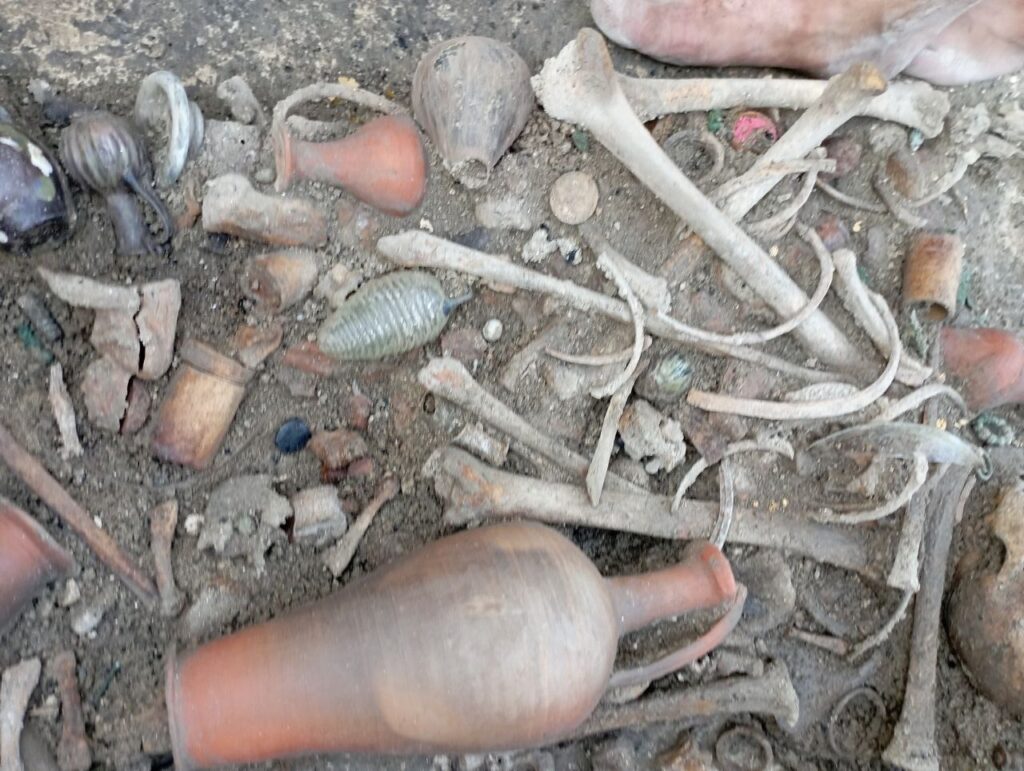
According to Vakhoneev, the core conservation and restoration work needed for scholarly study, photography, and publication of Annion’s grave goods has now been completed, even as some specialist analysis continues.
It’s worth noting that this is not the first time this same team has carried out restoration work of this caliber. The IHMC RAS group behind the Chersonesos project also led the restoration of the Triumphal Arch of Palmyra in Syria — an effort that received international recognition, including praise from UNESCO — giving this Crimean project the benefit of a methodology already tested on one of the world’s most closely watched heritage sites.
Readers interested in the full restoration process, including step-by-step documentation and 3D models of the reassembled monuments, can find further detail through the Center for Rescue Archaeology of the Institute for the History of Material Culture, Russian Academy of Sciences.
We are especially grateful to Viktor V. Vakhoneev and the Center for Rescue Archaeology at the Institute for the History of Material Culture, Russian Academy of Sciences, for sharing these details directly and exclusively for this article, helping ensure that Annion’s story — and the story of the family who built her tomb — is told with the accuracy and care it deserves.
Photographs of the tomb, excavation, and finds courtesy of Viktor V. Vakhoneev / Institute for the History of Material Culture, Russian Academy of Sciences.
Editorial note: This article includes links to Artec Eva scanners. These links are not part of a partnership or sponsored content arrangement and are included solely for informational purposes.
