

Researchers identified a 115-million-year-old dinosaur fossil in an unexpected place in northern China: inside a drill core extracted during a search for copper.
Recovered from a depth of 473.2 meters in Inner Mongolia’s Yin’gen-Ejinaqi Basin, the fossil represents the first published dinosaur record from the western part of the Bayan Gobi Formation. Until now, known dinosaur finds from this Early Cretaceous rock unit had been concentrated mainly farther east.
Cataloged as 208GPV01, the specimen was discovered near Guaizihu by Geological Party No. 208 during a mineral exploration project. Rather than being exposed at the surface during a paleontological excavation, the bones emerged in rock brought up by drilling.
The fossil comes from the upper Bayan Gobi Formation and dates to the Aptian stage of the Early Cretaceous. It preserves part of the animal’s tail, including four vertebral centra, six neural arches, transverse processes, a sacral rib, and ossified tendons.
A close resemblance to Psittacosaurus
Although the skeleton is incomplete, researchers were able to identify the dinosaur as an ornithischian, the broad group of “bird-hipped” dinosaurs that included ceratopsians, stegosaurs, ankylosaurs and hadrosaurs.
The identification is supported by several features of the tail. Its transverse processes are slender, sit relatively low on the vertebrae and taper toward their ends, while ossified tendons occur along the upper part of the tail.
Researchers also compared the shape and proportions of the vertebrae with those of other ornithischian dinosaurs using geometric morphometrics. The fossil plotted closest to Psittacosaurus, a small early ceratopsian widely distributed across Early Cretaceous East Asia.
That resemblance does not mean the fossil can be identified as Psittacosaurus. Too little material survives for a reliable genus or species assignment, so the team classified it more cautiously as an indeterminate ornithischian.
The bones also appear to have belonged to a young animal. Several vertebral elements had not yet fused, which the researchers interpret as evidence that the dinosaur had not reached full skeletal maturity.
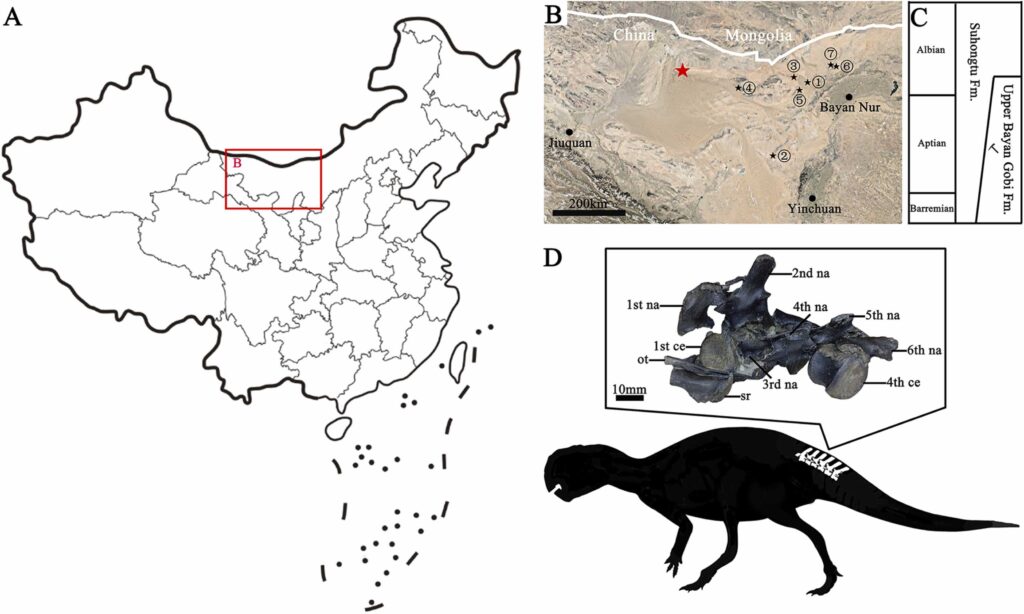
The 208GPV01 fossil from the Bayan Gobi Formation in the Yin’gen-Ejinaqi Basin, China. Image credit: Li et al. 2026
An unusual feature hidden in the tail
The most distinctive anatomical detail may be a series of small openings along several tail vertebrae.
These openings, known as nutrient or neurovascular foramina, appear in a regular arrangement on the second through fourth preserved caudal centra. According to the study, this pattern has not previously been reported in Psittacosaurus or other ornithischian dinosaurs.
The researchers caution against treating the feature as evidence of a new species. Because the specimen was probably immature, the pattern could reflect age or individual variation rather than a taxonomic difference.
A new point on Inner Mongolia’s dinosaur map
The Bayan Gobi Formation has previously produced dinosaurs including Penelopognathus, Psittacosaurus and alvarezsauroids. Its fauna also shares similarities with that of western Liaoning, one of the regions associated with the Jehol Biota.
What makes 208GPV01 important is where it was found. The specimen is now the westernmost known dinosaur record from the Bayan Gobi Formation, extending the documented geographic range of its dinosaur fauna.
The discovery also shows how paleontological finds can emerge far outside traditional fossil excavations. In this case, a geological survey searching for copper unexpectedly brought part of an Early Cretaceous dinosaur tail back to the surface.
The study by Tianyu Li, Ranwei Wang, Lida Xing, Xing Xu, and colleagues appears in Earth History and Biodiversity.
Li, T., Wang, R., Xing, L., Xu, X., Qin, Y., Yan, P., Liu, B., Li, P., & Yang, Y. (2026). The first dinosaur from the Lower Cretaceous Bayan Gobi Formation in the western Yin’gen-Ejinaqi Basin of Inner Mongolia, China. Earth History and Biodiversity. Advance online publication. https://doi.org/10.1016/j.hisbio.2026.100044
