
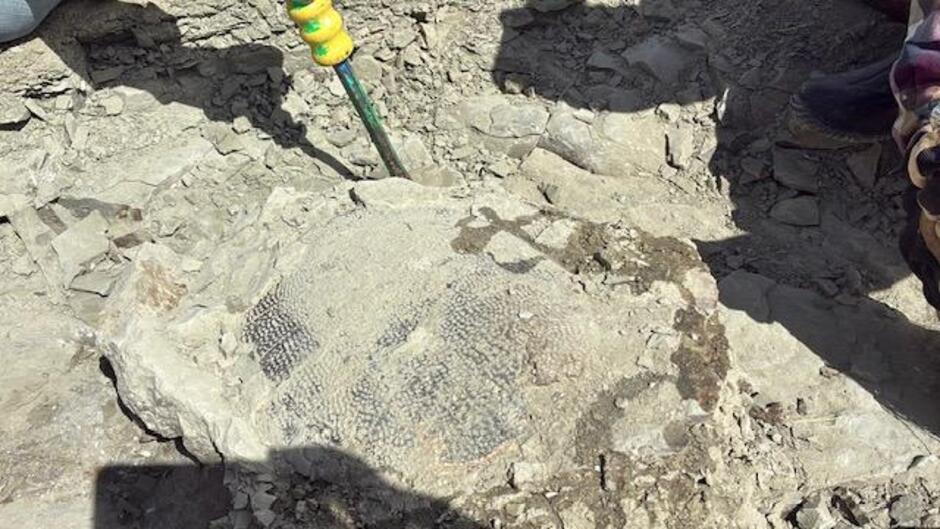
Located in the western United States, Wyoming is known for its vast open landscapes, national parks, and rich geological history. Now, the state has gained international attention for an extraordinary fossil discovery made by an unlikely explorer. On Bureau of Land Management (BLM)–managed public land in southwest Wyoming, an 11-year-old boy uncovered a remarkably well-preserved turtle fossil dating back nearly 48 million years.
What began as a routine rockhounding trip quickly turned into a significant scientific find, highlighting both Wyoming’s importance to paleontology and the critical role public lands play in preserving Earth’s ancient history.
The discovery was made last fall in the Greater Green River Basin, a region known among scientists for its rich fossil record. Today the area is dry and rugged, but during the Eocene Epoch it looked vastly different. Around 48 million years ago, southwest Wyoming had a warm, almost tropical climate dominated by rivers, streams, and the remnants of the ancient Lake Gosiute. This environment supported a wide variety of life, including early mammals, fish, crocodilians, and turtles.
A Sharp Eye on Public Lands
Touren was exploring the area with his grandparents, Patti and Tom Patterson, when he noticed something unusual among scattered shells and rocks. At first glance, the object looked like an ordinary stone. Instead of tossing it aside, however, Touren took a closer look and realized it might be something special.
His instincts proved correct. After reporting the find to the Bureau of Land Management, paleontology specialists from the BLM’s Rock Springs Field Office were notified and later escorted to the site by Touren and his grandparents. Once experts confirmed that the fossil was located on BLM-managed public land, steps were taken to properly document, stabilize, and protect the specimen from erosion.
Excavation and Scientific Significance
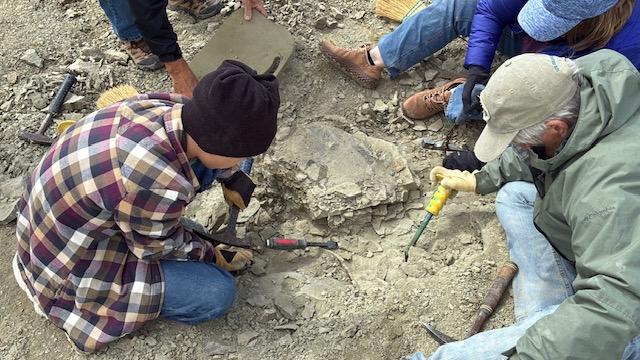
To ensure the fossil’s safe recovery, the BLM coordinated with a permitted paleontologist. JP Cavigelli, museum collections specialist at the Tate Geological Museum at Casper College, volunteered to lead the excavation effort. In September 2025, Cavigelli and his team returned to the site alongside Touren and his grandparents to carefully excavate the fossil.
The excavation revealed a nearly complete turtle carapace, or shell. While no bones beyond the shell were preserved, experts were impressed by the fossil’s condition. Based on its structure and the surrounding rock layer—dated to roughly 50 million years old—scientists determined the turtle belonged to the trionychid family, commonly known as soft-shelled turtles.
Soft-shelled turtles are characterized by flatter, more flexible shells that are not fully fused to the underside of the body. Members of this family still exist today, and researchers believe the ancient turtle likely resembled its modern relatives in appearance and behavior.
From Field to Museum
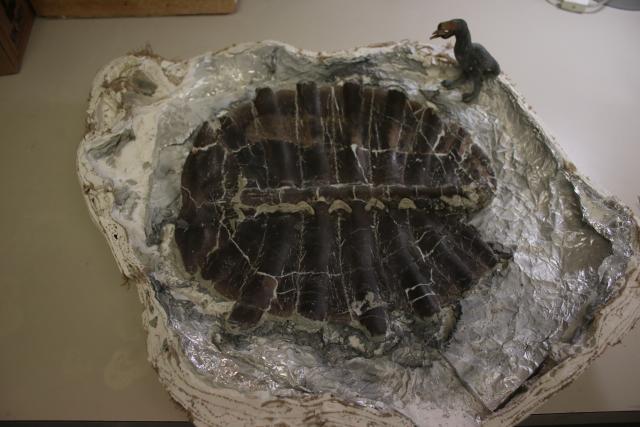
Following excavation, the fossil was transported to the Tate Geological Museum, a BLM-approved repository. There, preparation and conservation work is currently underway. Museum volunteers are carefully cleaning and stabilizing the specimen, gradually revealing details that were not visible in the field.
Recently released images show the interior of the turtle shell, while earlier excavation photos captured the top surface. A small toy included in one image provides scale, highlighting the fossil’s size and excellent preservation.
A Young Fossil Finder Makes His Mark
As recognition for responsibly reporting the discovery, Touren was invited to participate in the excavation—a rare opportunity for someone his age. He was also granted permission to name the fossil. The ancient turtle is now officially nicknamed “Little Timmy.”
Touren’s interest in science, particularly paleontology, runs deep. According to reports, his personal collection includes notable fossils such as a Tyrannosaurus rex tooth and the skull of a juvenile large carnivorous dinosaur. He also creates handmade notebooks filled with dinosaur facts, drawings, and research from around the world.
Protecting Scientific Resources on Public Lands
BLM officials emphasized that discoveries like this highlight the important role the public plays in protecting scientific and cultural resources on public lands. By reporting the fossil instead of removing it, Touren helped ensure that an important piece of Wyoming’s prehistoric history was preserved for research and education.
The Bureau of Land Management oversees vast areas of public land across the United States and operates an active paleontology program dedicated to conserving fossils for future generations. Officials encourage visitors to enjoy public lands responsibly and to report any potential fossil discoveries to their local BLM field office.
For more information about the BLM’s paleontology program, visit the agency’s official website or contact a local BLM office.
Cover Image Credit: A close-up shows the fossilized turtle shell on BLM-managed land during excavation. Craig Thomas, BLM Rock Springs Field Office
