
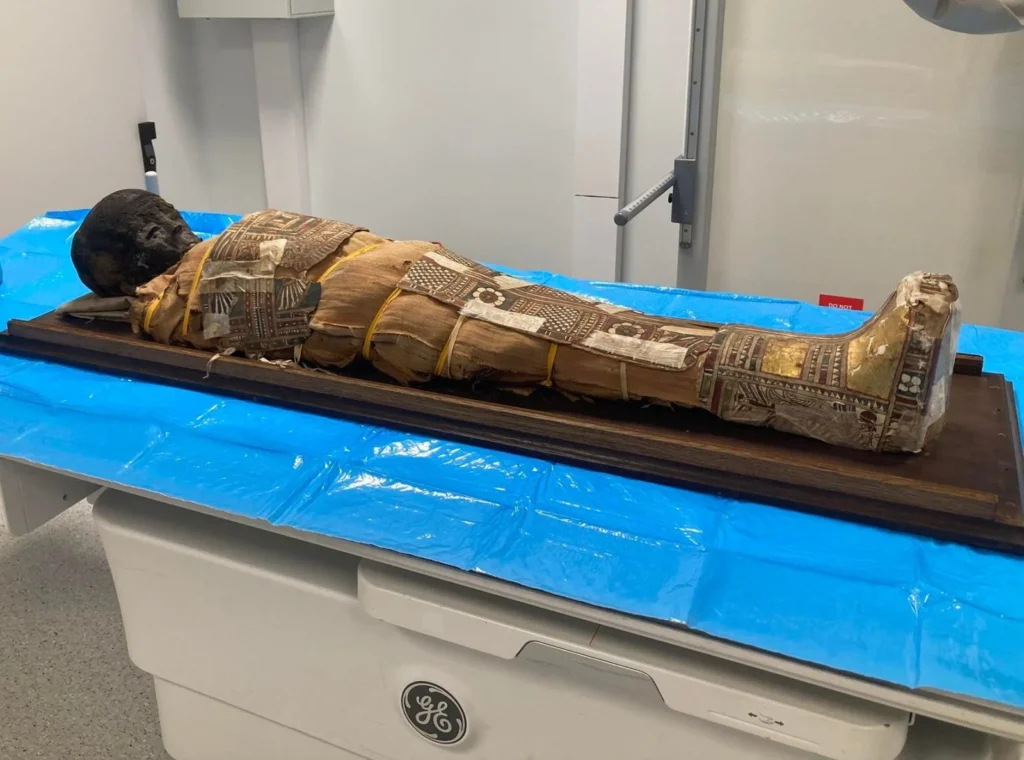
A 2,000-year-old Egyptian child mummy preserved in Wrocław, Poland, is offering rare insight into ancient burial practices—while raising a new and intriguing mystery. During its first-ever comprehensive scientific examination, researchers discovered a hidden object placed on the boy’s chest, potentially holding clues to his identity or the rituals surrounding his death.
The object, revealed through non-invasive CT scans, may be a papyrus or amulet deliberately included in the burial. Scientists believe it could contain the child’s name or a protective inscription for the afterlife. However, due to the fragile condition of the mummy’s cartonnage casing, the artifact remains inaccessible for now.
First Scientific Study in Over a Century
The mummy has been part of the Archdiocesan Museum in Wrocław since 1914, when it was brought to the city by Cardinal Adolf Bertram as part of a private antiquities collection. Despite its long presence in the museum, it had never been systematically studied.
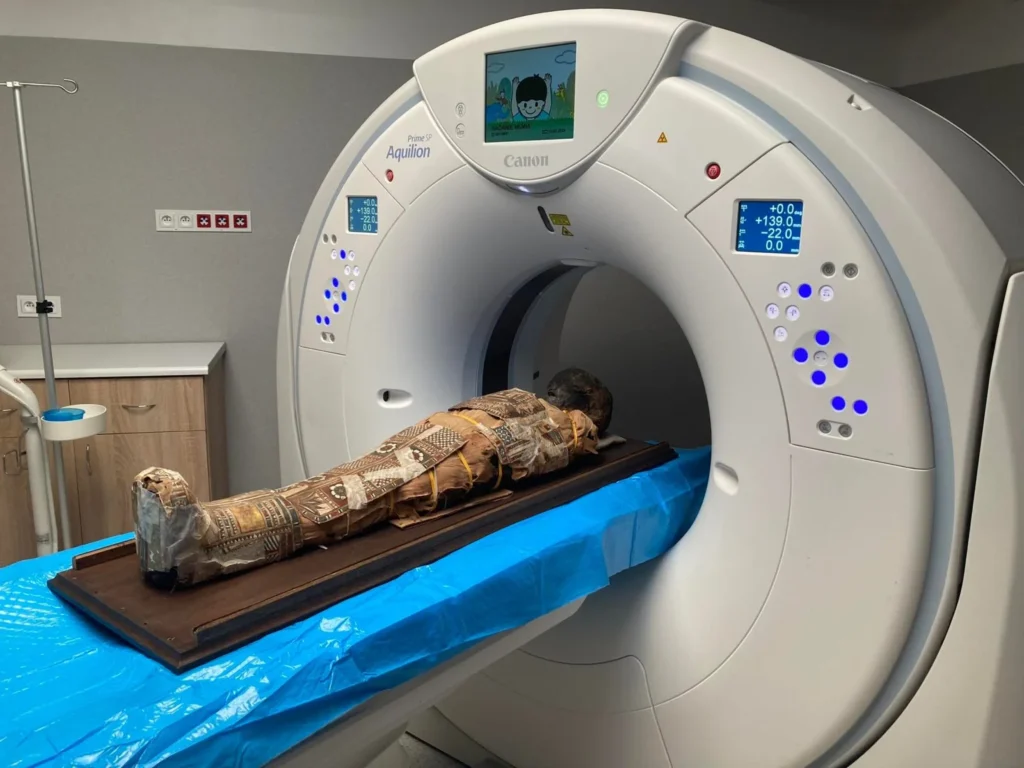
That changed in 2023, when researchers began the first full scientific investigation at the request of Archbishop Józef Kupny. The interdisciplinary team, led by Professor Agata Kubala of the University of Wrocław and supported by experts from the Mummy Research Center, used advanced radiological tools—including X-ray imaging and CT scanning—to examine the remains without damaging them.
Their findings were later published in the journal Digital Applications in Archaeology and Cultural Heritage, contributing valuable data to the global study of Egyptian mummies.
Who Was the Boy?
One of the most striking discoveries is the identity of the mummy as a young boy, approximately eight years old at the time of his death. Researchers were able to determine his age with remarkable precision by analyzing the development of his teeth—considered one of the most reliable indicators in juvenile remains.
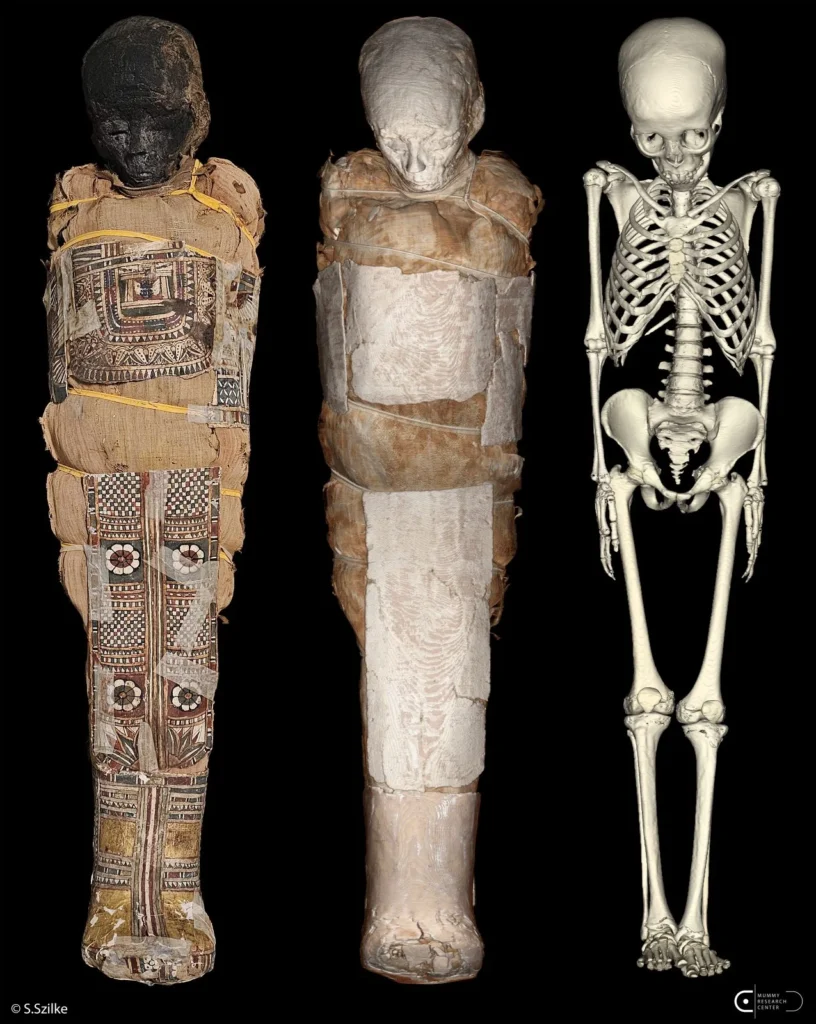
The body measures 123 centimeters in length and is relatively well-preserved. Anatomical features confirmed the child’s sex, resolving uncertainties that often arise in mummy studies due to layers of bandages and varying preservation conditions.
Despite these advances, one crucial mystery remains unsolved: the cause of the boy’s death. No clear signs of fatal trauma or disease have yet been identified, leaving researchers with more questions than answers.
Insights Into Ancient Mummification
The scans also revealed fascinating details about how the boy was mummified. In line with ancient Egyptian practices, his brain was removed through the nasal cavity—a standard procedure during the period. Most internal organs were also extracted, likely through non-traditional methods such as via the rectum, rather than through a visible abdominal incision.
Interestingly, some internal structures may still be partially preserved, including possible remnants of the liver. The body cavity was partially filled with textile material, and unlike more elaborate mummifications, there is little evidence of excessive resin use.
Experts say the process reflects a careful but not overly luxurious burial, typical of the Ptolemaic period (roughly 332–30 BCE). This suggests the boy may have come from a family of moderate social standing.
Tracing Origins Through Art and Style
Although historical records about the mummy’s origins were destroyed during World War II, researchers have turned to the artifact itself for answers. Decorative elements of the cartonnage—the painted casing surrounding the mummy—provide valuable clues.
The style, motifs, and iconography strongly indicate that the mummy likely originated from Upper Egypt, particularly the region around Kom Ombo or Aswan. Distinctive features such as lotus patterns, rosettes, and a winged scarab motif align with funerary art typical of that area during the late Pharaonic era.
One especially intriguing detail is the depiction of a rare hybrid deity, possibly Nehebkau, shown carrying a mummy. This unusual imagery may offer further insights into regional religious beliefs and burial customs.
A Hidden Object Sparks New Questions
Perhaps the most exciting discovery is the presence of an unidentified object located on the boy’s chest. Detected through imaging, the item could potentially be a papyrus scroll containing the child’s name or other personal information.
However, accessing it poses a significant challenge. The cartonnage is fragile and partially damaged, making any attempt at removal risky. Researchers are currently working on methods to safely examine the object without causing further deterioration.
Technology Transforming Archaeology
The study highlights how modern medical technology is revolutionizing archaeology. High-resolution CT scans allowed scientists to create detailed 3D models of the mummy, isolating bones, soft tissues, and wrappings layer by layer.
This process is particularly complex in mummies, where dried tissues and resin-soaked bandages behave very differently from living human bodies. Researchers had to manually adjust imaging parameters and carefully interpret each layer to build an accurate picture.
Such innovations are enabling scientists to revisit historical artifacts and uncover new data without invasive procedures—a major advancement in preserving cultural heritage.
A Child Brought Back to History
What was once seen as a static museum piece is now being reinterpreted as the remains of a real child who lived, died, and was carefully prepared for the afterlife over two millennia ago—while the hidden object on his chest may ultimately reveal the most personal detail of all: his name.
The Wrocław mummy’s journey—from ancient Egypt to a European collection, through war and loss of documentation, to modern scientific rediscovery—reflects not only the evolution of archaeology but also changing attitudes toward the past.
Researchers emphasize that their work is far from complete. Ongoing analysis of the cartonnage’s iconography and further imaging studies may help refine the mummy’s dating and confirm its exact place of origin.
As Professor Kubala notes, ancient mummies still hold countless secrets. And thanks to technology, those secrets are finally beginning to surface—one scan at a time.
KUBALA A., OŻAREK-SZILKE M.A., SZILKE S., EJSMOND W. 2026. Digital technology in the service of mummy studies. Egyptian child mummy at the Museum of the Archdiocese in Wroclaw, Digital Applications in Archaeology and Cultural Heritage, 40, s. e00505, https://doi.org/https://doi.org/10.1016/j.daach.2026.e00505.
Cover Image Credit: Marzena Ożarek-Szilke – University of Wrocław
