
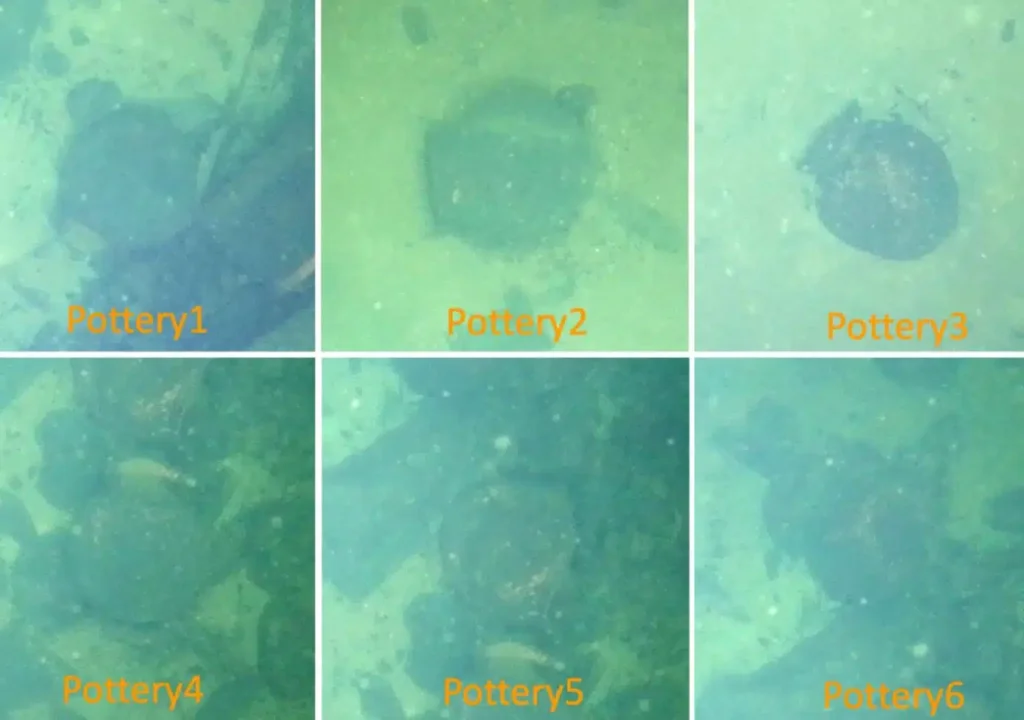
A team of Japanese researchers has announced a remarkable archaeological discovery at the bottom of Lake Biwa: a nearly intact pottery vessel dating back more than 10,000 years, making it one of the oldest known pottery vessels in the world. The find, located near the Tsuzuraozaki underwater ruins, is being hailed as one of the most significant breakthroughs in Japan’s underwater archaeology. But the real story goes deeper—this ancient artifact was uncovered thanks to a new generation of autonomous underwater vehicle (AUV) technology, originally designed for deep-sea exploration and recently adapted for inland archaeological surveys.
The vessel, retrieved from a depth of 64 meters, measures approximately 25 centimeters tall and features a pointed base with engraved patterns characteristic of early Jomon-period pottery. Experts have identified it as belonging to either the Jinguji-style or the Konami Upper-layer tradition, dating it between 11,000 and 10,500 years ago. This makes it the oldest artifact ever recovered from the Tsuzuraozaki underwater site, a location first identified in 1924 when fishermen accidentally dredged up ancient pottery in their nets.
A Closer Look at Jinguji and Konami Pottery Traditions
Archaeologists note that the newly discovered vessel resembles pottery from the Jinguji-style or Konami Upper-layer tradition, two early forms of Jomon-period ceramic craftsmanship. Jinguji-style pottery is known for its pointed bases, soft contours, and subtle engraved patterns, traits that reflect some of the earliest experiments in fired clay technology in prehistoric Japan.
The Konami Upper-layer style, on the other hand, is typically associated with refined surface treatments, linear decorative motifs, and improved firing techniques that emerged during the transitional stages of the early Jomon era. Both traditions represent critical evolutionary steps in the development of Japanese pottery, marking the shift from simple utilitarian vessels to objects that also carried aesthetic and cultural significance. The Lake Biwa vessel’s characteristics place it squarely within this pivotal period, making its exceptional preservation even more valuable for understanding the origins of Jomon ceramic culture.
A Technological Revolution Beneath the Surface
The discovery was made possible by a state-of-the-art 3-D underwater scanning system, originally engineered for submarine cable inspection. Equipped with four synchronized cameras, the technology can map deep underwater terrain with precision otherwise impossible for human divers. During the October survey, these underwater scanners generated a detailed reconstruction of a 200-by-40-meter lakebed area with clarity comparable to diver-led documentation—an impressive feat in the murky, low-visibility waters of Lake Biwa.
But the researchers did not rely solely on this scanning system. The survey’s success builds upon years of progress in underwater robotics, especially the development of sophisticated AUVs by Japan’s National Maritime Research Institute (NMRI). These AUVs were originally created for deep-sea missions, featuring advanced formation control systems, high-resolution sonar, and autonomous navigation capabilities. Their technology has been proven in real-world missions, including multivehicle AUV coordination, deep-water mapping campaigns, and archaeological searches in Lake Biwa, where NMRI previously used its hovering AUV “Hobalin” to locate ancient artifacts.
In the case of the recent discovery, the same principles—precise control, stable deep-water maneuvering, and high-fidelity seafloor scanning—enabled researchers to survey depths beyond the safe range for most divers. As Yoshifumi Ikeda, professor of underwater archaeology at Kokugakuin University, explained, the system produced data “comparable to what could be gathered by divers, even at depths exceeding 30 meters.”
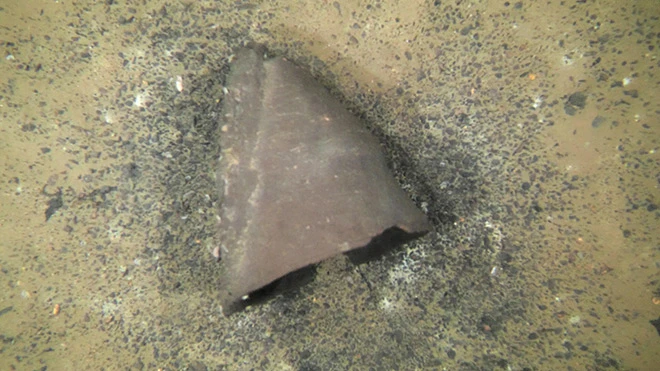
An Ancient Vessel in Pristine Condition
The nearly intact condition of the 10,000-year-old vessel is astonishing. While artifacts found on land are usually fragmented or eroded, underwater discoveries often remain protected for millennia. According to experts, Lake Biwa’s geological structure plays a key role: the Tsuzuraozaki site lies within a valley-like depression at depths sometimes exceeding 80 meters, where sediment accumulation is minimal. Continuous tectonic movements keep the lakebed exposed, preserving artifacts in situ for thousands of years.
Nearby, researchers also documented six Haji pottery jars roughly 1,500 years old, dating to the middle of the Kofun period. Although these jars are much younger than the newly found vessel, their proximity offers clues about how the site has been used across vastly different eras.
A Site of Mystery and Untapped Potential
Despite nearly a century of sporadic discoveries, the full scope of the Tsuzuraozaki ruins remains unknown. More than 200 pottery fragments from the Jomon to Heian periods have been recovered since the 1920s, but the site’s depth and challenging conditions have long limited systematic research.
Scholars continue to debate the origins of the submerged artifacts. Possible explanations include ritual deposits, lakeside settlements lost to subsidence, earthquake-related land shifts, or ancient fishing communities that were gradually overtaken by rising water levels. The newly discovered vessel—found upright and intact—may finally offer the context needed to unravel these mysteries.
A New Era for Underwater Archaeology
The success of the Lake Biwa mission highlights an important shift: underwater archaeology is entering a technological renaissance. NMRI’s AUV systems, including multi-AUV formation control and real-time communication algorithms, demonstrate how advanced robotics can safely explore deep-water environments once considered inaccessible.
As Professor Kenichi Yano of Ritsumeikan University noted, “This is a discovery that could only occur underwater. The preservation, location, and context offer insight impossible to obtain from land ruins.”
With nearly 400 underwater archaeological sites across Japan, the integration of AUVs and high-resolution scanning is expected to accelerate new discoveries, transforming both regional heritage research and our broader understanding of prehistoric cultures.
The 10,000-year-old pottery vessel from Lake Biwa not only rewrites Japan’s ancient history—it marks a turning point where robotics and archaeology converge, revealing the past with unprecedented clarity.
Cover Image Credit: Pottery vessels observed on the lake floor using NMRI AUV technology, as reported in Latest Development Information on NMRI AUVs (2021).
