
19 January 2026 The Future is the Product of the Past

Grave Dig Uncovers 1,500-Year-Old Mosaic with Star of David and Cryptic Greek Petition in Türkiye

During a routine grave dig in Türkiye’s Diyarbakır province, archaeologists uncovered a remarkable 1,500-year-old mosaic featuring the Star of David and a cryptic six-line inscription in ancient Greek.

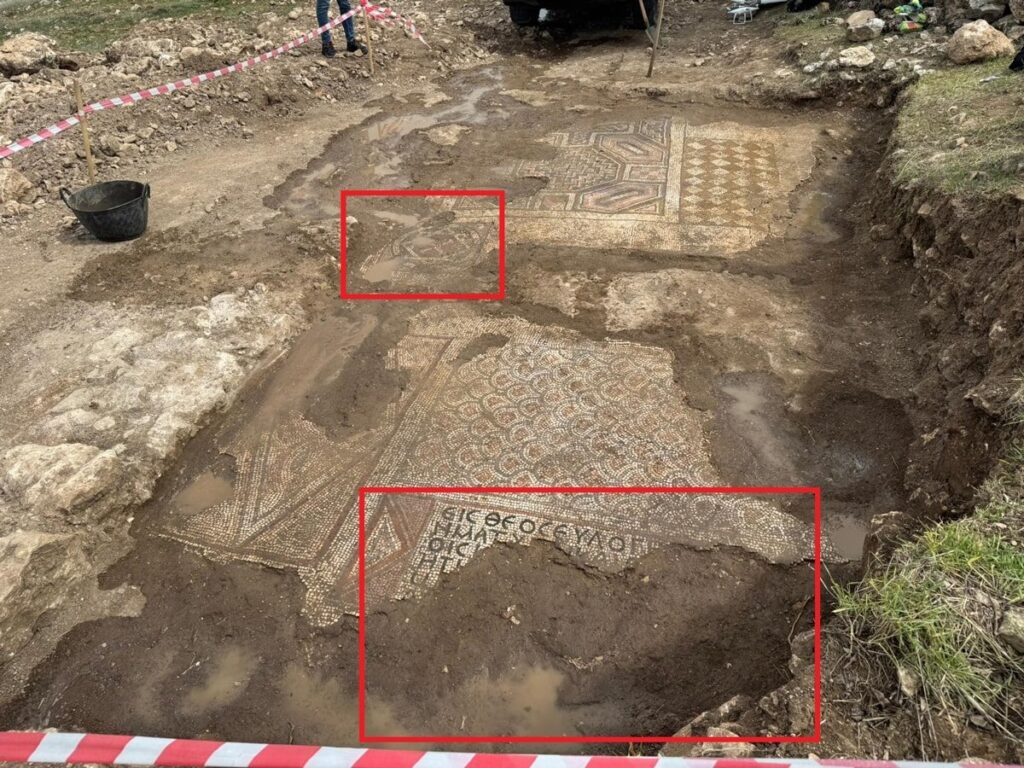
A routine burial in southeastern Türkiye has led to an extraordinary archaeological discovery. While digging a grave in the rural Özbilek neighborhood of Ergani district, local residents uncovered a stunning 35-square-meter mosaic floor believed to date back to the late Roman or early Byzantine period.

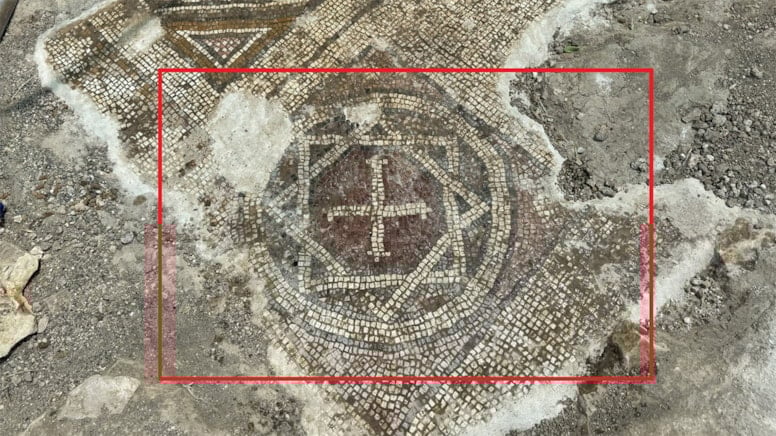
What makes the find even more fascinating is the presence of a six-line inscription in ancient Greek, resembling a formal petition or plea, along with a unique Star of David containing a Christian cross motif — a symbol rarely seen in combination. The mosaic was unearthed on March 8 during preparations for a burial, but the find has only recently been detailed by local museum authorities.

A Burial That Changed Everything

The mosaic came to light when villagers began preparing a grave for a deceased resident. As soon as the decorated floor emerged, the community halted the burial, opting to move the ceremony elsewhere and notify local authorities.

Responding swiftly, the Ergani District Gendarmerie secured the area and informed the Diyarbakır Museum Directorate, whose experts arrived the same day. After preliminary evaluations, the area was classified as a historically significant site, prompting the initiation of an emergency archaeological excavation.


📣 Our WhatsApp channel is now LIVE! Stay up-to-date with the latest news and updates, just click here to follow us on WhatsApp and never miss a thing!!


What makes the find even more fascinating is the presence of a six-line inscription in ancient Greek, resembling a formal petition or plea, along with a unique Star of David containing a Christian cross motif — a symbol rarely seen in combination. Credit: DHA

A Team of Experts Moves In

According to Mehmet Çelebi, Deputy Director of Diyarbakır Museum, a multidisciplinary team of archaeologists, art historians, restorers, and anthropologists was quickly assembled. On March 11, the team began a three-week rescue excavation, ultimately uncovering an intricately decorated mosaic spanning 35 square meters.

“Based on the style and motifs, we concluded that the mosaic likely dates to the late Roman or early Byzantine period,” said Çelebi. “It appears to have been the floor of a substantial structure — possibly a villa or religious building — and features rich geometric patterns.”

Star of David with a Cross and a Greek Petition

One of the most captivating aspects of the mosaic is the Star of David enclosing a cross, a striking fusion of Jewish and Christian iconography. This unique symbol has sparked widespread interest among historians and religious scholars.

Adding to the mystery is a six-line inscription written in ancient Greek, believed to be a petition or formal plea. While translations are still underway, early interpretations suggest it could relate to a spiritual request or legal declaration, possibly made by the structure’s owner or builder.

“This type of inscription, especially combined with such symbolic imagery, is rare and raises many questions about the religious and cultural interactions in the region during that period,” noted Çelebi.
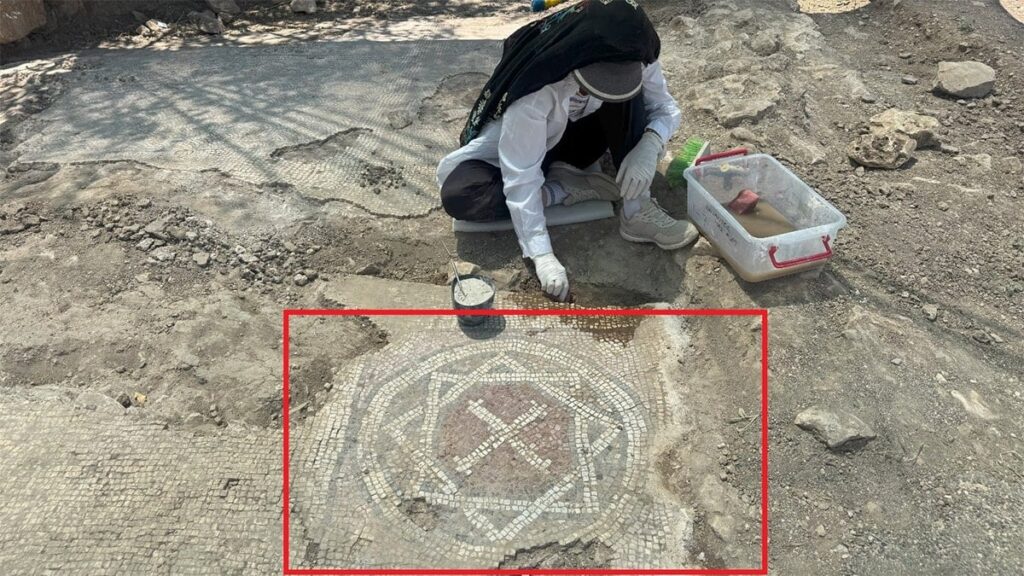

A rare mosaic detail showing a Star of David containing a Christian cross—an unusual blend of religious symbols from the late Roman–early Byzantine era. Credit: DHA

Preserving a Hidden Piece of History

Following the excavation, the entire site was covered with protective materials, including geotextiles, and cordoned off to prevent damage. The area falls within what is believed to be the ancient city of Memalan, which further supports the historical significance of the discovery.

Due to its location within the modern cemetery, concerns arose among local villagers and the neighborhood muhtar (village chief) about future burial activities. However, the Cultural Heritage Preservation Board ruled that all future burials must be carried out in a separate area away from the mosaic site.

“A new burial zone will be designated to protect the mosaic,” said Çelebi. “Until then, no grave will be dug near the discovered site. The current mosaic area is now officially under protection.”
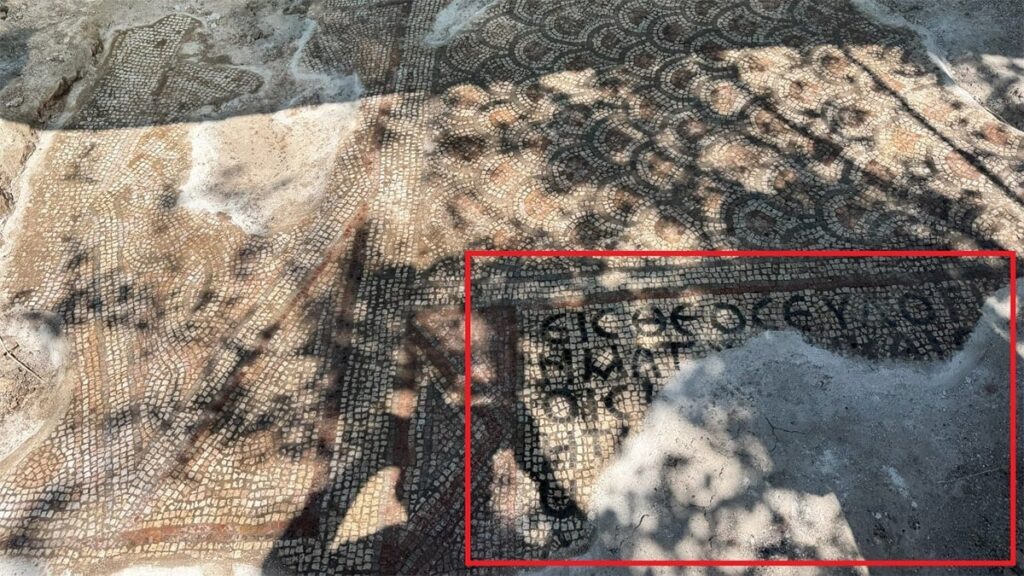

The mysterious six-line petition written in ancient Greek, found alongside the Star of David mosaic in southeastern Türkiye. Credit: DHA

A Portal into the Past

Archaeologists believe that the site may be part of a larger, undiscovered settlement. Given the presence of such a high-quality mosaic and complex symbolic elements, future excavations in the Memalan region may yield further insights into the religious and social life of southeastern Anatolia during antiquity.

The discovery offers a rare glimpse into the cultural syncretism of the region, where different religious traditions and artistic expressions coexisted and intertwined.

As translation efforts on the Greek inscription continue, and scholars analyze the symbolism of the Star of David and cross motif, this seemingly routine burial has opened the door to one of the most intriguing archaeological finds in recent Diyarbakır history.

Related Articles

13th-Century skeletons Unearthed in Annaea Mound

8 May 2021

8 May 2021

At the historical Kadıkalesi archaeological site in Turkey’s western Aydin province’s Kuşadası district, a total of five skeletons thought to...

New Discoveries in Nineveh: Archaeologists Unearth Fifteen Lamassu and Stunning Reliefs in Ancient Assyrian Palace

6 October 2025

6 October 2025

Just weeks after the September 21 announcement of the “Colossal Assyrian Winged Bull Unearthed in Iraq: Largest Ever at Six...

World treasure that cannot be displayed in the Local Museum in Pljevlja, Montenegro

30 July 2023

30 July 2023

Despite representing one of the most valuable portable cultural assets of Montenegro, the Pljevlja Diatreta is not accessible to visitors. The...

Kurt Tepesi: The Silent Sentinel in the Shadows of Göbeklitepe and Karahan Tepe – Unearthing the Forgotten Sister

31 May 2025

31 May 2025

In the arid plains of southeastern Anatolia, a quiet giant slumbers. While Göbekli Tepe has dazzled archaeologists and the global...

A 2000-year-old bronze military diploma was discovered in Turkey’s Perre ancient city

2 January 2022

2 January 2022

During excavations in the ancient city of Perre, located in the southeastern Turkish province of Adiyaman, archaeologists uncovered a bronze...

New Findings from 3,000-year-old Uluburun shipwreck: Uzbekistan Nomads Supplied a Third of the Bronze Used Across Ancient Mediterranean

5 December 2022

5 December 2022

A new study of the 3,o00 years old Uluburun shipwreck revealed a complex ancient trading network during the late bronze...

Decapitated skeletons of Roman ‘criminals’ found on HS2 route

5 February 2022

5 February 2022

Archaeologists working with the HS2 project have discovered 425 bodies on the route of the new railway line – around...

1.5-Million-year-old Footprints have Revealed the Co-Existence of two Ancient Human Species in Kenya

30 November 2024

30 November 2024

Thanks to a set of preserved footprints on the ancient shores of Lake Turkana in Kenya, researchers have uncovered the...

“Human evolution” Migration out of Africa was affected by climate constraints.

25 August 2021

25 August 2021

The story of modern man’s migration from Africa still remains unclear in many aspects. Why did people migrate? Is it...

Researchers Suggest That the 5,000-Year-Old Boat-Shaped Mound May Be Fossilized Remains of Noah’s Ark

16 March 2025

16 March 2025

A recent discovery in Türkiye has ignited interest among experts who believe they may have found the fossilized remains of...

The Headless Corpses of Somersham was Victims of Roman Executions

30 May 2021

30 May 2021

Excavations at Knobb’s Farm in Somersham, Cambridgeshire, unearthed three small late Roman graves on the outskirts of an agricultural village....

Secrets of the Ancient Walls: 1,700-Year-Old Roman Altar Unearthed at Vuçak Castle in Kosovo

19 April 2025

19 April 2025

Excavations at Vuçak Castle in the Kosovo countryside have led to a remarkable discovery: a Roman altar dating back to...

2,000‑Year‑Old “Jesus Cup” Unearthed in Alexandria: Could It Be the Earliest Material Reference to Christ?

23 September 2025

23 September 2025

A ceramic bowl discovered in Alexandria, dubbed the “Jesus Cup” and inscribed “DIA CHRSTOU O GOISTAIS”, has sparked debate: might...

700 Years After Dante’s Death, His Handwritten Notes Are Discovered

11 July 2021

11 July 2021

Dante Alighieri, an Italian poet, and scholar are best known for his masterwork La Commedia (also known as The Divine...

Anatolia’s First Phoenician Find: Human-Faced Glass Beads and Baby Jar Burials Unearthed

30 December 2025

30 December 2025

Archaeological excavations at Oluz Höyük in Amasya, north-central Türkiye, have revealed rare evidence of Phoenician presence deep inside Anatolia, including...