
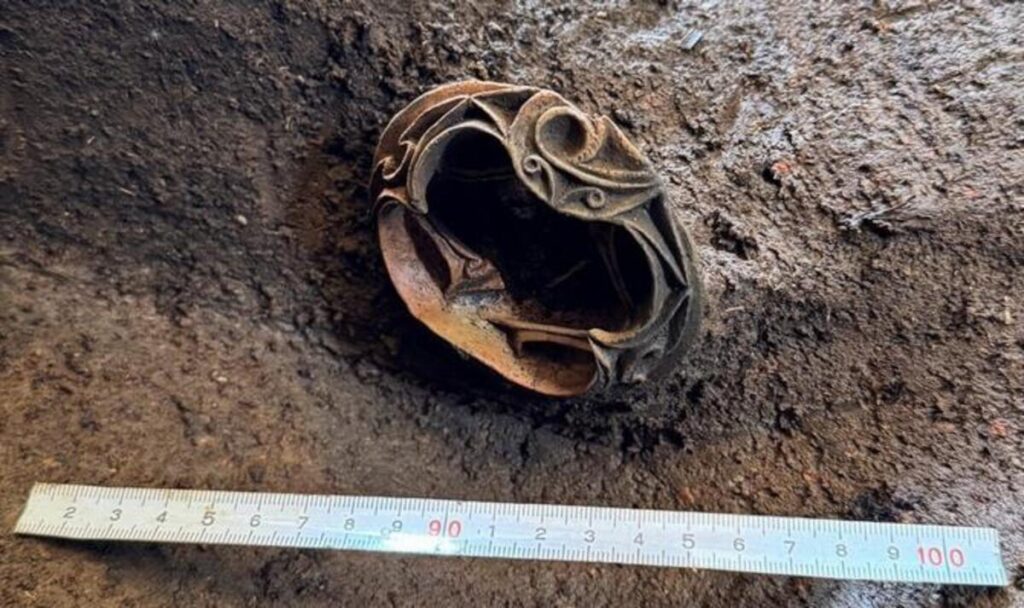
Archaeologists in Japan have discovered a 2,900-year-old clay earring decorated with intricate spiral patterns and traces of red pigment. Found at the Shinpukuji Shell Mound in Saitama, the ornament features exceptionally delicate openwork, with some sections measuring just one millimeter thick.
An ornament small enough to fit in the palm of a hand is one of the most remarkable finds from the Shinpukuji Shell Mound in Saitama, north of Tokyo. Archaeologists discovered the clay earring during excavations on July 23, revealing an elaborate design of spirals and open spaces that survived nearly three millennia underground.
At approximately eight centimeters across, the earring stands out for the extraordinary precision of its workmanship. Some of its clay elements are barely one millimeter thick, while traces of red pigment suggest that its original appearance was considerably more colorful. Its distinctive design also closely resembles ornaments from other parts of Japan, allowing researchers to investigate shared artistic traditions during the Final Jomon period.
An Extraordinary Piece of Jomon Craftsmanship
The earring measures approximately eight centimeters across at its widest point, with a wearing section about four centimeters in diameter. Its maker created a complex arrangement of circular and spiral elements, leaving open spaces between the clay decorations.
The most delicate sections are only about one millimeter thick, an impressive achievement for an object formed from clay and preserved for nearly three millennia. Archaeologists also identified traces of red pigment, indicating that the original ornament was even more visually striking than its surviving appearance suggests.
The combination of openwork decoration, sculptural details, and applied color reflects the technical abilities of Jomon artisans. Far from producing only simple utilitarian objects, these communities developed elaborate forms of personal ornamentation that demanded considerable skill and an understanding of the materials they used.
Clay earrings were familiar objects in Jomon society, although their shapes and decorative complexity varied considerably. Some examples were relatively small and simple, while others featured elaborate designs that transformed an everyday form of bodily adornment into a carefully crafted personal possession.
Similar Earrings Found Far Beyond Saitama
The discovery becomes particularly interesting when compared with ornaments from other archaeological sites. According to the Saitama City Board of Education, the newly recovered earring closely resembles examples excavated at the Sennami-Yato site in Kiryu, Gunma Prefecture, and the Shimofuda site in Chofu, Tokyo.
The similarities extend beyond their general circular form. Researchers have identified closely related decorative arrangements, suggesting that communities in different parts of the region shared recognizable artistic traditions.
The ornaments came from geographically separate settlements rather than a single production center. Their resemblance raises questions about the movement of people, objects, and ideas during the later stages of the Jomon period, although researchers have yet to establish how these decorative traditions spread between communities.
Comparable earrings from Gunma and Tokyo have been designated Important Cultural Properties of Japan, reflecting their archaeological and artistic significance. The new Saitama discovery adds another example to this distinctive tradition of prehistoric craftsmanship.

Jewelry That May Have Carried Social Meaning
The location of the discovery offers another possible clue to the earring’s significance. Archaeologists believe the area where it was recovered may have been associated with a burial, raising the possibility that the ornament belonged to someone interred there.
Researchers have proposed that elaborate Jomon earrings could communicate aspects of a person’s social identity, including their background or position within a community. Other interpretations have considered whether certain ornaments reflected marital status or stages of life, although such associations remain difficult to establish for individual discoveries.
If the Saitama ornament came from a burial, its inclusion may indicate that it held meaning beyond its decorative value. However, the available evidence does not yet establish who wore it, whether it was made locally or how it eventually entered the archaeological deposit.
A Century of Archaeological Research
The Shinpukuji Shell Mound is a nationally designated historic site in Saitama’s Iwatsuki district. Its archaeological remains document settlement activity during the Late and Final Jomon periods, when communities occupied the region long before the emergence of Japan’s historic states.
Archaeological investigations at Shinpukuji began in 1926, making 2026 the centenary of research at the site. Earlier investigations have revealed pottery, clay figurines and numerous personal ornaments, allowing researchers to examine different aspects of everyday life and ritual practices.
The newly discovered earring will make its public debut at a symposium commemorating the site’s excavation centenary on November 14, 2026. The event will bring together specialists to discuss Shinpukuji’s archaeological history and recent research into Jomon society.
