
An unexpected discovery inside a medieval church in Hungary has revealed two remarkable objects: fragments of an 800-year-old gilded cross crafted in France and pieces of chain mail armor. Their presence in the church’s sacristy offers a rare glimpse into its medieval past while raising questions about how such different objects came to occupy the same space.
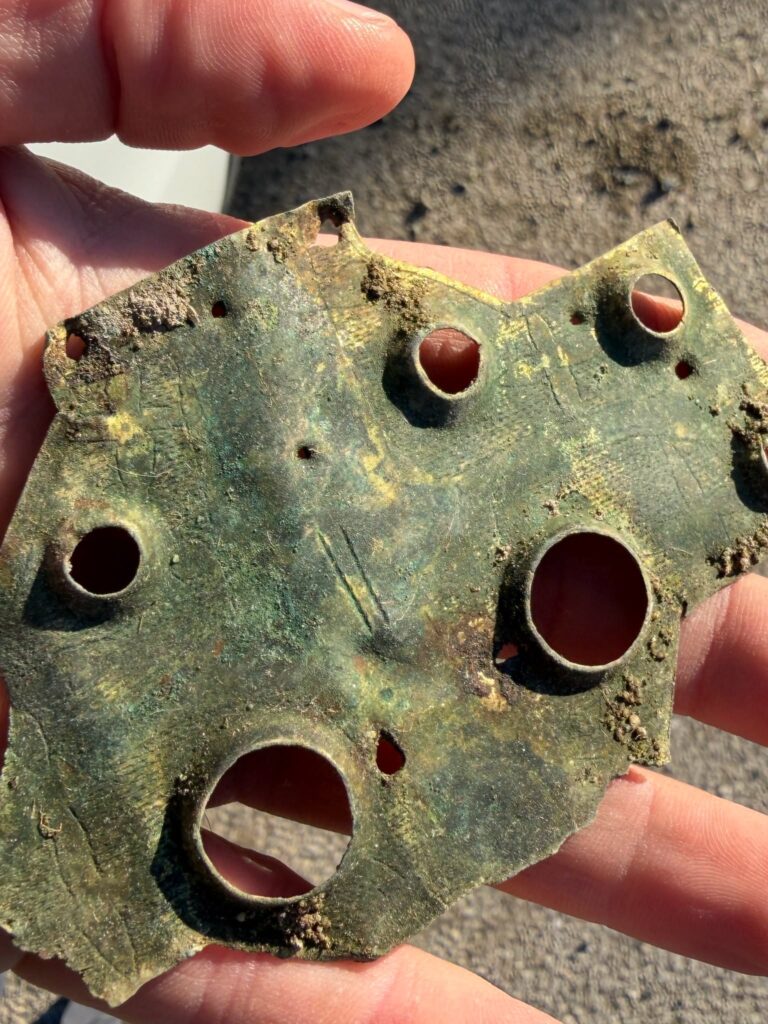
After nine months of archaeological work at the Avas Church in Szigliget, near Lake Balaton, one of the excavation’s most remarkable discoveries came just as the project was drawing to a close. While replacing a gravel surface in the sacristy, archaeologists encountered several greenish copper plates and what initially appeared to be little more than a handful of rusted iron.
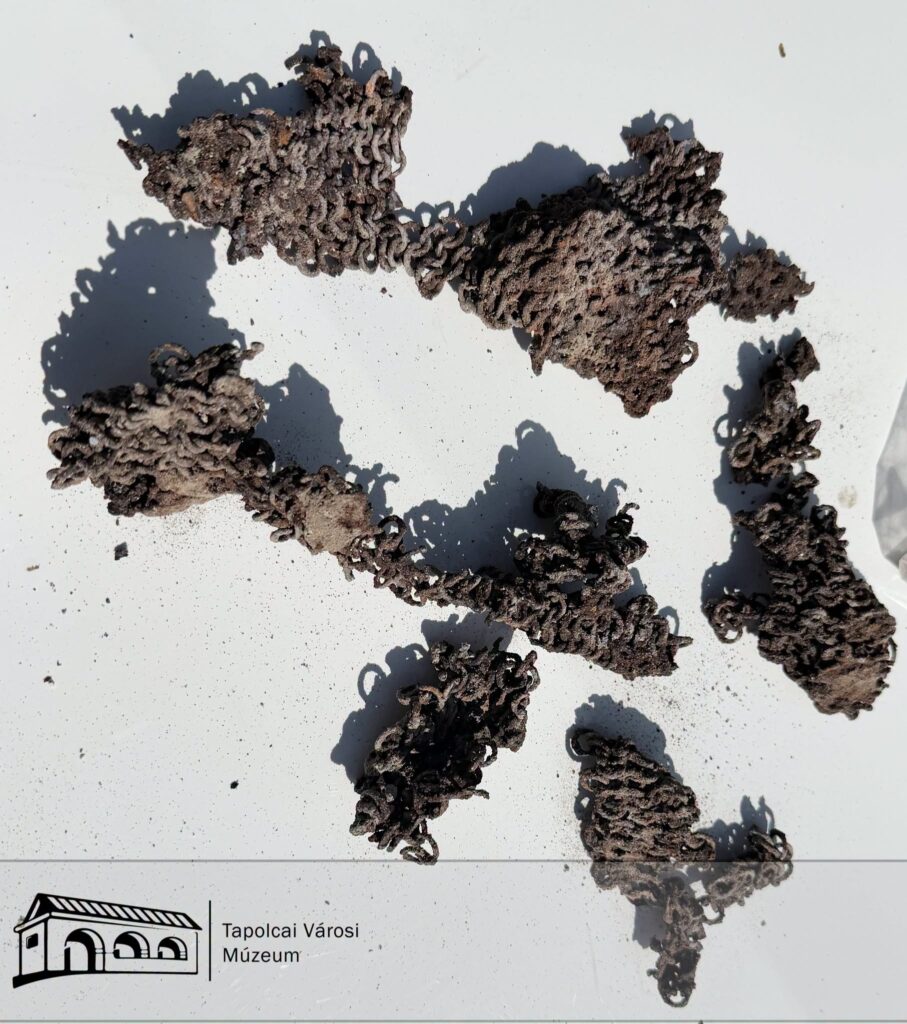
The iron fragments soon revealed themselves to be pieces of chain mail, an unusual find in a church setting. But cleaning the copper plates brought an even greater surprise: beneath the corrosion, researchers identified traces of gilding and engraved decoration belonging to a 13th-century Limoges cross, a religious object produced in the celebrated metalworking workshops of southern France.
An Unexpected Discovery at the End of Nine Months
The discoveries came during archaeological investigations associated with the construction of the Tóti Lengyel Gáspár Visitor Centre. The Wass Albert Library and Museum began monitoring earthworks on January 19, 2026, when temperatures fell to minus 9 degrees Celsius. Further excavations followed in July, sometimes under summer temperatures reaching 39 degrees.
After months of fieldwork, the most remarkable objects appeared on the second-to-last day involving earthmoving. Archaeologists were replacing a gravel walking surface inside the church’s sacristy when they encountered several greenish copper plates and a collection of heavily corroded iron fragments.
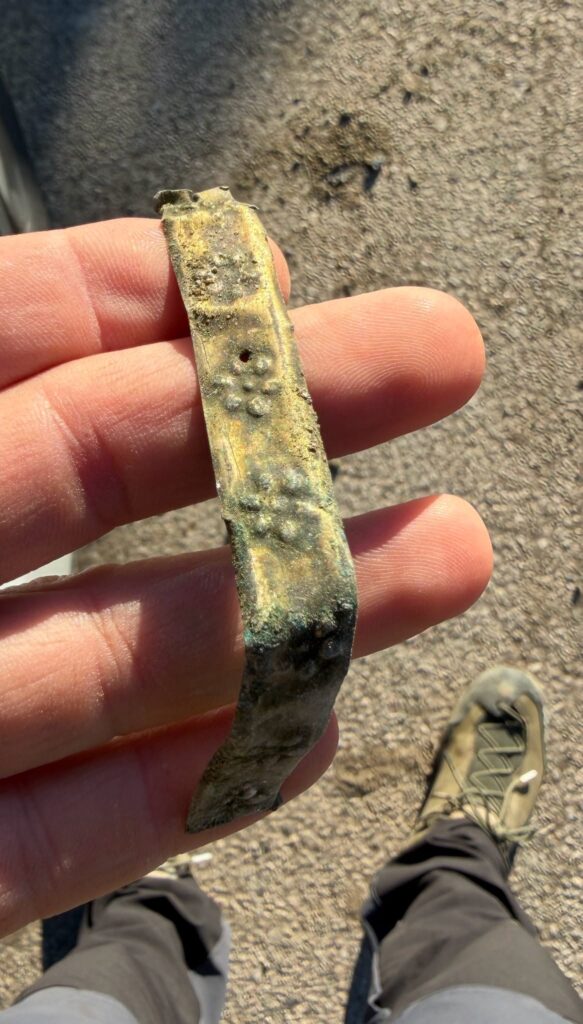
The iron pieces initially resembled little more than a handful of rust. Closer examination, however, revealed sections of chain mail armor, an unusual discovery in a church setting. Cleaning the copper fragments then produced an even greater surprise: traces of gilding and decoration that identified them as parts of a medieval liturgical cross.
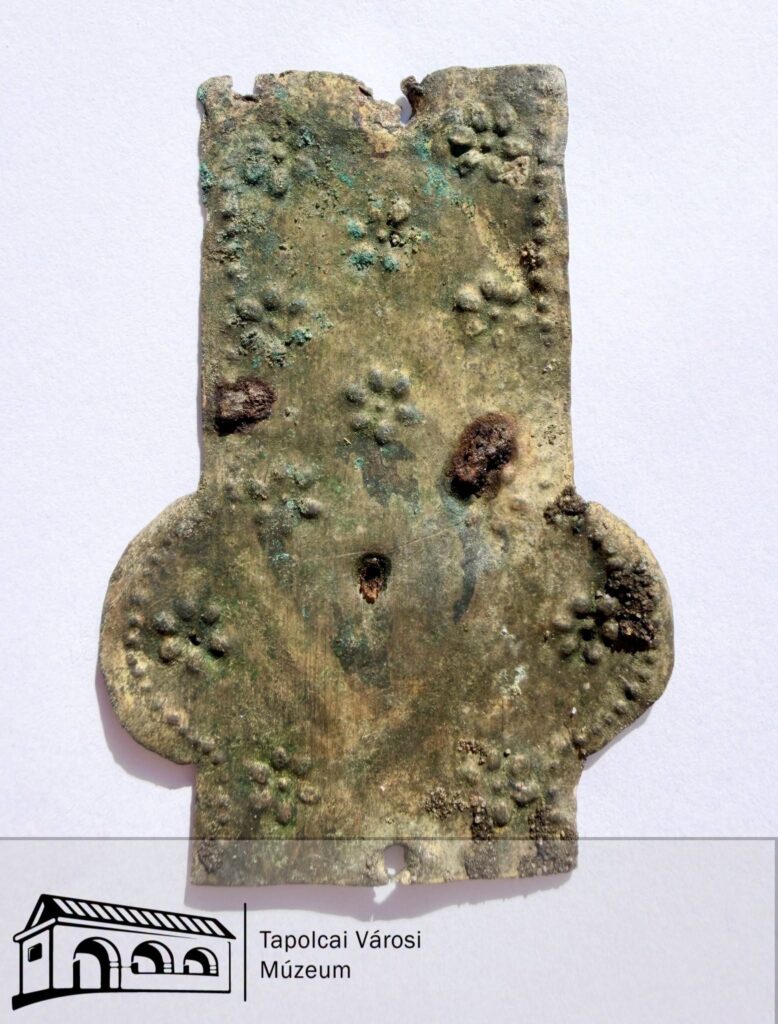
The museum’s archaeologist, Győrffy-Villám Zsombor, reported that the surviving pieces belonged to a cross produced in Limoges, a major medieval metalworking center in southern France. The identification places the object within a tradition of religious craftsmanship whose products circulated widely across medieval Europe.
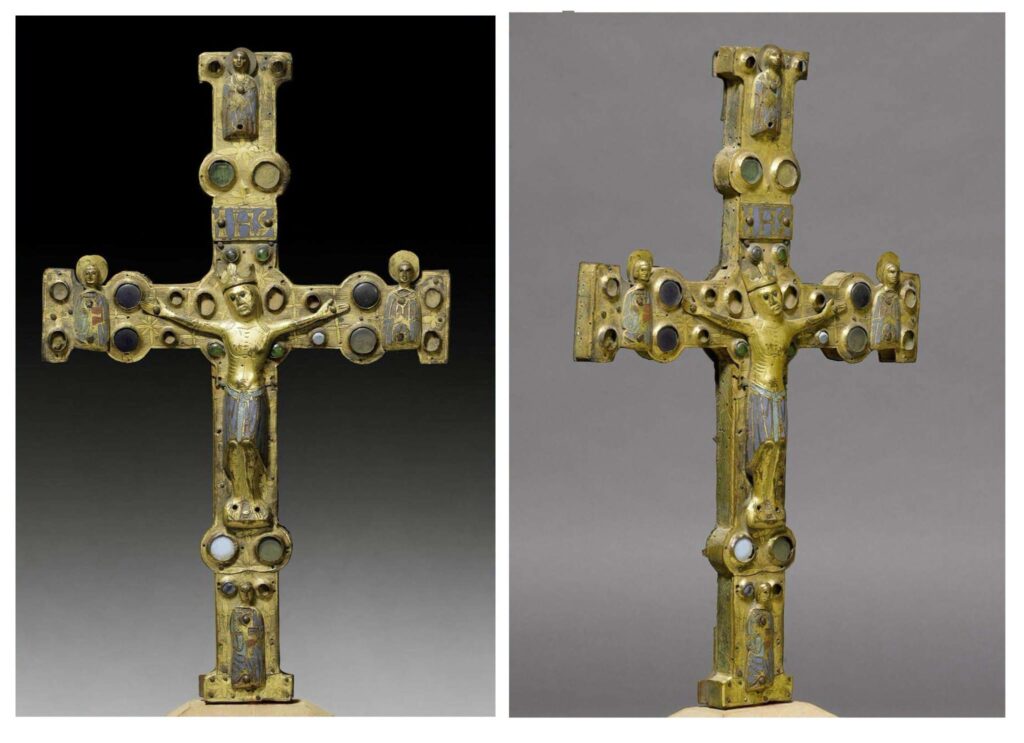
A medieval Limoges cross illustrating how the fragmented object discovered at Szigliget may originally have appeared. This is a comparative example, not the excavated cross. Koller Auctions. Credit: Wass Albert Könyvtár és Múzeum
A French Cross in a Hungarian Church
During the 12th and 13th centuries, Limoges became particularly famous for its decorated copper objects, including crosses, reliquaries, and other furnishings used in Christian worship. Its workshops developed a distinctive approach to metalworking that combined gilded surfaces with brightly colored enamel decoration.
Artisans frequently employed a technique known as champlevé, cutting recessed areas into copper plates and filling them with powdered glass. Heating fused the glass into colorful designs, while gilding and engraved patterns enhanced the appearance of the finished object. Churches and monasteries across Europe acquired such works, making Limoges one of the most recognizable centers of medieval religious metalwork.
The fragments from Szigliget retain their gilded surfaces, engraved ornamental patterns, and the outline of the crucified Christ. Although the enamel figures that once decorated the cross are missing, enough of its metal components survive for researchers to reconstruct much of its original appearance.
The find indicates that the Avas Church possessed a religious object produced far beyond its immediate region. It also connects the small Hungarian settlement to the broader movement of devotional art and church furnishings across medieval Europe, even though the precise circumstances of the cross’s arrival remain unknown.
Chain Mail Inside a Sacred Space
The pieces of chain mail add a different dimension to the discovery. Medieval armor of this type consisted of interconnected iron rings that formed a flexible protective garment, allowing its wearer to move while providing protection against certain weapons.
Unlike the cross, whose religious function and approximate period have been identified, the armor fragments remain more difficult to interpret. Their discovery inside the sacristy is particularly unusual because this room ordinarily served as a place for storing religious vessels, vestments, and other objects used during church services.
The museum has not established whether the armor belonged to someone associated with the church, arrived there during a later phase of the building’s history, or was deposited under other circumstances. Its proximity to the cross makes the discovery especially striking, but does not establish that the objects were originally used or deposited together.
A Church Built Among Older Remains
The Avas Church, also known locally as Csonkatorony, or the Broken Tower, stands in an area occupied long before the medieval period. Archaeological evidence around the site includes Roman building materials, and local historical research has proposed that the medieval church incorporated the remains or foundations of an earlier Roman structure.
The surviving building features a distinctive tower that rises from a square base into an octagonal upper section. Architectural comparisons suggest that the church took shape around the late 12th or early 13th century, when Szigliget formed part of the medieval Kingdom of Hungary.
The church served a settlement that later declined as the population gradually moved toward the fortified area around Szigliget Castle. A document from the 1420s still mentions a stone church dedicated to All Saints in the old settlement, providing an important historical reference for the surviving ruins.
