
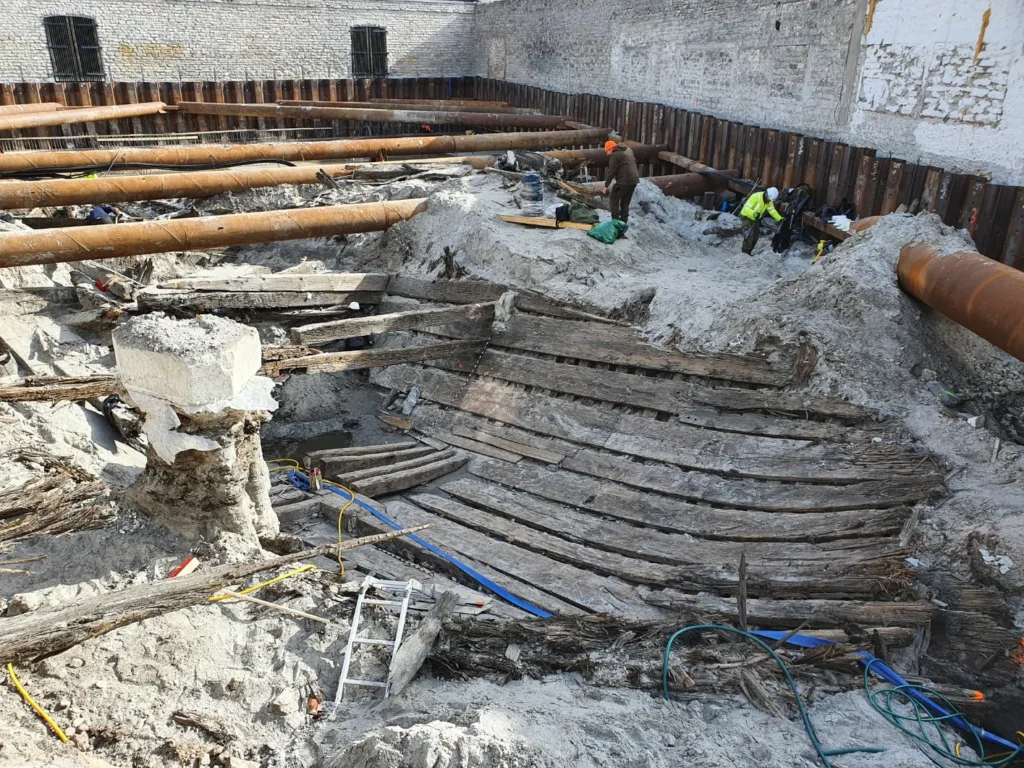
In the heart of Tallinn, Estonia, an ordinary office construction project was expected to add another modern building to the city. Instead, it uncovered the 14th-century Lootsi cog, one of Europe’s best-preserved medieval ships, preserving an unusually complete record of Baltic trade, shipbuilding and early navigation.
On March 31, 2022, workers digging foundations at Lootsi Street 8, near Tallinn’s old harbor, hit a wooden structure about 1.5 meters below the surface. Archaeological monitoring stopped the work. What emerged from the wet sand was not a small fragment of harbor debris, but the remains of a large 14th-century merchant ship.
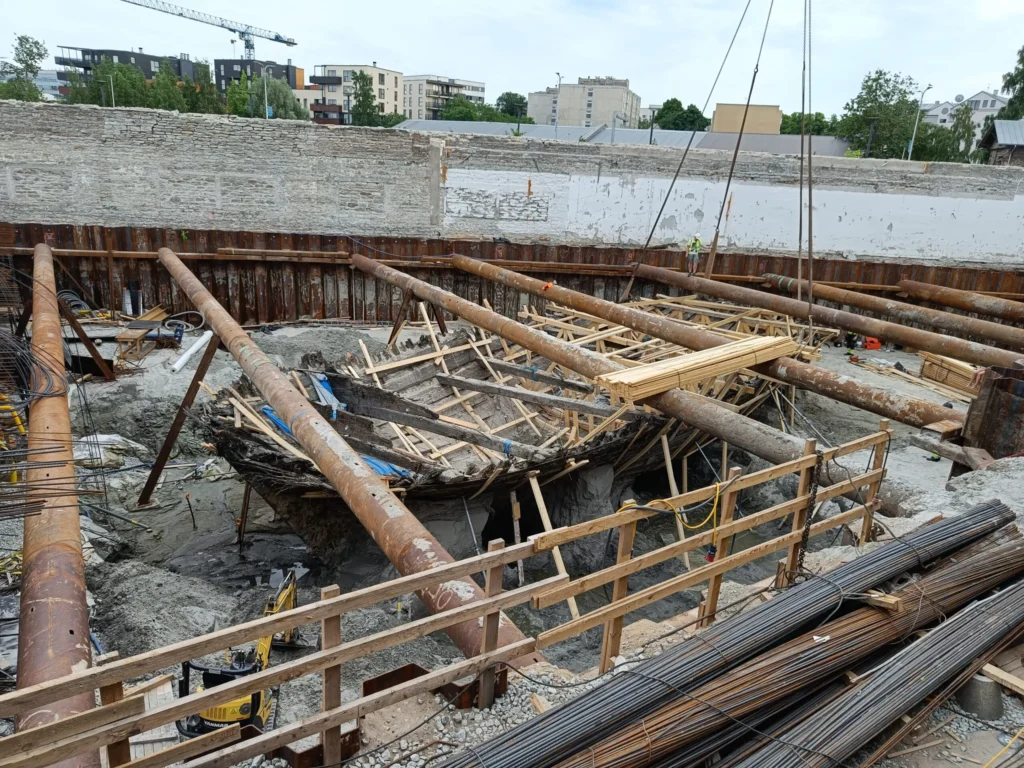
The vessel, now known as the Lootsi 8 cog, measures about 24.5 meters long and 8.6 meters wide. Researchers describe it as one of the best-preserved medieval ships found in Europe. It was so large and fragile that specialists had to lift it in four major sections and move it to the Estonian Maritime Museum, where conservation and detailed study could continue away from the construction site.
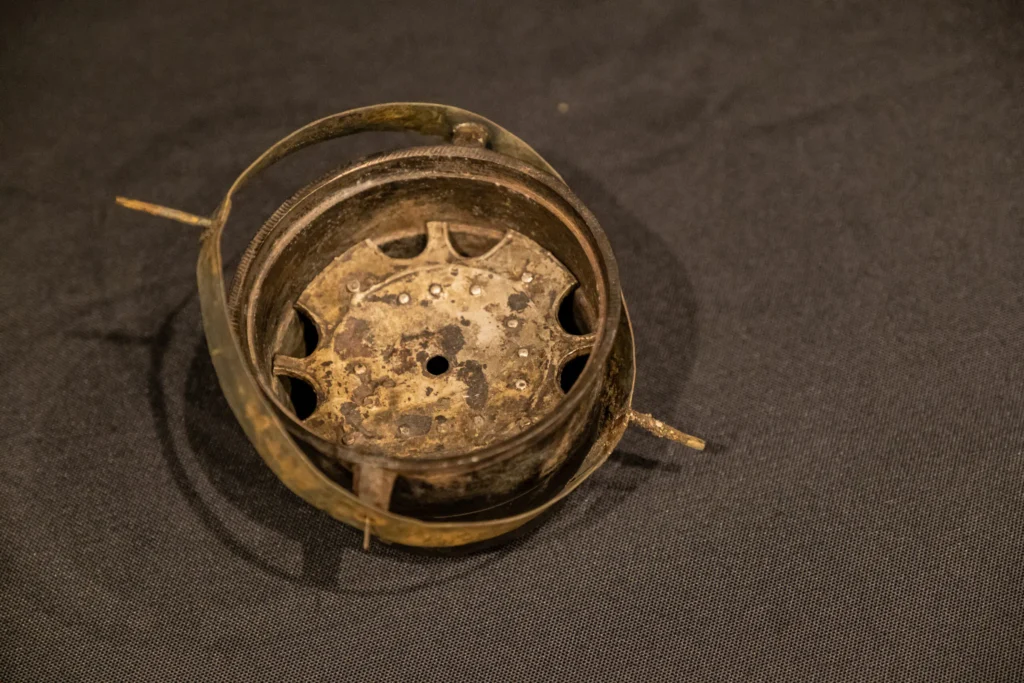
But the ship itself was only the beginning. Among the objects recovered from the wreck was a dry compass believed to be the oldest surviving example of its kind in Europe. Reports from Estonia have described it as still functional, a remarkable survival from a time when Baltic merchants depended on wind, coastlines, memory and increasingly sophisticated navigational tools.
A ship sealed beneath a changing shoreline
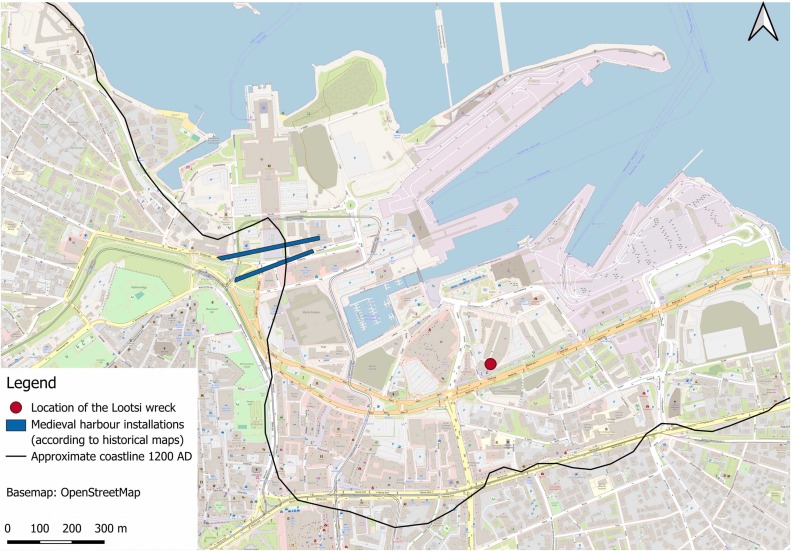
The place where the ship was found no longer looks like a medieval shore. Today, it is part of urban Tallinn. In the Middle Ages, however, the area lay near shallow coastal waters close to the delta of the Harjapea River. Sediment, sandbanks and harbor activity shaped a difficult maritime landscape.
The presumed medieval harbor stood roughly 800 meters west-northwest of the wreck. Over later centuries, the marshy ground was reclaimed from the sea, filled, built over and used for warehouses, railway infrastructure and eventually parking areas. The ship remained below, sealed in marine sediments.
That survival is what makes the Lootsi cog so important. Medieval ships are often found as broken remains, stripped hulls or isolated timbers. This one preserved not only a large part of its structure, but also traces of the life that once moved across its deck.
The compass that changes the story
The compass is the object most likely to capture public attention, and for good reason. A dry compass from the 14th century is not a routine find. If the identification holds, it places the Lootsi discovery among the most important pieces of medieval navigational evidence in Europe.
The compass matters because it changes how readers should see the ship. This was not merely a wooden cargo vessel that sank near Tallinn. It was part of a commercial world that required planning, navigation and technical knowledge. Baltic merchants crossed waters that could be profitable, but also dangerous. A working compass on board speaks to the growing importance of instruments in medieval seafaring.
The wreck also produced objects that feel more intimate: tools, weapons, leather shoes and the preserved remains of two ship rats found in spilled tar. Some of the shoes were worn and repaired. These details suggest a working ship, not a ceremonial object. People lived, ate, worked and navigated aboard it.
The disorder of the finds also points to a sudden end. Archaeologists have suggested that the crew may have had to leave quickly, with everyday objects left scattered behind. That raises the central human question of the wreck: why was such a large and apparently valuable ship abandoned or lost so close to shore?
Tree rings date the ship almost year by year
The new scientific study gives the ship a precise internal clock. Researchers analyzed 97 wood samples from the wreck, including hull planks, frames, beams, reinforcing planks and other structural elements. Of these, 87 were successfully dated through dendrochronology, the study of tree rings.
The results show that the main structure was built from oak trees felled in the winters of 1370–71 and 1371–72. Other parts, including planks from a possible galley or pantry-related structure, came from trees felled in winter 1373–74.
This means the vessel was not simply “from the 14th century” in a vague sense. Its construction can be placed in the early 1370s with unusual precision. The spread of dates may show that the lower hull took several years to build, or that the ship was completed and fitted out in stages.
Just as important, the hull shows little evidence of major repair. Only smaller repairs, such as caulked cracks, were recorded. That suggests the ship may have been relatively new when it met its end near Tallinn.
Baltic forests inside a Tallinn ship
The ship’s wood also reveals a trade network. The study found that many of the oaks used in the vessel likely came from coastal Lithuania, with other groups possibly linked to nearby Baltic regions and a smaller group connected to Estonia.
This is one of the strongest parts of the story. The Lootsi cog was not just a ship moving through trade routes. It was built from the same networks. Its timber may have been cut in one region, moved across the Baltic, shaped by specialized builders and fitted for service near Tallinn.
The vessel belongs to the cog tradition, a broad medieval ship type associated with cargo transport across northern European waters. Cogs are often linked with Hanseatic trade, but the Lootsi 8 ship does not fit every simple category. Its construction includes features that complicate the standard image of what a late medieval cog should look like.
That is part of its value. It shows that shipbuilding was not fixed or uniform. Builders adapted materials, techniques and structural choices to local knowledge, available timber and practical needs.
Medieval builders knew the wood was damaged
One of the strangest discoveries came from inside the timbers. Many of the oak planks contained so-called moon rings, pale bands of included sapwood formed when a tree is damaged during growth. The cause may include frost, broken branches or environmental stress.
In the Lootsi 8 ship, 21 of the 87 dated samples showed moon rings. That is a strikingly high proportion compared with earlier studies from other regions.
The shipbuilders clearly noticed the problem. In areas where moon rings appeared in hull planks, they placed long reinforcing planks inside the vessel. In other words, the wood was not perfect, but the builders understood its weaknesses and compensated for them. This detail brings medieval craftsmanship into sharp focus. The ship was not just assembled from timber. It was judged, corrected and reinforced by people who knew the behavior of wood from experience.

Another older ship remains underground
The Lootsi cog may not be the only ship beneath this part of Tallinn. Archaeologists have confirmed that another, older wreck lies nearby, still buried and unexcavated. The decision to leave it in the ground is deliberate. Soil has protected it for centuries, and future methods may allow a more careful recovery.
For now, the Lootsi cog is enough to show how much of medieval Tallinn still lies beneath the modern city. A construction pit revealed one of Europe’s best-preserved medieval ships, a possible record-breaking compass, traces of shipboard life and a timber record stretching from Baltic forests to the harbor waters of Estonia.
It began as an office foundation. It became one of the most important medieval maritime discoveries in northern Europe.
Daly, A., Sohar, K., Läänelaid, A., Lätti, P., & Reinvars, L. (2026). Timber for a medieval cog: Wood studies of the Lootsi 8 wreck, Tallinn. Dendrochronologia, 97, Article 126519. https://doi.org/10.1016/j.dendro.2026.126519
Cover Image Credit: Estonian Maritime Museum (Eesti Meremuuseum)
