
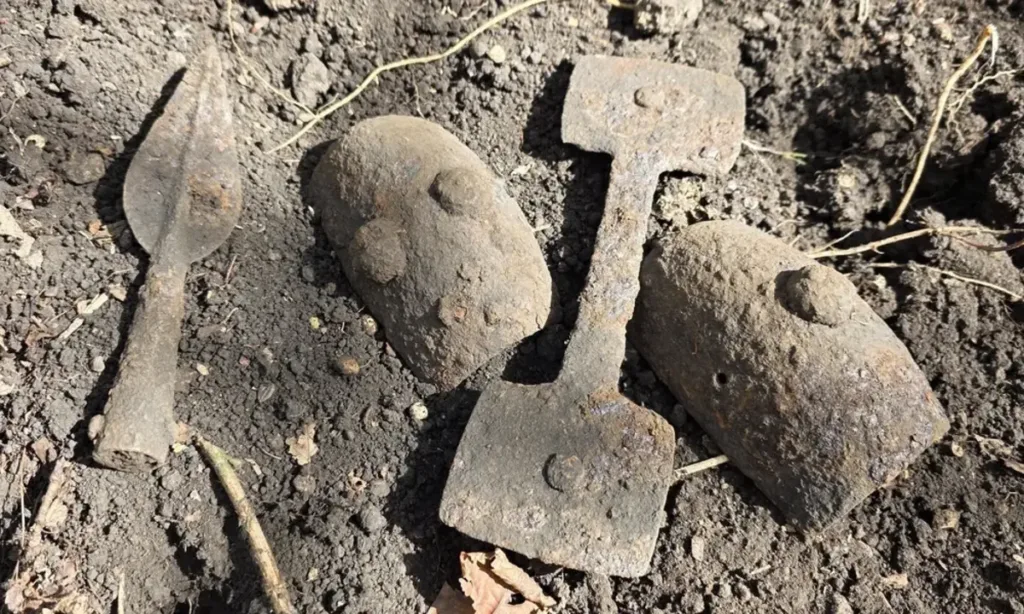
Archaeologists surveying the hills around Erdőbénye in northeastern Hungary have uncovered an unusual group of Iron Age weapons: a Celtic spear and what researchers describe as a complete shield set.
The objects emerged during fieldwork in September as part of an archaeological survey that has been systematically mapping Erdőbénye and its surroundings since 2024. According to the Hungarian National Museum, nothing comparable has previously been documented in the immediate area, making the discovery an important new piece of evidence for the region’s Iron Age past.
Rather than coming from a large excavation, the finds grew out of patient landscape survey. Archaeologists, specialists and volunteers have been walking the countryside, examining known sites and searching for traces of previously undocumented ones through conventional fieldwalking and metal-detector surveys.
Weapons Found Together in the Landscape
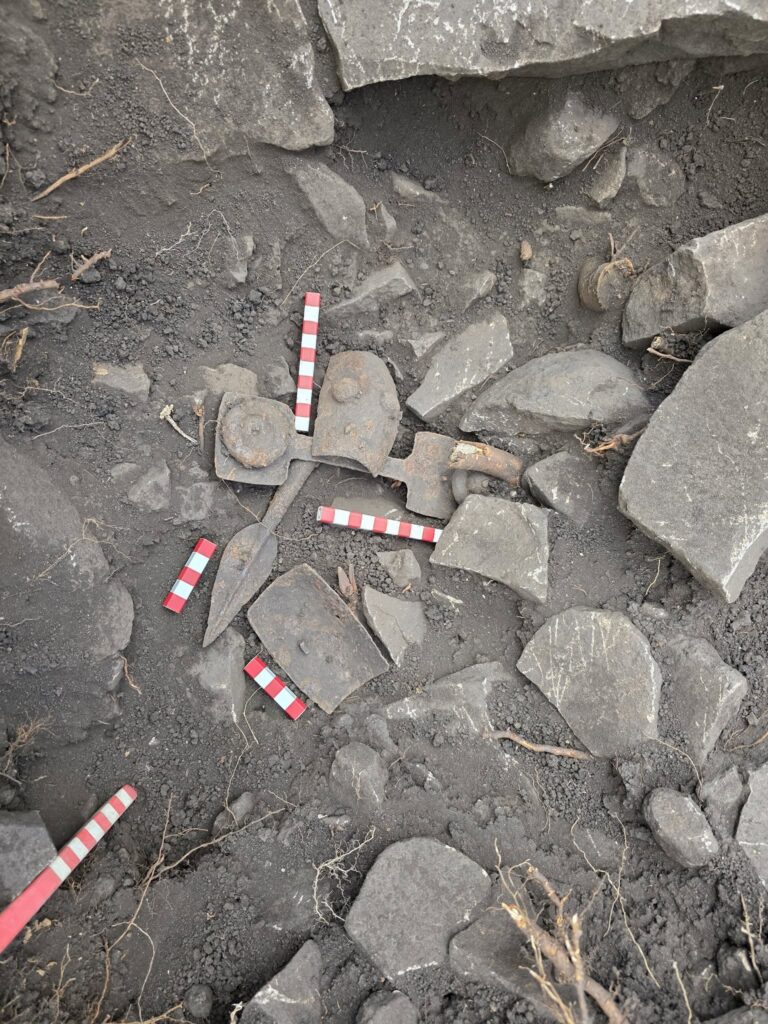
The September campaign produced the project’s most striking discovery so far. Researchers recovered a Celtic spear together with a complete set of shield fittings, creating a rare group of weapons that appears to have remained associated in the ground.
Múlt-kor reports that the weapons were found lying close together along with additional metal objects and fragments of pottery. Their relationship to one another is particularly valuable because archaeologists can learn considerably more from objects recovered in a documented archaeological context than from isolated finds whose original positions have been lost.
The Hungarian National Museum describes the assemblage as the first of its kind known from the Erdőbénye area. Researchers are now interested not only in the weapons themselves but also in their precise location, the circumstances of their deposition and other material recovered from the surrounding ground.
Those details may eventually help explain why the objects ended up together. At present, however, the museum has not announced whether they belonged to a burial, were intentionally deposited, were lost, or reached the ground under some other circumstances.
A New Window Into Celtic Erdőbénye
The discovery adds an unexpectedly tangible dimension to what archaeologists know about Celtic communities in this part of the Carpathian Basin.
Groups associated archaeologically with the La Tène cultural world had established themselves in parts of the region during the later Iron Age. Cemeteries and artifacts linked with Celtic communities are already known elsewhere in northeastern Hungary, but the Erdőbénye assemblage fills a more local gap in the archaeological record.
That local context is precisely what makes the new find important. A spear or shield fitting discovered on its own might reveal the presence of Iron Age material, but a group of related weapons recovered together can potentially preserve information about how people used a particular place and how the objects were deposited there.
The museum has so far avoided assigning a more specific interpretation to the assemblage. Further study of the weapons, pottery and surrounding archaeological evidence will be needed before researchers can determine exactly where the finds belong within the area’s Iron Age history.
Archaeology Beyond the Excavation Trench
The Erdőbénye project began in 2024 with a broader objective than searching for individual spectacular artifacts. Researchers want to build a systematic archaeological map of the region by revisiting previously known sites, locating new ones, and examining how communities occupied and moved through the landscape over time.
Community archaeology has become an important part of that work. Volunteers participate alongside professional archaeologists in repeated field surveys, allowing large areas to be examined methodically rather than limiting research to individual excavation trenches.
The latest discovery demonstrates what that approach can reveal. The spear and shield components were not uncovered because researchers already knew exactly where an Iron Age weapon deposit lay. They appeared during a continuing program of landscape investigation designed to build a much larger archaeological picture.
The Search Around Erdőbénye Continues
The research is jointly led by archaeologists Vera Majerik of the Hungarian National Museum’s National Institute of Archaeology and Borbála Nyíri. Gábor Bakos coordinates the community archaeology program with assistance from archaeologist Máté Piros-Pozdora.
The wider collaboration also includes archaeologist Gábor V. Szabó of the Institute of Archaeological Sciences at Eötvös Loránd University and geographer András Gömöri of the University of Miskolc.
Fieldwork will continue through the autumn, with researchers and volunteers returning to the landscape around Erdőbénye in search of additional archaeological evidence. The newly discovered weapons have already demonstrated that the area still holds information capable of changing the archaeological picture of its Iron Age communities.
For the moment, the most intriguing question remains unresolved: why a Celtic spear and an entire set of shield fittings came to rest together in this particular corner of northeastern Hungary.
