
10 March 2026 The Future is the Product of the Past

The Glauberg Celtic Prince: A 5th Century BCE Most Extraordinary Iron Age Royal Discovery

The Glauberg Celtic Prince is one of the most extraordinary Iron Age discoveries in Central Europe. Unearthed in 1996 near the Glauberg hill in Hesse, Germany, this remarkable archaeological find has reshaped our understanding of early Celtic elite culture. Often referred to as the “Celtic Prince of Glauberg,” the burial dates to approximately the early 5th century BCE, placing it firmly within the Late Hallstatt to Early La Tène period of the Celtic Iron Age.

What makes the Glauberg Celtic Prince truly exceptional is the life-sized sandstone statue discovered near the burial mound. This statue is one of the oldest known anthropomorphic Celtic sculptures in Europe. The figure is depicted wearing distinctive leaf-shaped headgear—often interpreted as mistletoe leaves—along with a torc (a rigid neck ring symbolizing status and power), a shield, and a sword. These elements strongly indicate aristocratic rank and possibly even religious significance.
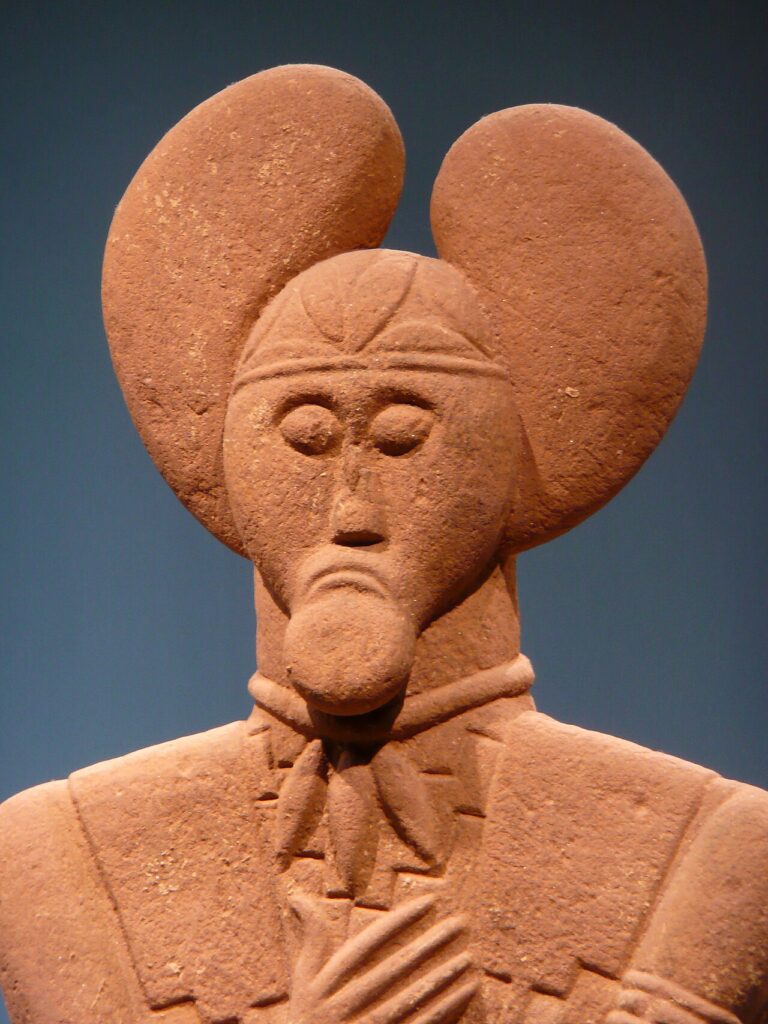
The Celtic Prince of Glauberg (c. 500 BCE) displayed at the Keltenwelt am Glauberg museum and research center. Credit: Public Domain

One of the most striking features of the Glauberg Celtic Prince statue is his unusual headdress. At first glance, it may resemble Mickey Mouse ears, but it actually represents a stylized mistletoe leaf crown. This symbolic headgear is widely interpreted as a sign of sacred authority and possibly priestly status within Celtic society. In Celtic belief systems, mistletoe held deep spiritual significance, often associated with ritual practices and elite religious power. The distinctive “mistletoe crown” not only makes the sculpture visually unique among Iron Age artifacts, but also strengthens the theory that the Glauberg figure was more than a warrior — he may have been a ruler with both political and spiritual authority.

The burial chamber itself contained lavish grave goods, including gold jewelry, finely crafted weapons, and imported items that suggest long-distance trade connections across Iron Age Europe. Such artifacts highlight the extensive cultural and economic networks of the Celtic world. The princely tomb was part of a larger complex featuring burial mounds, processional avenues, and fortified settlements, indicating that the Glauberg site was a significant political and ceremonial center.
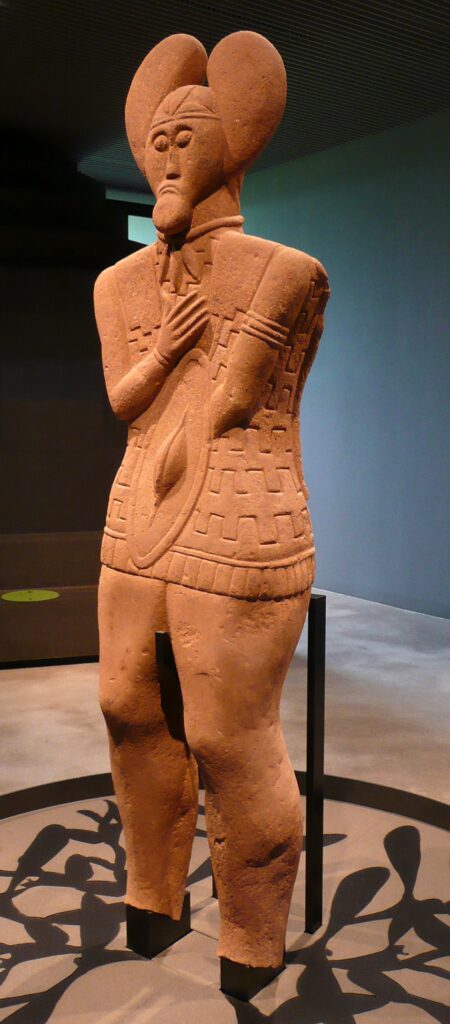
The Celtic Prince of Glauberg (c. 500 BCE) displayed at the Keltenwelt am Glauberg museum and research center. Credit: Public Domain

Radiocarbon dating and artifact typology confirm that the burial dates to around 480–450 BCE. This period marks the transition from the Hallstatt culture to the La Tène culture, a time when Celtic art and social hierarchies were becoming increasingly sophisticated.


📣 Our WhatsApp channel is now LIVE! Stay up-to-date with the latest news and updates, just click here to follow us on WhatsApp and never miss a thing!!


Today, the discoveries from the Glauberg site are displayed at the Keltenwelt am Glauberg, where visitors can explore the fascinating legacy of this Iron Age prince.

Keltenwelt am Glauberg Museum

Related Articles

Before the Olympics, the Alps Reveal a 200-Million-Year-Old Secret

18 December 2025

18 December 2025

High in the heart of the Italian Alps, where jagged peaks rise above future Olympic venues, an extraordinary window into...

The new study presents evidence suggesting the use of threshing sledges in Neolithic Greece as early as 6500 BCE, about 3000 Years Earlier than Previously Thought

17 May 2024

17 May 2024

The threshing sledges, which until a few decades ago was used in many Mediterranean countries from Turkey to Spain to...

The 1,000-year-old surgical kit found in Sican tomb, Peru

28 March 2022

28 March 2022

A set of surgical tools indicating that the deceased was a surgeon was found in a funerary bundle found in...

Archaeologists Identify Previously Unknown Monumental Theater and Forum in Roman Irpinia

17 February 2026

17 February 2026

A groundbreaking archaeological campaign at the Fioccaglia Archaeological Site in southern Italy has uncovered the remains of a Roman forum...

4000-year-old Palace complex dating from China’s earliest known Xia dynasty unearthed

30 December 2023

30 December 2023

In Xinmi, in the Henan Province of Central China, a four-courtyard style palace complex from the Xia Dynasty (2070BC–1600BC), China’s...

In Neolithic China, Death Was Gendered: Men for the Gates, Women for the Elites

2 December 2025

2 December 2025

Human sacrifice was not just a ritual act in Neolithic China—it was a carefully engineered system, and nowhere is this...

The earliest human remains 11,000-year-old discovered in northern Britain

25 January 2023

25 January 2023

An international team of archaeologists at the University of Central Lancashire (UCLan) has discovered 11,000-year-old human remains in the Heaning...

Well-preserved Ming Dynasty tomb unearthed in China’s Shanxi Province

17 March 2024

17 March 2024

Archaeologists from the Shanxi Institute of Cultural Relics and Archeology have unearthed a well-preserved tomb from the Ming Dynasty (1368-1644)...

12 tombs with Beautiful Decorations and Carved Bricks from the period of Kublai Khan, the grandson of Genghis Khan, found in China

22 May 2023

22 May 2023

China has a rich history. In addition to the fossil records from the Paleolithic Period, the country has witnessed the...

Was the mystery of Noceto Vasca Votiva the water ritual?

13 June 2021

13 June 2021

The Noceto Vasca Votiva is a one-of-a-kind wood building discovered in 2005 on a tiny hill in northern Italy. The...

Queen of Seas Who Challenged Rome: ‘Queen Teuta’

31 October 2023

31 October 2023

Illyrian Queen Teuta is one of the most extraordinary figures of Illyrian antiquity and of Albanian heritage. She was also...

Using Google Earth and aircraft reconnaissance, archaeologists identify unknown sites and Serbia’s hidden Bronze Age megastructures

17 November 2023

17 November 2023

Using Google Earth and aircraft reconnaissance, archaeologists at University College Dublin identified more than 100 previously unknown sites. Satellite remote...

A 12.000 -year-old temple was found during excavations in Boncuklu Tarla in southeastern Turkey

21 October 2021

21 October 2021

A temple thought to be 12 thousand years old was unearthed in Boncuklu Tarla in the Ilısu Neighborhood of Dargeçit...

Swiss Scientists Identify Arrowhead Made from a Meteoritic Iron

1 August 2023

1 August 2023

In a recent study of archaeological collections in the Lake Biel region in Switzerland, an arrowhead from the Bronze Age,...

1900 years old a Customs Inscription from the Lycian civilization reveals Anatolia’s strategic importance in maritime trade

16 September 2023

16 September 2023

A Customs Inscription from the Lycian civilization, located in Andriake port in the southern province of Antalya’s Demre district, tells...