
An exceptionally large Roman inscription has been discovered at the ancient thermal baths of Fortuna in southeastern Spain. Its surviving letters reach 23 centimeters in height, while archaeologists estimate that the original inscription extended at least 4.8 meters and may date to the reign of Augustus.
Archaeologists discovered the inscription carved into a stone block measuring approximately 90 centimeters in length, reused in a later wall at the Roman Baths of Fortuna. Although only this fragment survives, researchers estimate that the original monumental inscription extended at least 4.8 meters. The surviving stone bears unusually large lettering, with characters reaching 23 centimeters in height, a size seldom encountered among Roman inscriptions preserved on the Iberian Peninsula.
The discovery emerged during excavations directed by historian Gonzalo Matilla of the University of Murcia. Archaeologists found the inscribed stone block reused in a later wall, meaning that its present position does not reveal where the original inscription once stood. Researchers estimate that the complete text would have extended at least 4.8 meters, although only a portion survives.
Monumental Letters at the Roman Baths
The inscription was recovered during work in the northern part of the thermal complex, where archaeologists were clearing structural remains and examining the boundaries of the ancient buildings. Its discovery adds an important piece of evidence to the ongoing reconstruction of the site’s Roman architecture.
The stone preserves lettering of two different sizes, with larger characters measuring approximately 23 centimeters and smaller ones around 13 centimeters. According to Matilla, very few examples with letters of comparable dimensions survive on the Iberian Peninsula. The unusually large script suggests that the original inscription was intended to be visible as part of a substantial architectural setting rather than as an ordinary funerary or domestic text.
Preliminary interpretations suggest that the inscription may date to the reign of Augustus, Rome’s first emperor, who ruled from 27 BC to AD 14. However, its precise date and original location remain uncertain.
The surviving text is incomplete, and researchers have not yet established the full wording or the identity of the person or institution associated with it. Further epigraphic analysis may help determine whether the inscription commemorated a benefactor, recorded a dedication, or belonged to another form of monumental public display.
An Ancient Sanctuary Built Around Thermal Waters
The Roman Baths of Fortuna developed around natural thermal springs in a landscape where mineral-rich waters have attracted visitors for centuries. Located a few kilometers north of the modern town of Fortuna, the archaeological complex preserves evidence of Roman bathing facilities and monumental structures associated with the management and presentation of spring water.
Systematic archaeological investigations began in 1990, initially examining structures interpreted as accommodation for visitors to the baths. A major advance followed in 1999, when excavations identified the ancient thermal spring and helped clarify the relationship between the water source and the surrounding Roman buildings. Subsequent research revealed an elaborate architectural setting incorporating rock-cut features, water channels, pools, and structures associated with the thermal sanctuary.
Among the most significant elements is a monumental nymphaeum, a structure associated with water and the religious or symbolic importance attached to it in Roman culture. At Fortuna, the architecture suggests that the springs were more than a practical source of hot water. The complex combined bathing facilities with a carefully organized setting that emphasized the natural spring and its place within the built environment.
The principal Roman architectural phases have been associated with the early imperial period, while later remains demonstrate that the site continued to change after its original monumental development. Excavations have also identified evidence of subsequent occupation and alterations, complicating the task of reconstructing the appearance of the baths at any single moment in their history.
Excavations Reveal the Full Outline of the Pool
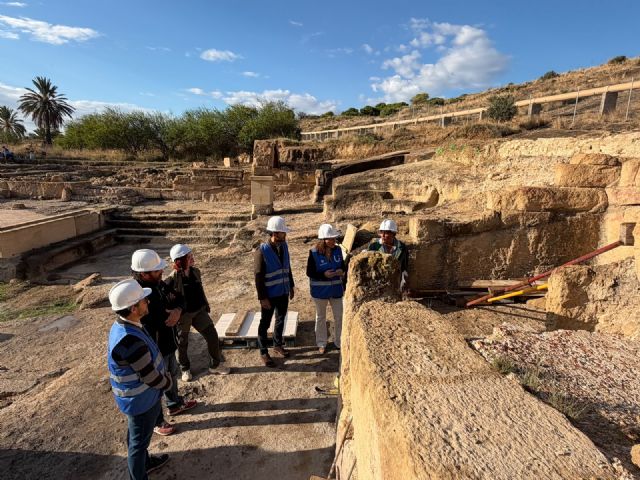
The latest archaeological campaign has produced results beyond the monumental inscription. Excavators have completely cleared the bathing pool, allowing the full outline of the structure to be seen, while work around the main building has made its boundaries more clearly recognizable. These discoveries are helping researchers understand the organization of the thermal complex and how its different architectural elements were connected.
The regional government of Murcia has allocated €150,000 to the intervention, which includes archaeological excavation, the recovery and conservation of architectural remains, and measures intended to improve the future presentation of the site. The Roman Baths of Fortuna have been protected as a Bien de Interés Cultural, a designation recognizing their cultural significance, since 2016
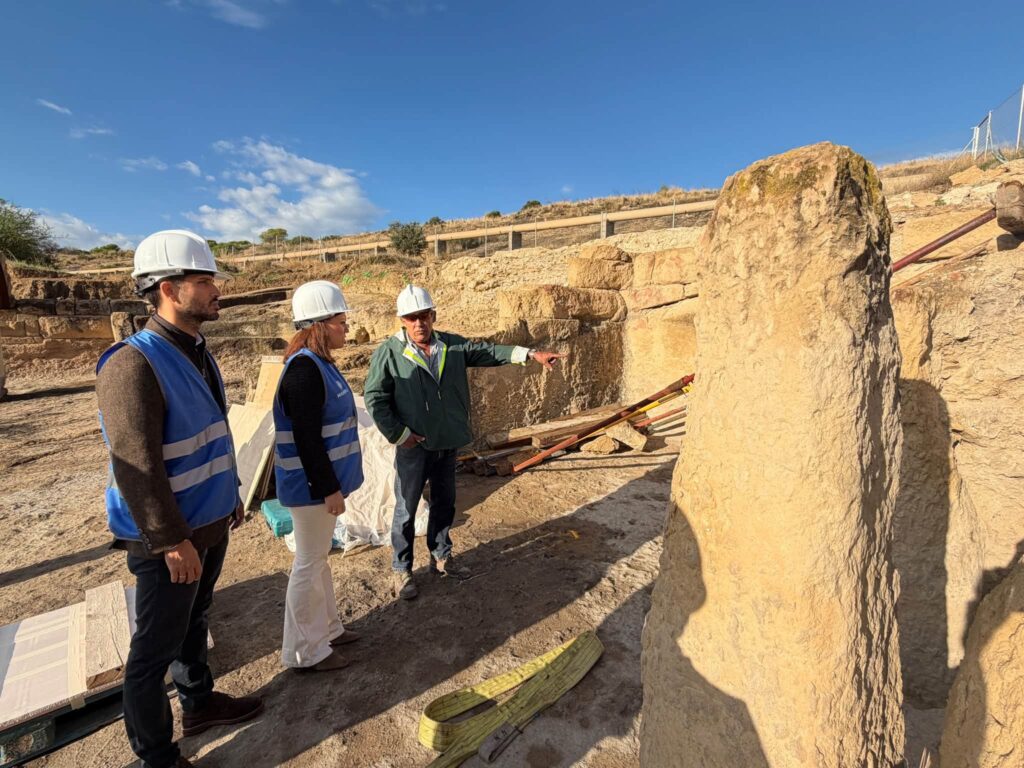
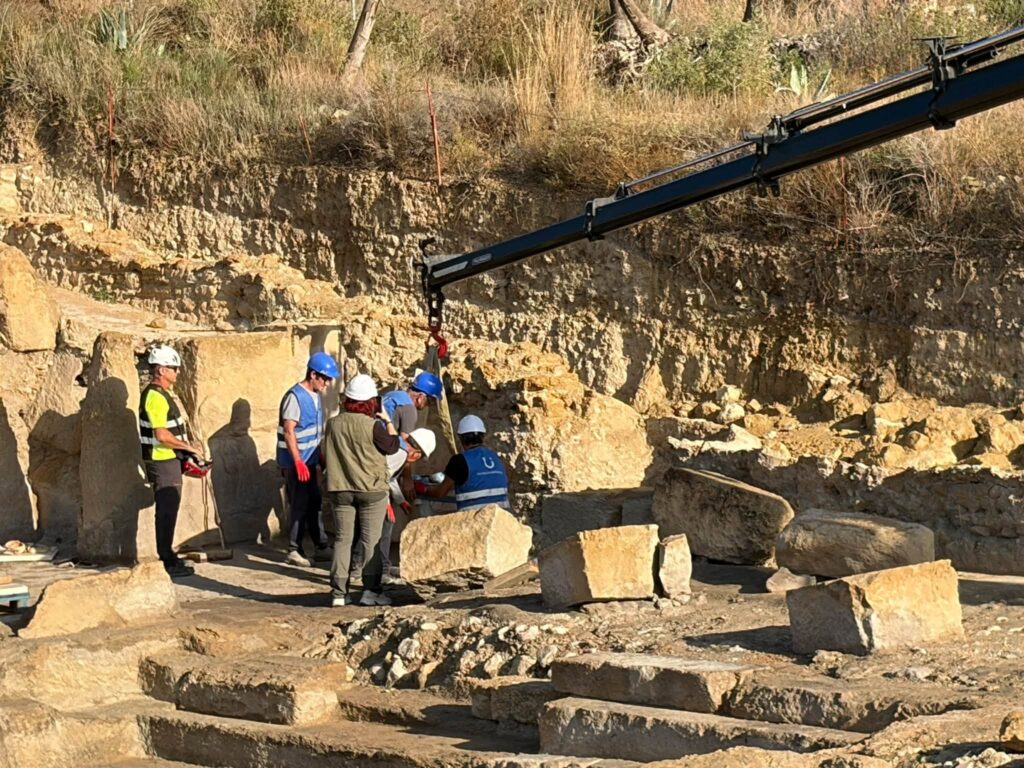
Fortuna Mayor Catalina Herrero visited the excavation alongside Murcia’s Director General of Cultural Heritage, Patricio Sánchez, and Culture Councillor Juan Manuel Soler during the removal of the inscribed stone. The artifact is being transferred to the Archaeological Museum of Murcia, where specialists will be able to examine and conserve it under controlled conditions.
Sánchez described the find as significant both for its dimensions and for the historical information it could provide. He emphasized that its transfer to the museum would allow researchers to document the inscription more thoroughly while ensuring its long-term preservation.
