
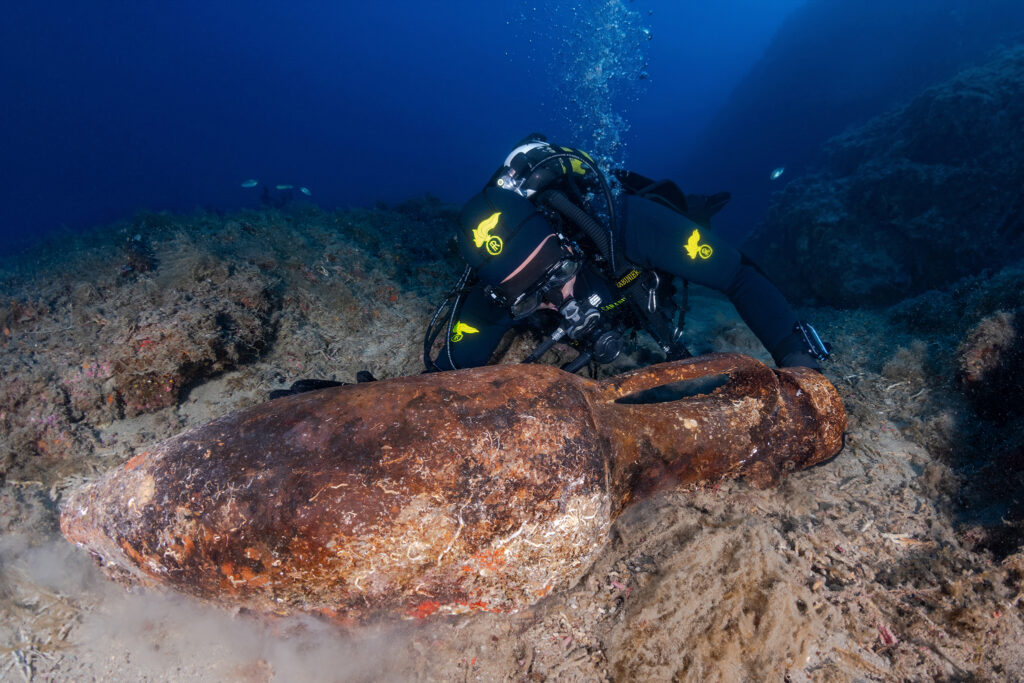
A Roman ghost shipwreck first discovered in 1959 has been rediscovered off Italy’s Ligurian coast after 67 years, with nine ancient wine amphorae identified more than 40 meters beneath the Mediterranean Sea. The discovery near Punta Chiappa has revealed nine ancient wine amphorae dating to the late Roman Republic.
The site, described by Italian heritage authorities as a “ghost shipwreck,” was located during a training exercise by Carabinieri divers near Camogli, within the Portofino Marine Protected Area. Subsequent archaeological investigations confirmed that the newly identified remains correspond to those reported in 1959, restoring an important piece of evidence for Roman maritime trade along the northwestern Italian coast.
Nine Roman Amphorae Discovered Beneath the Sea
The discovery began when members of the Genoa Underwater Unit of the Carabinieri encountered an intact Dressel 1 Roman amphora at a depth exceeding 40 meters. They immediately notified the Soprintendenza Archeologia, Belle Arti e Paesaggio per la Liguria, which organized further investigations with its Technical Service for Underwater Archaeology (S.T.A.S.).
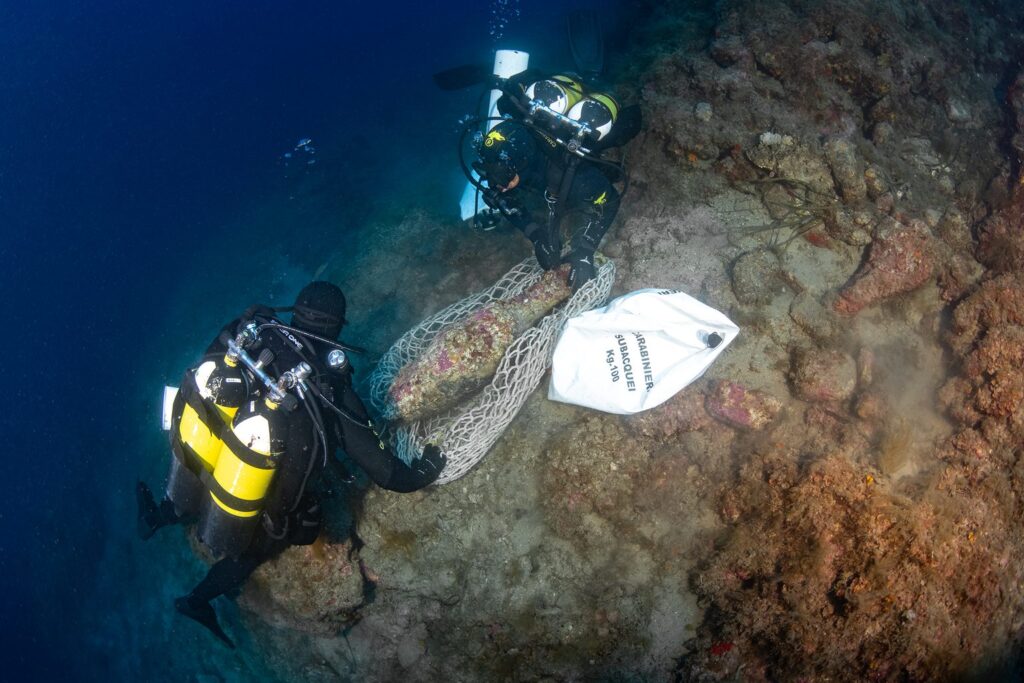
The underwater survey documented nine amphorae concentrated in a small area among crevices along a steep rocky cliff. Centuries of marine growth had covered the vessels with thick coralligenous deposits, leaving them firmly attached to the seabed and making their identification particularly difficult. Two amphorae were recovered because their exposed positions made them vulnerable to damage or unauthorized removal in an area frequently visited by divers.
The amphora concentration indicates the probable remains of a Roman merchant vessel, although no surviving hull structure has yet been confirmed. Further investigations will be needed to determine the original dimensions of the ship and whether additional cargo or structural remains survive nearby.
A Discovery Dating Back to 1959
The history of the site began on November 7, 1959, when Duilio Marcante explored the waters off Punta Chiappa alongside Carabinieri divers. He encountered two amphorae wedged between rocks and covered with marine encrustations, then noticed additional examples scattered nearby. At the base of the underwater cliff, he also observed what appeared to be a larger accumulation partly hidden beneath muddy sediment.
The divers returned on November 9 and recovered two intact amphorae to protect them from possible theft. The following day, Marcante reported the discovery to the Ligurian antiquities authority and the Experimental Center for Underwater Archaeology at Albenga. Marcante had previously participated in the 1958 investigations of the Roman shipwreck at Spargi, Sardinia, and was among the early figures who helped establish underwater archaeological exploration in Italy.
The Punta Chiappa discovery attracted attention beyond archaeological circles. A report published in Il Secolo XIX on November 18, 1959, recorded the interest of provincial tourism authorities, who already recognized the potential of submerged archaeological heritage for cultural tourism. Scientific investigation, however, faced serious practical obstacles because of the site’s depth and the steep underwater terrain.
The Search That Failed in 1960
On May 8 and 9, 1960, Gianni Roghi, a collaborator of the Albenga research center directed by Nino Lamboglia, returned with Marcante and Carabinieri divers to investigate the site. The team was unable to relocate the suspected accumulation of amphorae beneath the muddy seabed. Instead, they found an amphora tied with a thin rope, apparently prepared for illicit removal, together with three fragmentary amphorae embedded in marine concretions.
The findings raised concerns that unauthorized collectors had disturbed the archaeological remains. Lamboglia discussed the discovery at the Third International Congress of Underwater Archaeology in Barcelona in September 1961, noting that Marcante had originally identified Roman amphorae at a depth of approximately 45 meters. He explained that seasonal conditions had delayed further research, while the depth and steep seabed made the deployment of the research vessel Daino impractical.
Lamboglia also considered it possible that archaeological material had been removed illegally in the intervening period. With subsequent investigations failing to relocate the original site, the Punta Chiappa discovery remained known chiefly through archival reports rather than accessible archaeological evidence.
A Lost Site Identified and Dated
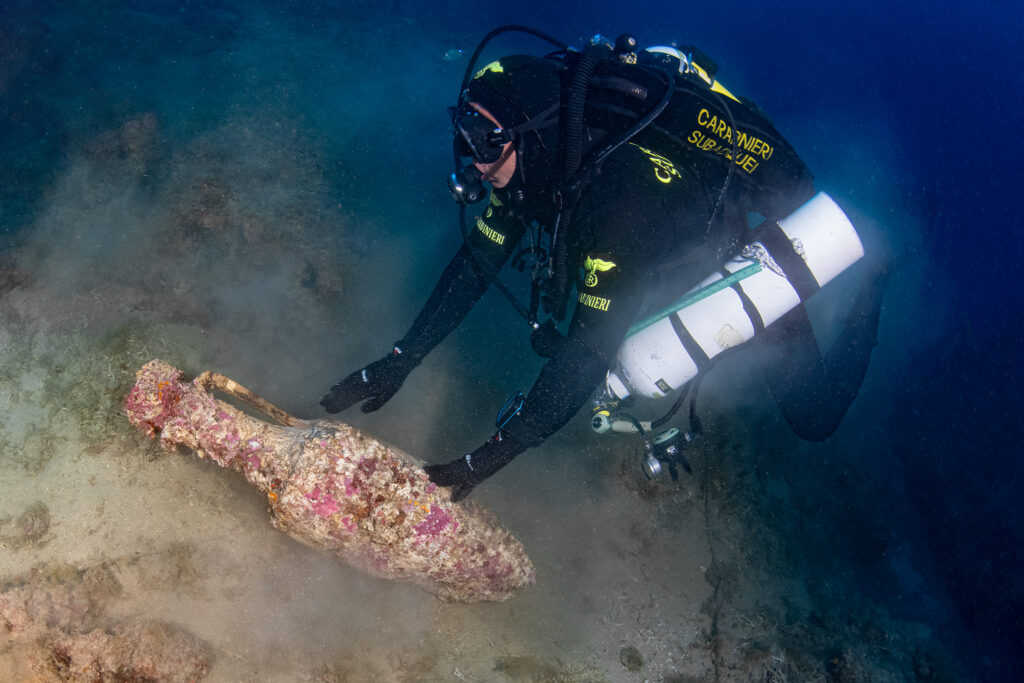
The latest investigations have resolved the question of the site’s location. Simon Luca Trigona, underwater archaeologist and head of S.T.A.S. Liguria, stated that the survey results and preliminary examination of the artifacts confirm their identification with the site reported by Marcante. The location can now be included among the recorded wreck sites of the Portofino Marine Protected Area.
Trigona identified the assemblage as a homogeneous cargo of Dressel 1A wine amphorae produced in the Tyrrhenian region of Italy. Their typology dates the material to the end of the second century BC and the first decade of the first century BC, a period when Roman commercial activity was expanding across the western Mediterranean.
The chronology places the cargo shortly after Rome’s conquest of southern Gaul, when Genoa and other Ligurian ports were acquiring greater strategic importance in Mediterranean commerce. Wine transported in Italian amphorae was a major component of these trading networks, connecting producers on the Italian peninsula with markets farther west.
Trigona also drew attention to another broadly contemporary Roman wreck near Pegli, west of Genoa. First reported in the early 1950s, that site has likewise not been relocated. Together, the two discoveries illustrate the maritime activity associated with the growing commercial role of the Ligurian coast during the late Roman Republic.
Protection and Future Research
The rediscovery has prompted measures to protect the surviving archaeological remains. The Soprintendenza plans continued monitoring and appropriate regulation of diving activity, while Carabinieri underwater personnel and cultural heritage protection specialists are involved in surveillance and efforts to prevent illicit recovery of artifacts.
Vincenzo Tiné, Liguria’s archaeological superintendent, emphasized that the discovery demonstrates the potential for further underwater research even in coastal areas considered well explored. Alessandra Cabella, an underwater cultural heritage specialist with S.T.A.S., highlighted its historical importance in reconnecting the work of modern archaeologists with that of Marcante, Lamboglia and the early Carabinieri diving teams.
The Soprintendenza’s underwater archaeology service is responsible for surveying, protecting and studying submerged heritage across Liguria. Its work includes archaeological investigations associated with major ports, the management of underwater sites and cooperation with local authorities on controlled access to submerged cultural heritage. The Mediterranean Archaeology Laboratory at Scuole Pie in Genoa, inaugurated in October 2024, also provides facilities for the conservation, research, and public presentation of archaeological finds from the region’s port and underwater contexts.
The next stage of research will focus on establishing the extent of the Punta Chiappa wreck and identifying any additional remains concealed among the rocks or beneath the sediments.
Soprintendenza Archeologia, Belle Arti e Paesaggio per la Liguria
