
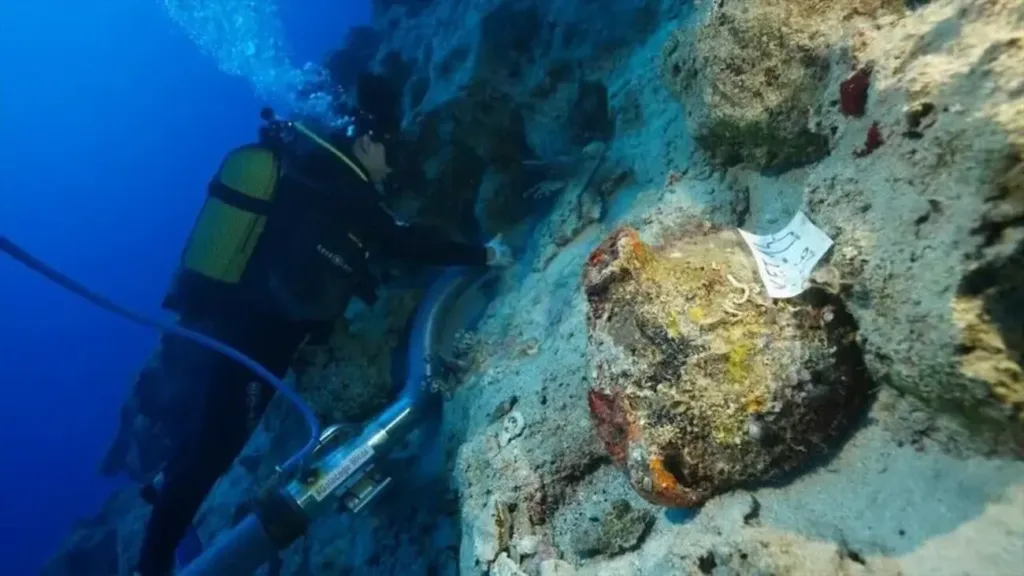
Underwater excavations near Kekova Island off Türkiye’s Mediterranean coast uncovered 4,700-year-old amphorae from an Early Bronze Age shipwreck. Its cargo offers remarkable evidence of trade across the Eastern Mediterranean during the Early Bronze Age. The cargo offers valuable evidence of early Mediterranean trade, while one unusual vessel bearing nine distinct markings and two holes may provide an unexpected glimpse into everyday life at sea.
Türkiye’s Minister of Culture and Tourism, Mehmet Nuri Ersoy, announced the findings on October 14, highlighting the significance of the cargo for understanding early maritime trade between Anatolia and the Eastern Mediterranean.
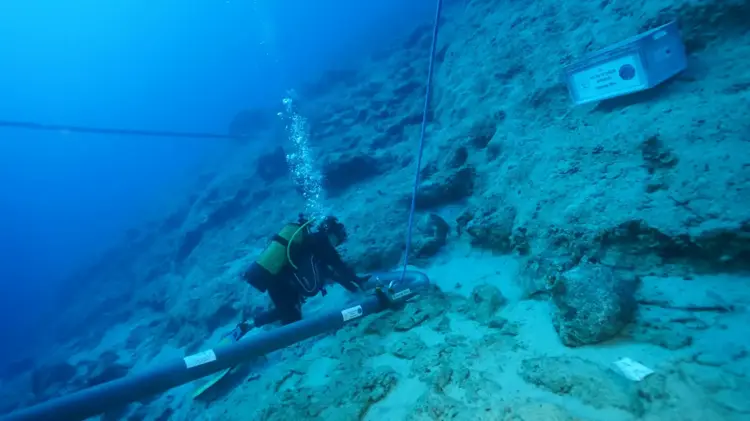
The shipwreck itself was first documented in 2024 by researchers from Akdeniz University. The ongoing investigations, led by underwater archaeologist Hakan Öniz, are now providing a clearer picture of the vessels carried aboard the ship and their possible functions.
An Ancient Cargo Connected to the Jordan Valley
The ceramic vessels provide the strongest evidence for the shipwreck’s age and possible origins. Preliminary clay analyses suggest that some amphorae may have originated in workshops in the Jordan Valley, linking the cargo to production centers in the ancient Levant.
Researchers have identified comparable vessels in Egypt, Troy, and Crete, suggesting that similar ceramic containers circulated across an extensive network of exchange long before the emergence of the great maritime trading systems of the Late Bronze Age.
The amphorae may have carried olive oil, wine, or other agricultural products. Their distinctive flat bases, side handles, and decorative features resemble Early Bronze Age pottery from the Eastern Mediterranean.
The ship may have been traveling westward from the Levantine coast, possibly toward Crete or the Anatolian coast.
Researchers have so far recovered two amphorae for detailed examination, one in 2024 and another in 2025. Their technical characteristics, clay composition, and possible functions differ, suggesting that the ship may have carried containers intended for more than one purpose.
An Unusual Vessel Raises Questions About Life at Sea
Among the discoveries is an amphora bearing nine different markings and two holes in its body. Ersoy said the vessel may have served as a churn for making cheese or butter, an interpretation that could offer an unexpected glimpse of everyday life aboard an ancient trading ship.
If archaeologists confirm this function, the container could indicate that sailors processed food during their voyages rather than relying entirely on provisions prepared before departure.
Such an activity would have practical advantages for crews traveling considerable distances along the Mediterranean coast. Producing or processing dairy products aboard a vessel could have provided another way to manage food supplies during extended journeys.
The recovered ceramics also display differences in decoration and manufacture. One amphora described in the scientific study features two parallel incised lines near its upper section and a zigzag pattern between them, adding to the evidence that the cargo contained vessels with varying technical characteristics.
Three Stone Anchors Found Near the Wreck
Underwater investigations have also identified three stone anchors around the wreck site, including two with three holes and one with a single hole.
However, archaeologists have not yet been able to determine whether any of these three anchors actually belonged to the ship itself.
These objects resemble anchors known from Bronze Age archaeological contexts in Anatolia, Cyprus, Crete, and the Levant. Their similarities could help researchers place the Kekova discoveries within the broader history of early Mediterranean seafaring.
The surrounding seabed contains both sandy and rocky areas, and further excavation may reveal additional objects connected with the ship and its cargo.
Based on the available evidence, researchers propose that a small vessel sank while traveling from east to west across the Mediterranean.
Mavi Vatan’da, dünyanın en eski batığının izlerini gün yüzüne çıkarıyoruz. Kekova’da yürüttüğümüz su altı kazılarında çıkarılan, 4.700 yıl öncesine uzanan amforalar, Anadolu kıyılarının deniz ticaretindeki köklü geçmişine ışık tutuyor. Zeytinyağı ya da şarap taşımak için kullanıldığı düşünülen bu kaplar, Doğu Akdeniz’deki ticaretin ve kültürler arası etkileşimin önemli izlerini taşıyor. Kil analizleri, amforaların muhtemelen Ürdün Vadisi’ndeki atölyelerde üretildiğine işaret ediyor. Benzer örneklerin Mısır, Troya ve Girit’te de bulunması, farklı coğrafyaları deniz yoluyla birbirine bağlayan ticaret ağlarını anlamamız açısından büyük önem taşıyor. Buluntular arasında, üzerinde dokuz farklı işaret ve gövdesinde iki delik bulunan bir amfora da dikkat çekiyor. Peynir ya da tereyağı yapımında yayık olarak kullanılmış olabileceği düşünülen bu kap, denizcilerin uzun yolculuklarda kendi yiyeceklerini üretmiş olabileceklerine dair ipuçları sunuyor. Anadolu’nun denizcilik tarihini yeni bulgularla aydınlatmaya, su altındaki kültürel mirasımızı koruyarak gelecek nesillere aktarmaya devam ediyoruz. Kazıların bilimsel sorumluluğunu üstlenen Doç. Dr. Hakan Öniz’i ve emeği geçen tüm çalışma arkadaşlarımızı kutluyorum.
— Mehmet Nuri Ersoy (@MehmetNuriErsoy) October 14, 2026
New Evidence of Mediterranean Trade Before the Great Empires
The Kekova discovery pushes the archaeological evidence for organized maritime trade along Türkiye’s southern coast deeper into the Early Bronze Age.
Other famous wrecks in the region, including Uluburun and Cape Gelidonya, date to much later periods. The newly investigated cargo offers a glimpse of Mediterranean navigation centuries before those ships carried metals, luxury goods, and other commodities across the sea.
Excavations under the scientific direction of Hakan Öniz continue to examine the site and recover evidence that could clarify the vessel’s cargo, origins, and final voyage.
Beyond the possibility of establishing a new chronological record, the discovery offers something equally important: physical evidence that communities around the Eastern Mediterranean were exchanging goods across considerable distances nearly 5,000 years ago.
Öniz, H., Öztosun, C. Preliminary Report on the Early Bronze Age Shipwreck in the Kekova Region of Antalya. J Mari Arch 21, 41 (2026). https://doi.org/10.1007/s11457-026-09532-3
