
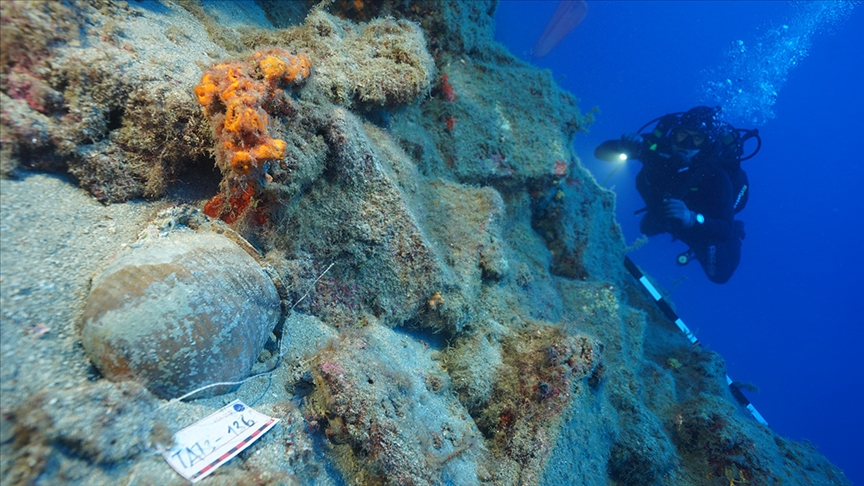
A sweeping underwater survey along the eastern shores of Fethiye in southwestern Türkiye has uncovered an ancient anchorage used continuously from the Bronze Age to the Ottoman period—alongside three shipwrecks that failed to escape sudden storms. The find, made under the Geleceğe Miras (Heritage to the Future) Project authorized by Türkiye’s Ministry of Culture and Tourism, provides a rare cross-section of maritime activity spanning nearly four millennia.
The research was led by Assoc. Prof. Hakan Öniz, head of the Department of Conservation and Restoration of Cultural Heritage at Akdeniz University. His team, aboard the UPL scientific research vessel, combined deep-water dives with high-resolution sonar systems and robotic platforms to document submerged archaeology along the Turkish coastline.
This season alone, the mission recorded 10 new shipwrecks—six in Antalya and four in Fethiye—bringing Türkiye’s total underwater archaeological count to 421 documented wrecks.
A Hidden Anchorage Used for Thousands of Years
The most striking discovery in Fethiye was a previously unknown anchorage dated to the 4th century BCE through the 6th century CE, with evidence indicating its use well into the Ottoman era. According to Öniz, the site had never been recorded before.
“We documented an anchorage that shows uninterrupted maritime traffic from the Bronze Age to the Ottoman period,” he said. “The anchors lying on the seabed tell us how many thousands of years ships have stopped here—whether to seek shelter or while navigating trade routes connecting Egypt, the Levant, and southern Anatolia.”
Preliminary analysis indicates the anchorage once served ships traveling between Egypt, Palestine, Lebanon, Syria, and the ports of Hatay, Adana, and Mersin. During storms, vessels sailing westward along the Anatolian coast likely diverted into Fethiye’s eastern bays, where natural landforms offered partial protection.
Why This Anchorage Matters: The Maritime Logic Behind It
Ancient sailors needed predictable shelter points—safe zones where they could anchor without risking hull damage or rolling in crosswinds. The newly identified Fethiye anchorage fits several criteria known from ancient navigation manuals and archaeological parallels:
Partial wind shadow created by islands, promontories, or coves
Sandy or muddy seabed that could securely hold stone or metal anchors
Moderate depth allowing ships to anchor without dragging
Freshwater sources nearby, which increased the value of stopovers during long-distance trade
Visibility of landmarks from the sea, aiding Bronze Age navigators who sailed by line-of-sight rather than open-sea reckoning
The distribution of anchors—some lost, others intentionally abandoned—indicates repeated, long-term use. The team identified anchors belonging to distinct chronological phases, confirming sustained maritime activity across multiple civilizations.
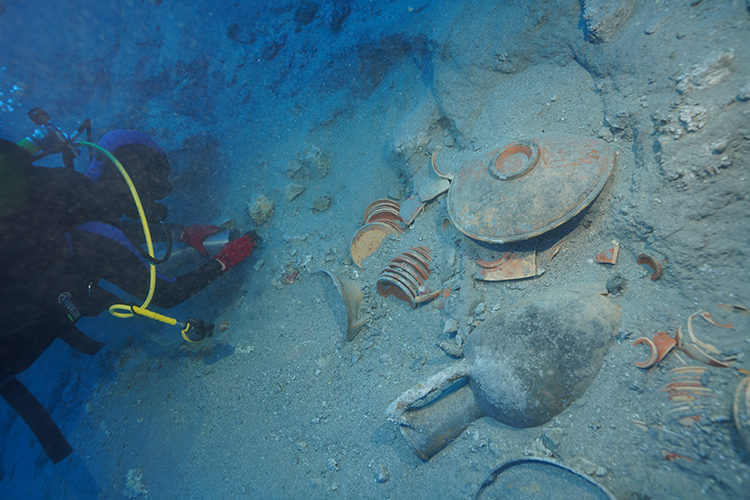
Three Shipwrecks Tell the Story of Storms and Split-Second Decisions
Although the anchorage offered relative protection from westerly winds, Öniz noted that sudden storms blowing from the east could trap ships with little time to react.
“The site is safe against winds coming from the west, but if a storm hits from the east, sailors must escape immediately. In some cases, lifting the anchor is impossible. They cut the rope and flee.”
Not every captain managed to escape.
Three ships—each a “time capsule,” according to Öniz—were discovered in the area, likely sunk in sudden, violent weather events. Such wrecks preserve cargo types, amphora forms, production techniques, and trade origins, enabling archaeologists to reconstruct regional commercial networks of their respective eras.
Expanding Türkiye’s Underwater Archaeological Inventory
Before this year, Türkiye had 411 documented underwater shipwrecks. With the latest discoveries, the number has climbed to 421, solidifying the region’s role as one of the most archaeologically significant maritime corridors in the Mediterranean.
Among the most prominent recent finds are:
The Kumluca Ceramic Wreck, widely covered in international media
The Middle Bronze Age Kumluca Wreck, considered the world’s oldest known shipwreck
Artifacts recovered from these wrecks—and the new Fethiye discoveries—are set to be displayed at the Mediterranean Underwater Archaeology Museum in Kemer, scheduled to open in late 2026.
A Critical Addition to Eastern Mediterranean Maritime History
The Fethiye anchorage discovery reinforces the view that southwestern Türkiye was a primary maritime artery for thousands of years. It expands what was previously known mainly from the Antalya coast and fills a significant geographical gap in regional maritime archaeology.
Beyond the shipwrecks themselves, the anchorage is a strategic data point that helps scholars understand how Bronze Age, Roman, Byzantine, and Ottoman sailors navigated weather patterns, seasonal winds, and coastal hazards.
Cover Image Credit: AA
