
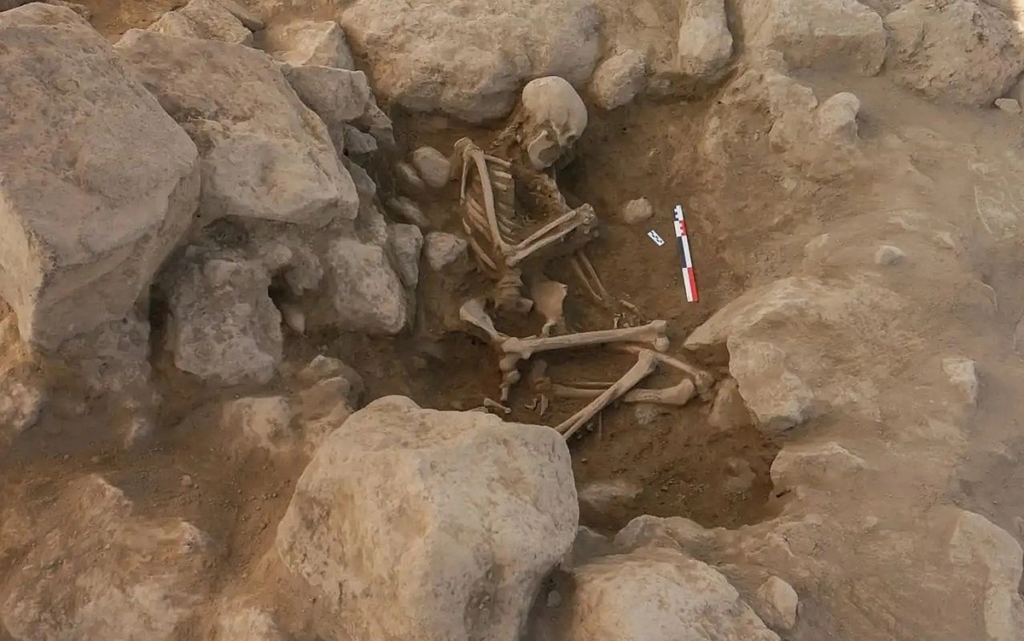
An unusual burial discovered inside an ancient house at Metsamor, Armenia, has revealed the remains of a woman accompanied by a Urartian-style cylinder seal. Archaeological evidence and isotope analysis suggest she held a distinctive place in her community and may have spent her childhood elsewhere.
Some 2,700 years ago, a woman was buried in the courtyard of a house at Metsamor, in present-day Armenia. Her body was placed in a tightly contracted position, accompanied by a cylinder seal and several bronze objects. Unlike most burials found in the settlement, her grave appears to have been created while the house was still occupied. Now, new scientific analysis suggests that she may also have grown up beyond the immediate area, raising questions about her identity and the position she held in her community.
Archaeologists Krzysztof Jakubiak and Arkadiusz Sołtysiak examined the burial using skeletal analysis, radiocarbon dating, and strontium isotope testing. Their study, published in the Journal of Archaeological Science: Reports, explores whether the unusual grave represents an isolated case or belongs to a broader pattern of funerary practices in the Iron Age South Caucasus.
A Grave Beneath an Occupied House
Metsamor lies in Armenia’s Ararat Valley, approximately 30 kilometers west of Yerevan. Occupied since prehistoric times, the settlement became an important fortified and metalworking center during the Bronze and Iron Ages. Its citadel was protected by massive stone walls, while the Lower Town contained residential buildings and an organized network of streets.
The woman’s grave, identified as Burial 11, was discovered in the courtyard of a structure known as House II, associated with the late eighth and early seventh centuries BC. Most burials documented in the Lower Town belong to later periods, when abandoned buildings were reused for funerary purposes. This grave, however, appears to have been deliberately inserted into the courtyard floor while domestic life continued around it.
The burial pit measured approximately 2.56 by 1.96 meters and was oriented north to south. The woman’s remains lay on her left side, with her body tightly flexed. Although early interpretations described her as sitting or crouching, closer examination suggests that she was buried in a contracted lateral position.
The grave had been looted in antiquity, leaving only part of its original contents. Nevertheless, several surviving objects provide an important indication of the circumstances surrounding her burial.
A Seal That Suggests Status, but Not a Title
The most distinctive object is a cylinder seal associated with Urartian traditions. Its decoration appears to include stylized animals, possibly including fantastic creatures, although the surviving details are not sufficiently clear for a definitive interpretation.
Similar seals have been documented at sites including Armavir, Karmir Blur, Iğdır, and Noratus. Their forms and decorative styles help place the Metsamor example within the wider material culture of the Armenian Highlands during the Iron Age.
In the ancient Near East, seals served practical functions related to identification, ownership, and administration. They could also carry symbolic significance and were sometimes worn on the body. Its presence in the Metsamor grave suggests that the seal may have held personal or symbolic significance for the woman, although its exact function remains unknown.
However, the researchers caution that the object does not establish whether the woman was a priestess, administrator, or member of an elite institution. Her burial suggests that she held a socially distinctive position, but the precise nature of that position remains unknown.
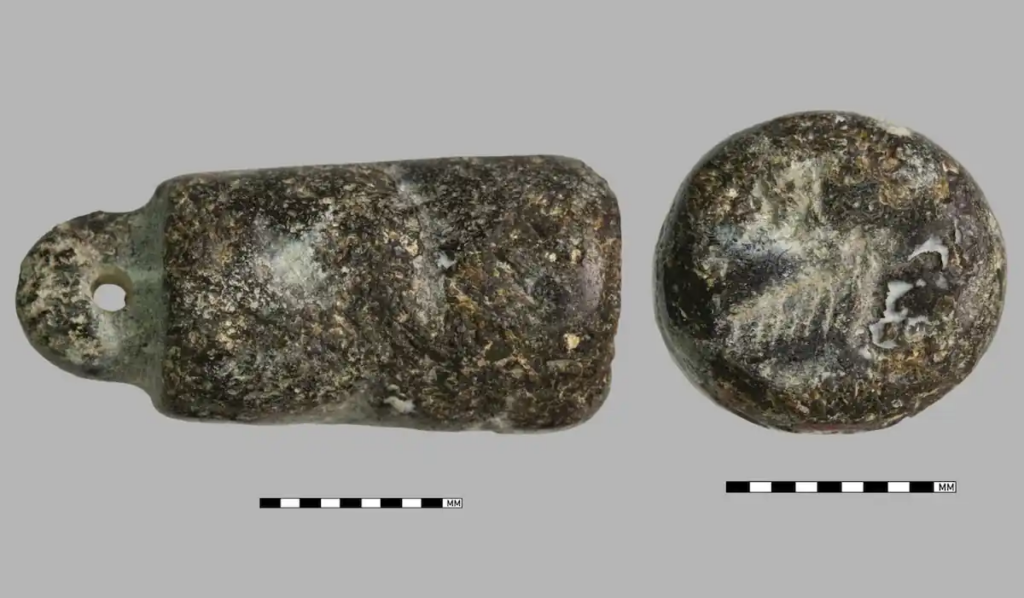
The cylinder seal discovered in the 2,700-year-old woman’s grave at Metsamor, Armenia, shown from the side and end. Credit: © Krzysztof Jakubiak and Arkadiusz Sołtysiak, 2026.
Her Skeleton Reveals a Difficult Life
Analysis of the poorly preserved skeletal remains indicates that the woman was probably over 40 when she died. Her bones and teeth preserve evidence of physical stresses experienced at different stages of her life.
Degenerative changes in her knee joints may reflect long-term mechanical strain, habitual activities, or age-related processes. Her teeth also showed advanced decay, potentially associated with dietary practices and other factors affecting oral health.
Particularly revealing were defects in the enamel of her upper canine teeth. Known as enamel hypoplasia, these markings can develop when childhood growth is disrupted by illness, nutritional deficiencies, or other physiological stresses.
Although the evidence cannot identify the specific hardships she experienced, it suggests that her childhood included periods of biological stress. Her unusual burial treatment, however, indicates that the circumstances of her death and commemoration were different from those of many other individuals buried at Metsamor.
Chemical Evidence Points Beyond Metsamor
To investigate where the woman may have grown up, the researchers analyzed strontium isotopes preserved in her tooth enamel. Because enamel develops during childhood, its chemical composition can reflect the geology of the environment in which an individual spent their early years.
The woman’s measured strontium ratio was 0.70740, slightly outside the currently established local range for Metsamor, approximately 0.70689 to 0.70736. This difference suggests that she may not have spent her childhood in the immediate surroundings of the settlement.
The researchers emphasize that the result is not conclusive. Geological conditions can change over short distances, and the comparative isotope data available for Metsamor remain limited. Consequently, the analysis cannot establish where she originated or how far she may have traveled.
Marriage, family relocation, or wider social connections could explain such movement, but none of these possibilities can currently be demonstrated.
Radiocarbon analysis provides another important qualification. Although the grave’s archaeological context points toward the late eighth or early seventh century BC, the calibrated radiocarbon result spans approximately 775–430 BC. This broad interval reflects the Hallstatt plateau, a period in which fluctuations in atmospheric radiocarbon concentrations make precise dating particularly difficult.
An Unusual Burial in the Urartian World
The researchers also compared the Metsamor grave with funerary discoveries elsewhere in the region. At Oshakan, north of Metsamor, archaeologists documented a woman buried in a possibly contracted or seated position, although poor preservation complicates interpretation. Another comparison comes from Estark in northern Iran, where a female burial displayed some similar characteristics.
Particularly relevant examples come from the Van region of eastern Türkiye. Several female burials there combine strongly contracted body positions with seals or small metal objects associated with Urartian cultural traditions. Their dates and archaeological interpretations remain debated, preventing researchers from identifying a single, widespread funerary custom.
The Metsamor burial therefore appears unusual without being entirely without parallels. Its significance lies in the combination of its location within an occupied house, the woman’s carefully arranged body, the surviving grave goods, and chemical evidence suggesting possible mobility.
Jakubiak, K., & Sołtysiak, A. (2026). The burial of a woman at Metsamor: An isolated phenomenon or part of a broader funerary pattern? Journal of Archaeological Science: Reports, 74, Article 105927. https://doi.org/10.1016/j.jasrep.2026.105927
