
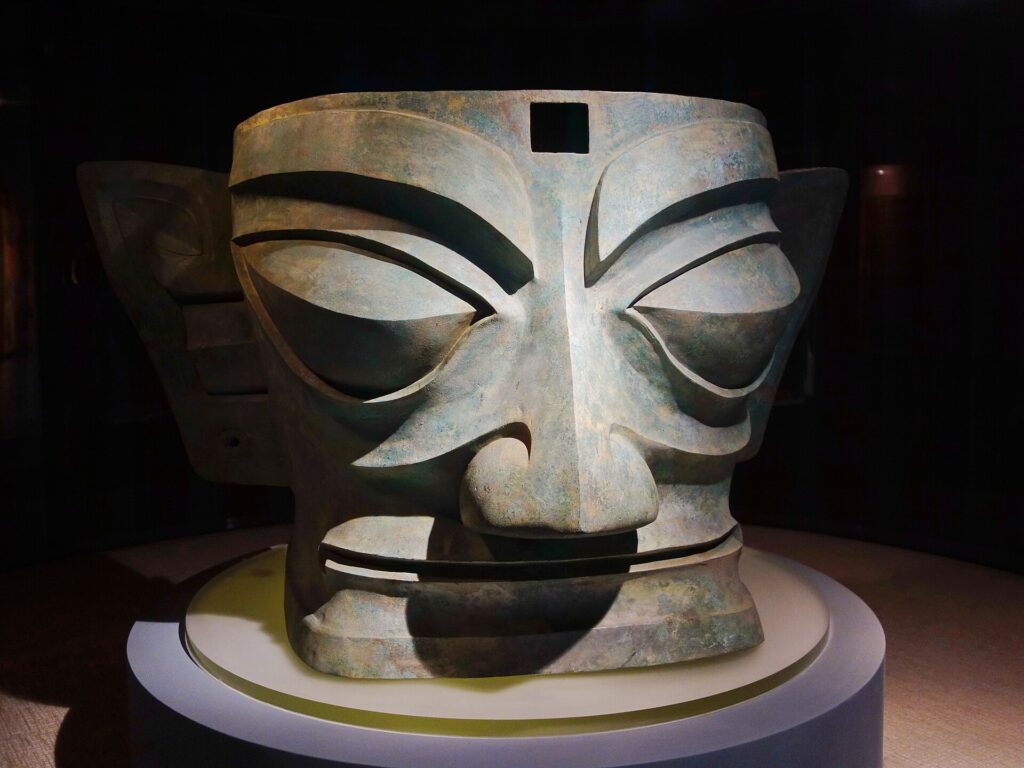
Researchers examining ancient ritual objects from China’s Sanxingdui archaeological site have identified silk remnants on bronze masks, gold ornaments, jade, and ivory. Their findings suggest that fabrics played a much larger role in the ceremonies of the ancient Shu civilization than the surviving objects alone reveal.
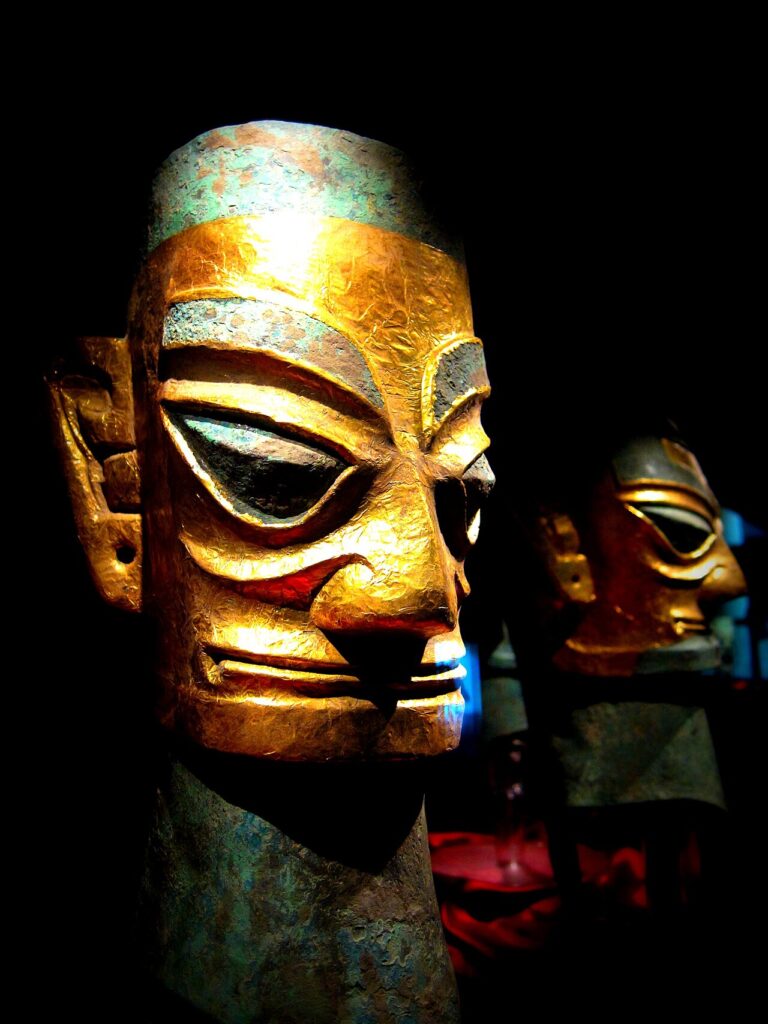
The extraordinary bronze masks of Sanxingdui, with their exaggerated eyes and striking facial features, have fascinated archaeologists for decades. Yet these famous objects may once have looked quite different. A new scientific study has identified traces of silk around the eyes of a large bronze mask, raising the possibility that some of Sanxingdui’s most remarkable ritual objects were originally covered or decorated with finely woven fabrics.
The research, published in the journal Antiquity on October 26, 2026, examines silk residues associated with 101 archaeological objects recovered from sacrificial pits at Sanxingdui in Sichuan Province, southwestern China. Dating to the Late Shang period, approximately 1300–1046 BCE, the finds suggest that silk was not simply a luxury material but an important part of the ritual traditions practiced by the ancient Shu civilization.
Silk Hidden on the Faces of Bronze Masks
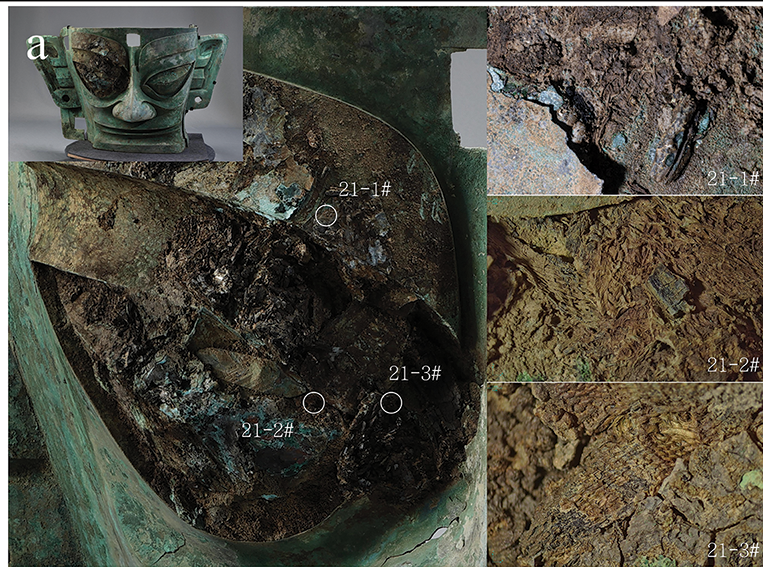
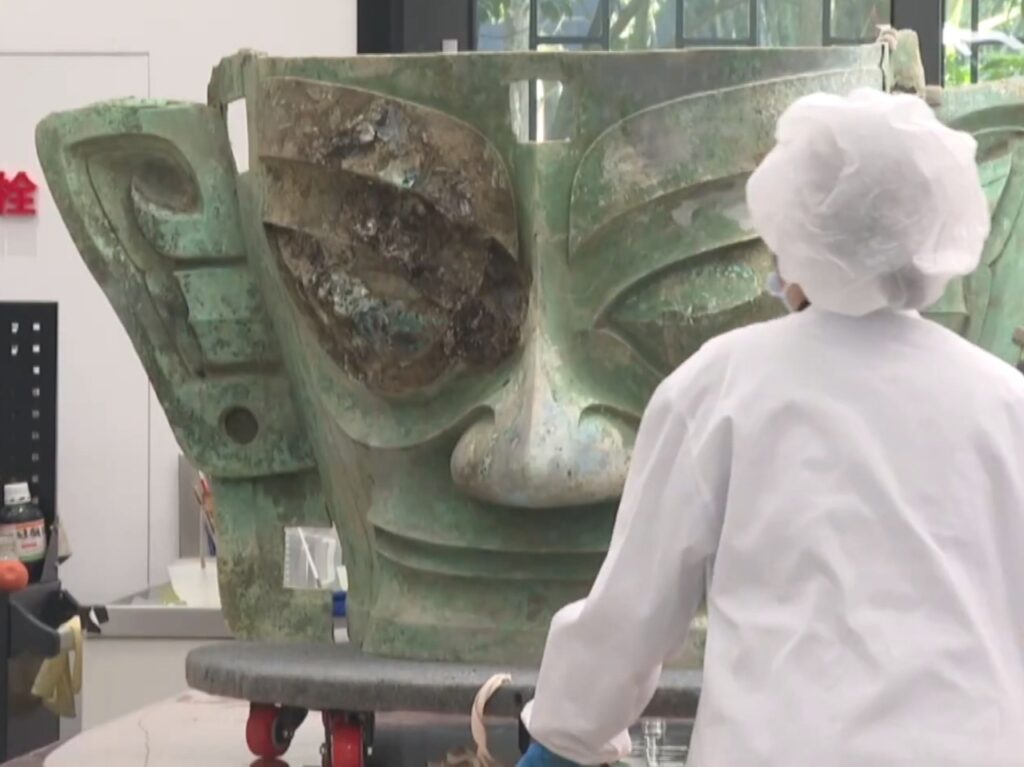
Among the most revealing discoveries was a large bronze mask recovered from Sacrificial Pit K3. Researchers identified three areas of silk residue around its right eyebrow and eye, each preserving different weaving characteristics.
The differences are particularly intriguing. One fragment has a relatively open, gauze-like structure, while the others preserve more closely woven threads. Their varying textures and positions suggest that several pieces of silk may have covered or decorated the mask, although researchers cannot reconstruct its original appearance with certainty.
The discovery raises an important question about the famous bronze faces of Sanxingdui. If some masks originally incorporated textiles, their appearance during ceremonies may have been considerably more elaborate than the surviving metal surfaces suggest.
The evidence extends well beyond this single mask. Archaeologists identified silk residues on 94 bronze objects, representing 28 categories, as well as on gold foil, jade implements and ivory fragments. These associations show that textiles accompanied a wide range of objects deposited in Sanxingdui’s ritual pits.
A Lost World of Coloured Silk
The investigation also revealed evidence that some textiles carried colour, offering another perspective on the visual appearance of ancient Shu ritual objects.
Laboratory analysis identified red ochre, an iron-rich mineral pigment, adhering to silk fibres. Researchers also detected calcite, which may have formed part of a surface coating, although its precise function remains uncertain.
Another sample preserved traces of a deep-red organic colourant that had penetrated the fibres themselves. The researchers could establish that an organic dye was probably responsible but could not identify the plant or other material from which it originated.
These findings suggest that Sanxingdui’s textile traditions involved more than simply producing silk thread and weaving cloth. Craftspeople also used colouring techniques, combining mineral substances and organic dyes to alter the appearance of fabrics.
The surviving fragments reveal considerable variation in weaving quality. Some consisted of loosely woven gauze, while others preserved dense, carefully structured arrangements of threads. Most used a simple plain weave, but researchers also identified evidence of more complex interlacing.
When compared with textiles from contemporary sites in China’s Central Plains, some Sanxingdui samples displayed similarly sophisticated weaving characteristics. The findings indicate that communities in the Sichuan Basin possessed access to advanced textile technologies during the Late Bronze Age, although the study does not establish whether all the silk was produced locally.
Why Was Silk Placed in the Sacrificial Pits?
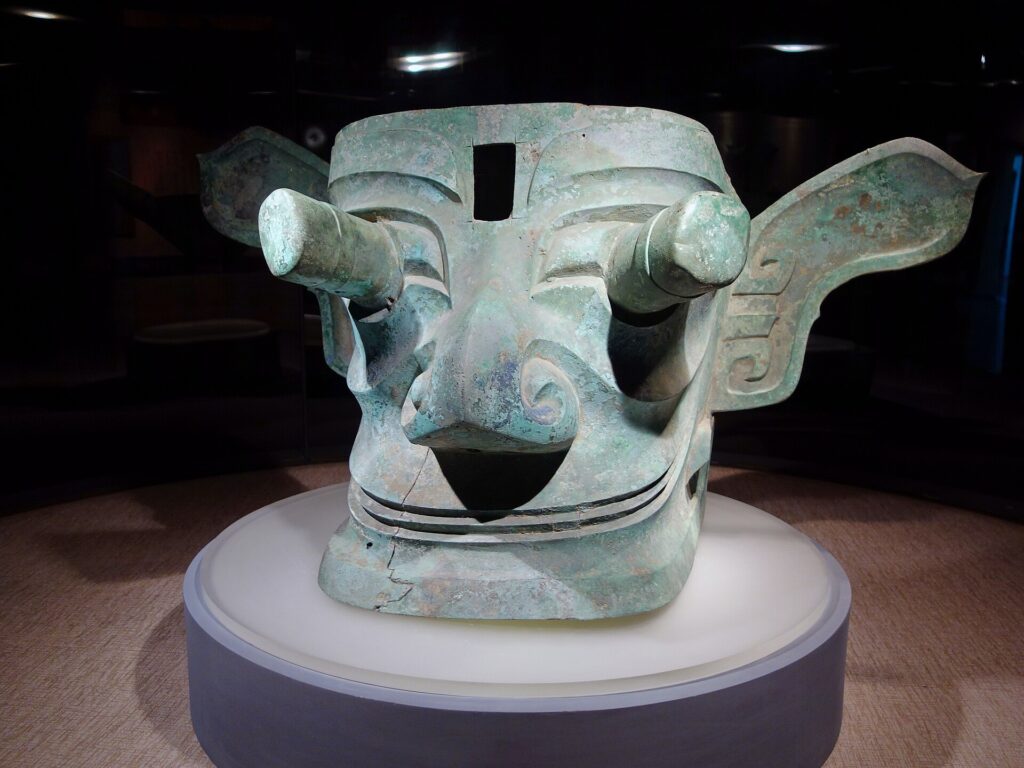
Sanxingdui became internationally famous following the discovery of two major sacrificial pits in 1986. Archaeologists recovered hundreds of bronze objects, including distinctive masks, human heads, and elaborate ritual sculptures that differed considerably from contemporary bronze traditions elsewhere in China.
Excavations between 2019 and 2022 uncovered six additional pits, allowing researchers to examine how objects had been deposited and how different materials were arranged together.
The distribution of silk within these pits provides some of the strongest evidence for its ceremonial significance.
In Pit K3, researchers found silk residues beneath archaeological objects, particularly toward the southern-central part of the pit floor. A similar pattern appeared in Pit K7, where most affected objects preserved silk on their undersides rather than their upper surfaces.
Some objects also retained several layers of fabric. On one bronze ornament, investigators identified as many as five distinguishable textile layers, suggesting that the material had been arranged deliberately rather than accidentally introduced into the deposits.
These patterns support several possibilities. Silk could have served as a protective layer beneath valuable objects, wrapped or covered ritual implements, or formed an offering in its own right.
The study cannot determine precisely which function applied in every case. Nevertheless, the recurring association of textiles with bronze, gold, jade and ivory indicates that fabric was an important component of activities represented by the sacrificial pits.
How Could Delicate Silk Survive for 3,000 Years?
One of the remarkable aspects of the discovery is the survival of such fragile material.
Silk normally deteriorates over time, especially when exposed to moisture, microorganisms, and changing environmental conditions. At Sanxingdui, however, the objects themselves sometimes helped preserve the material that surrounded them.
Researchers found that corrosion products from bronze objects contributed to the mineralisation of certain fibres. Copper and other metals could inhibit microbial activity or help preserve the shape of textile structures as their original organic components gradually deteriorated.
Other fragments survived in a carbonised state, appearing black and extremely fragile after exposure to heat. A smaller number retained relatively well-preserved fibre structures.
Using electron microscopy and infrared spectroscopy, the research team examined the microscopic shapes and chemical characteristics of these residues. The results supported their identification as silk, distinguishing them from animal hair and other possible textile materials.
The study therefore reveals not only how ancient fabrics were used but also how archaeological conditions can preserve evidence of materials that would otherwise disappear almost completely.
Beyond Bronze and Gold: The Forgotten Role of Silk
The Sanxingdui discoveries have long demonstrated the artistic and technological achievements of the ancient Shu civilization, particularly its extraordinary bronze casting traditions. Yet bronze sculptures and gold ornaments represent only part of the material culture that once existed.
The new study suggests that silk played a significant role alongside those more durable materials. Its presence on numerous ritual objects indicates that the ceremonies of ancient Shu may have involved a combination of metals, precious materials, and carefully prepared textiles.
Researchers also point to spindle whorls and other textile-related tools recovered at Sanxingdui as possible evidence of local production. However, the current evidence cannot establish exactly where the silk found in the sacrificial pits was manufactured.
One further possibility concerns writing. Unlike the Central Plains, where Shang-period inscriptions provide extensive historical evidence, Sanxingdui has not produced a comparable body of written records. The researchers suggest that perishable materials such as silk could theoretically have served as surfaces for writing or symbols, although no such writing has been identified on the studied fragments.
Guo, J., Ge, R., Cai, Q., Tian, J., & Yang, L. (2026). Silk and sacrifice at Sanxingdui: early evidence of silk use in ancient Shu, southwest China. Antiquity, 1–18. doi:10.15184/aqy.2026.10448
