
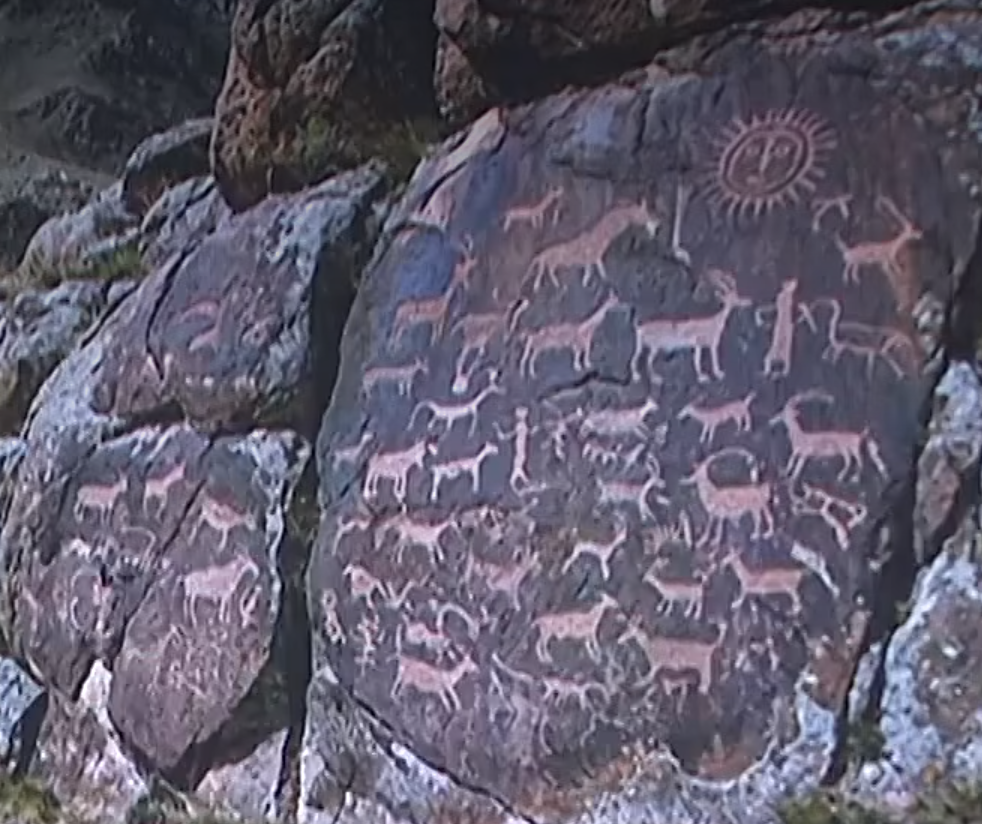
More than 1,200 petroglyphs and a rare Old Turkic runic inscription have been documented in Burkhansai Gorge in Kazakhstan’s Jambyl Region, opening a new chapter in the study of rock art, pastoral life, and early Turkic literacy in southern Kazakhstan.
The gorge, located in Zhualy District, has so far yielded a large group of rock carvings spanning several periods, from the end of the 3rd millennium BC to the Middle Ages and even later times. Researchers say the number of documented images is still preliminary.
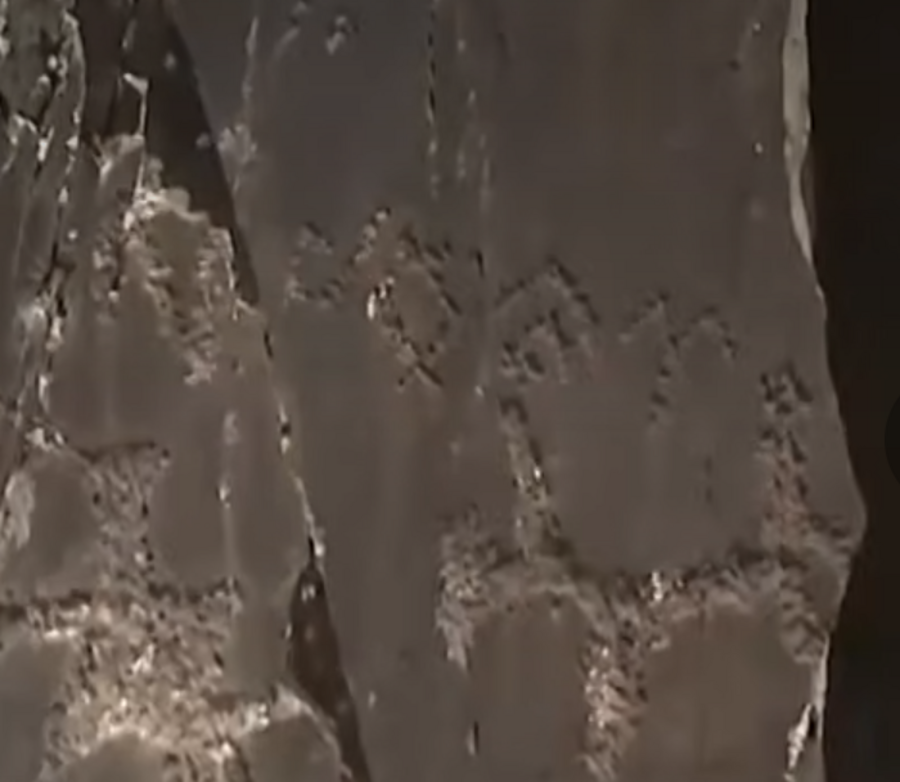
What makes the site especially important is not only the scale of the petroglyphs, but the rare inscription carved in Old Turkic runiform signs. According to the archaeologists, the short text consists of five signs and has been interpreted as “Er atym Aba,” meaning “My name is Aba.”
A rock archive stretching across several eras
Burkhansai Gorge appears to preserve a long sequence of human activity rather than a single archaeological moment. Anatoly Shayakhmetov, a researcher at the A. Kh. Margulan Institute of Archaeology said the petroglyphs are arranged in five groups along the direction of a stream. The carvings belong to different periods, including the Bronze Age, Early Iron Age, Middle Ages, and more recent historical phases.
Three burial grounds, known as Burkhansai 1, Burkhansai 2, and Burkhansai 3, have also been identified in the area. According to the researchers, these cemeteries belong to the Early Iron Age and medieval periods, suggesting that the gorge was not merely a place where images were carved, but part of a wider cultural landscape used for movement, burial, memory, and possibly seasonal occupation.
The earliest images are believed to have appeared around 4,000 years ago. Many show goats, one-humped camels, and hunting scenes. Such motifs are common in Central Asian rock art, where animals often carried both practical and symbolic meaning. They point to communities familiar with herding, hunting, and the use of mountain corridors as part of their daily life.
Five signs that preserve a personal name
The most striking find is the short Old Turkic runic inscription carved among the petroglyphs. It has been preliminarily dated to the 4th to 10th centuries AD, with researchers suggesting it may have been made more than 1,000 years ago.
Boris Zheleznyakov, a leading researcher at the A. Kh. Margulan Institute of Archaeology, described the inscription as unique because it was written in the Talas script, a regional form of Old Turkic runiform writing. He suggested that the person who carved it may have been regarded as the owner or guardian of the area, leaving his name on the rock as a statement of identity and presence.
The inscription was sent to Vladimir Tishin, a recognized specialist in Old Turkic writing, who interpreted the text. Its short and direct message, “My name is Aba,” gives the discovery a rare human immediacy. Unlike monumental royal inscriptions, this appears to be a personal mark in a mountain landscape already filled with much older images.
Old Turkic runic writing, also known as Turkic runiform script, is best known from the Orkhon inscriptions of Mongolia, but related examples are found across a broad Eurasian zone, including the Yenisei, Altai, Talas, and parts of Kazakhstan. The Talas tradition is particularly important because it reflects how Turkic writing spread and adapted across Central Asia.
Burkhansai and the wider rock art landscape of Kazakhstan
Kazakhstan is home to some of Central Asia’s most important petroglyph landscapes. The UNESCO-listed Tanbaly site, for example, contains thousands of carvings connected with pastoral communities, ritual activity, settlements, and burial grounds. Burkhansai is not Tanbaly, and the two sites should not be confused, but the new discovery fits into the same broader pattern: mountain gorges and river valleys often served as long-term cultural archives.
Jambyl Region adds another layer of significance. Southern Kazakhstan was historically linked to the Talas Valley, the Western Tien Shan, and the Silk Road city of Taraz, one of the oldest urban centers in Kazakhstan. This was a contact zone where nomadic, pastoral, urban, and trade networks met over many centuries.
That setting helps explain why Burkhansai may contain material from such different periods. A gorge with water, shelter, rock surfaces, and routes through the landscape could remain meaningful for many communities over thousands of years. Bronze Age herders, Early Iron Age groups, medieval Turkic speakers, and later visitors may all have left traces there.
Researchers plan a monograph and state protection proposal
The work at Burkhansai is still in its early stage. Archaeologists are now studying and classifying the petroglyphs by period. They also plan to investigate the burial grounds more fully and search for associated settlements that could explain how ancient communities used the wider landscape.
After the comprehensive study is completed, researchers plan to publish a monograph on the petroglyphs and the runic inscription. They also intend to propose that the discoveries be placed under state protection.
For now, Burkhansai Gorge stands out as a newly documented archaeological complex with unusual depth. Its rock carvings trace patterns of hunting, herding, and movement over thousands of years. Its short Turkic inscription adds something more personal: a name, carved into stone, still readable after more than a millennium.
Source: 24 kz
